

To increase the rent or not increase the rent? That is the question.

money-with-wordingRent increases can be a tricky subject to tackle but it is something I am discussing with increasing regularity with Landlords so this week I thought I would break from my usual articles and share my thoughts with my lovely readers.

So should you rock the boat and increase your Tenant’s rent or not?  Let’s have a look at some points to help you make your mind up…

Potential problems

Before you make a decision you should take time to consider whether an increase is really needed.  A hasty decision could damage your relationship with your Tenant and in extreme cases could lead to them leaving the property altogether.  This can leave you with an empty property and some costs involved with finding a new Tenant.

Why am I thinking about an increase?

Ask yourself why you feel an increase is necessary – Are you increasing it because your costs or mortgage rates have risen or are you doing it out of greed?

From my experience, if you have a good Tenant (i.e. one that pays the rent on time and looks after the property) and treat them fairly, that usually equates to the most profitable experience – even without increasing rent.

Good reasons Vs Bad reasons

Some valid reasons for an increase can be a mortgage rate increase, changes in taxation, changes in market conditions or simply that the property is costing more to maintain.

However if you are increasing the rent out of greed or just because you can then I would recommend leaving it alone.

If you think that your property is worth more rent than you are currently getting then you should speak to a local lettings expert who can advise you on the current market conditions and give you an accurate up-to-date valuation of your property.

Am I able to increase my Tenant’s rent?

Before making any other considerations you need to know if you are actually able to increase your Tenant’s rent.

If you are currently within a fixed term tenancy then you cannot make an increase unless there is a clause in the tenancy agreement that specifically states that the Landlord can review the rent during the fixed term or it is specifically stated that the rent will increase to a set amount after a period of time (ie. After the first six months).  Of course any such clause would need to be deemed fair, and too much of a dramatic increase may spur your Tenant to contest the new rent amount at a tribunal.

How do I increase the rent?

Ok, so you’ve finally made up your mind and are looking to increase the rent.  Before you take the plunge there are strict procedures to follow.  Failure to follow the correct procedure could lead to your request for more rent being invalid.

  1. Negotiate the rent increase when renewing the Tenant’s contract.

If your tenancy has recently come to an end you may want to renew it on to another fixed term tenancy.  If this is the case the easiest way to enforce a new rent can be to agree it as part of the renewal process.  Just ensure that the new rent is detailed in the new tenancy agreement.

  1. Agree an increase mid-tenancy and document it

As I briefly mentioned earlier in this article you can agree a review of the rent or a set increase to take place during a tenancy before the tenancy agreements are signed.  Any clause must be fair and detailed within the tenancy agreement.  You should also write to the Tenant when the time comes to notify them that you would like to enforce the clause giving adequate notice.

  1. Serve the Tenant with a Rent Increase Notice

If nothing is done to renew the tenancy agreement after the fixed term ends it will roll on to a Statutory Periodic tenancy.  In this instance you should issue your Tenant with a Rent Increase Notice if you wish to increase the rent.

A Section 13(2) Notice of the Housing Act 1988 must be served proposing the new rent and the date at which you would like it to commence.  For a monthly, weekly or fortnightly tenancy, you should provide at least one month’s notice to your Tenant of the increase.

What if the Tenant refuses the rent increase?

If the Tenant feels that the rent increase that you are trying to enforce via a Section 13(2) notice is excessive and they do not wish to discuss it with you, they can refer the rent increase to the Tribunal.  They must do this before the starting date of the proposed new rent.  In this instance they should notify you that they are doing so.

The tribunal will consider the Tenant’s application and decide what the maximum rent for the property should be. In setting a rent, the tribunal must decide what rent the landlord could reasonably expect for the property if it were let on the open market under a new tenancy on the same terms. The tribunal may therefore set a rent that is higher, lower or the same as the proposed new rent.

A note to remember…

If you have a good Tenant paying the rent on time and looking after your property then think before increasing the rent.  A good Tenant can be hard to find so if you already have one then take into consideration how much time and money it will cost you to find a new Tenant should they not want to pay your increase.

Keep an eye on the market and comparative rental prices.  If you are charging less and the market is buoyant then it may be a good time to bargain with your Tenant.  If they can see that an alternative property will cost them more a month and that they will incur more fees and moving costs they will be more inclined to accept your increase.

For more articles on the local property market please visit www.thelocksheathpropertyblog.co.uk.

New House Building in Locks Heath increased by 2.4% in the last year

builders-wordingLet me speak frankly, even with Brexit and the fact immigration numbers will now be reduced in the coming years, there is an unending and severe shortage of new housing being built in the Locks Heath area (and the UK as a whole).  Even if there are short term confidence trembles fueled by newspapers hungry for bad news, the ever growing population of Locks Heath with its high demand for property versus curtailed supply of properties being built, this imbalance of supply/demand and the possibility of even lower interest rates will underpin the property market.

When the Tories were elected in 2015, Mr. Cameron vowed to build 1,000,000 new homes by 2020.  If we as a Country hit those levels of building, most academics stated the UK Housing market would balance itself as the increased supply of property would give a chance for the younger generation to buy their own home as opposed to rent.  However, the up-to-date building figures show that in the first three months of 2016 building starts were down.  Nationally, there were 35,530 house building starts in the first quarter, a long way off the 50,000 a quarter required to hit those ambitious targets.

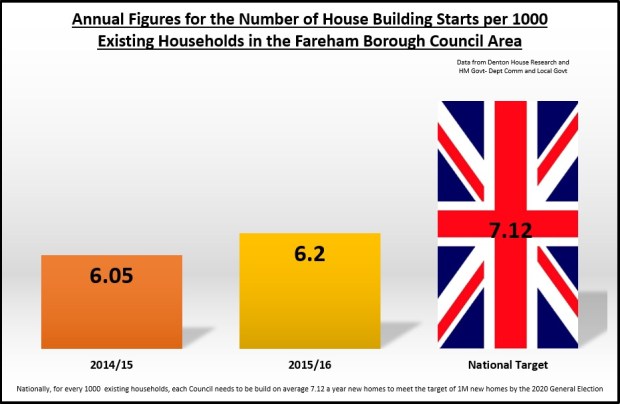
Looking closer to home, over the last 12 months, new building in the Fareham Borough Council area has grown.  In 2014/15, for every one thousand existing households in the area, an additional 6.05 homes were built.  For 2015/16, that figure is now 6.2 homes built per thousand existing households.  Nationally, to meet that 1,000,000 new homes target, we need to be at 7.12 new homes per thousand.

127-graph

To put those numbers into real chimney pots, over the last 12 months, in the Fareham Borough Council area,

  • 280 Private Builders (e.g. New Homes Builders)
  • 20 Housing Association
  • Nil Local Authority

These new house building numbers are down to the fact that not enough is being done to fix the broken Locks Heath housing market.  Although we are seeing 300 new homes being built per year in the Fareham Borough Council area, when we at least 345 a year to even stand still!

I am of the opinion Messers Cameron and Osborne focused their attention too much on the demand side of the housing equation, using the Help to Buy scheme and low deposit mortgages to convert the ‘Generation Rent’ i.e. Locks Heath ‘20 somethings’ who are set to rent for the rest of their lives to ‘Generation Buy’.  On the other side of the coin, I would strongly recommend the new Housing Minister, Gavin Barwell, should concentrate the Government’s efforts on the supply side of the equation.  There needs to be transformations to planning laws, massive scale releases of public land and more investment, as more inventive solutions are needed.

However, ultimately, responsibility has to rest on the shoulders of Theresa May.  Whilst our new PM has many plates to spin, evading on the housing crisis will only come at greater cost later on.  What a legacy it would be if it was Mrs May who finally got to grips with the persistent and enduring shortage of homes to live in.  The PM has already referenced the ‘need to do far more to get more houses built’ and stop the decline of home ownership.  However, she has also ruled out any changes to the green belt policy – something I will talk about in a future article.  Hopefully these statistics will raise the alarm bells again and persuade both residents and Councilors in the Fareham Borough Council area that housing needs to be higher on its agenda.

Locally of course fundamental changes to the district’s infrastructure will be required to ensure that there are adequate schools and doctors to support any new housing and subsequent increase of population.  I know that this is a hot topic amongst local residents and that there is an outcry for this to be addressed by Councilors when planning is considered.

In the meantime, for more thoughts and opinion on the Locks Heath Property Market, please visit the Locks Heath Property Blog.

Plans for flat complex at Warsash Maritime Academy expected

Long has it been the subject of conversation for the villagers of Warsash and other local residents in the area but it has recently been confirmed that plans to turn buildings at the Warsash Maritime Academy in Newtown Road into flats are set to be unveiled in the coming weeks.

The upper part of the Academy will be the subject of a planning application for a flat complex in the next month according to Councillor Trevor Cartwright who represents Warsash on Fareham Borough Council.

Southampton Solent University, which runs the academy has confirmed that it will be moving the facilities in the upper part to its central campus in Southampton.  However the site is set to retain the specialist facilities by the shore such as the lower part of the site and the pier.

Residents of Warsash will have mixed feelings about the news.  The Academy has been on the site for more than 100 years and has around 150 staff and 5,000 students.

I will post more details when they are made public.

For more articles about the local property market read The Locks Heath Property Blog.


Post Brexit – Locks Heath Property Prices set to drop £26,700 in the next 12 months?

shocked-wordsEven the most sane person in Britain has to admit the Brexit vote will, in one shape or another, affect the UK Property market. Excluding central London which is another world, most commentators are saying prices will be affected by around 10%. So looking at the commentators’ thoughts in more detail, property values in Locks Heath will be 10% lower than they would have been if we hadn’t voted to leave the EU.
As the average value of a property in the Fareham Borough Council area is £267,100, this means property values are set to drop for the average Locks Heath property by £26,710 … batten down the hatches .. soup kitchens and mega recession here we come ..it’s going to get rough.

but before we all go into panic mode in Locks Heath… the devil is always in the detail

Look at the phrase again, and I have highlighted the relevant part “Property values in Locks Heath will be 10% lower than they would have been if we hadn’t voted to leave the EU”

Property values today, according to the Land Registry are 9.87% higher than a year ago in the Fareham Borough Council area. The 12 months before that they rose by 11.16% and the 12 months before that, they rose by 5.37%. If we hadn’t voted to leave, I believe on these figures, we could have safely assumed Locks Heath House prices would have been 9% higher by the Summer of 2017.

… and that’s the point, we won’t see a house price crash in Locks Heath, it’s just that house prices in a year’s time will be 1% lower than they are now (ie 9% less the 10% lower figure because of Brexit). Let’s look at the historic figures and how that compares to today’s figures for the Fareham Borough Council area and Locks Heath as a whole.

Average Value of a property 20 years ago                             £  64,000

Average Value of a property 10 years ago                             £193,800

Average Value of a property 2 years ago                               £218,700

Average Value of a property 1 year ago                                  £243,100

Average Value of a property today                                          £267,100

Projected Value of a property in 12 months’ time             £264,400

Therefore, I believe the average value of a Locks Heath property will be £2,700 lower in 12 months’ time than today.

That’s not to say Locks Heath property prices might not dip slightly in the run up to Christmas (in fact they always have done just about every year since the year 2000 and most of those were boom years).  But in 12 months’ time this is my considered opinion of where Locks Heath property values will be, and looking at the historic prices, even if I (and many other property market commentators) are wrong and they do drop 10% from TODAY’S figure… in the whole scheme of things, we have been through a Credit Crunch, Black Monday and 15% interest rates over the last 20 to 30 years and still Locks Heath house prices have always bounced back.

… and Locks Heath landlords?  They have recently been thrashed by Osborne’s tax changes, but yields could rise if Locks Heath house prices fall/stablise and rents grow. This might also make it easier to obtain mortgages, as the income would cover more of the interest cost. If prices were to level or come down that could help Locks Heath landlords add to their portfolio, as rental demand for Locks Heath property is expected to stay strong as more people find it more and more difficult to obtain mortgages.

For more articles like this please visit The Locks Heath Property Blog.

Only 32.8% of Locks Heath Rented Property have Children living in them

Play House - wordedA few weeks ago I was asked a fascinating question by a local Councillor who, after reading the Locks Heath Property Blog, emailed me and asked me –
Are Locks Heath Landlords meeting the Challenges of tenanted families bringing up their families in Locks Heath?”

What an interesting question to be asked.

Irrespective of whether you are Tenant or a homeowner, to bring up a family, the most important factors are security and stability in the home. A great part of that security and stability in a rented property stems from whether Tenants are constantly being evicted. Many tenancies last just six months with families at risk of being thrown out after that with just two months’ notice for no reason.

Some “left leaning Politicians” keep saying we need to deal with the terrible insecurity of Britain’s private rental market by creating longer tenancies of 3 or 5 years instead of the current six months. However, the numbers seem to be telling a different story. The average length of residence in private rental homes has risen in the last 5 years from 3.7 years to 4 years (a growth of 8.1%), which in turn has directly affected the number of renters who have children. In fact, the proportion of private rented property that have dependent children in them, has gone from 29.1% in 2003 to 37.4% today.

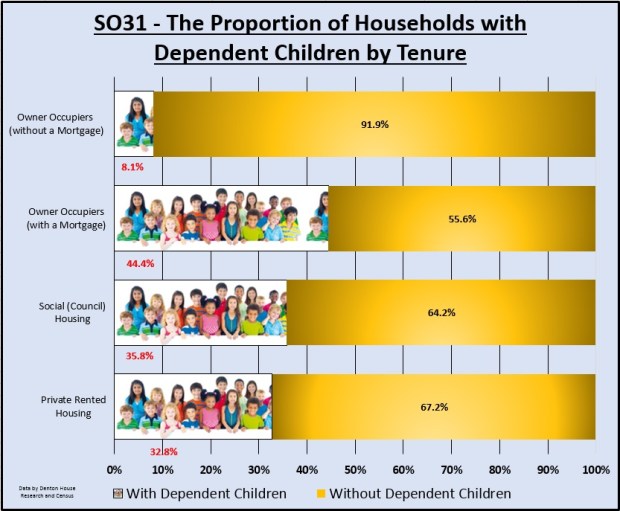
Looking specifically at the SO31 are including Locks Heath compared to the National figures, of the 2,467 private rental homes in Locks Heath, 810 of these have dependent children in them (or 32.8%), which is interestingly (although expected) below the National average of already stated 37.4%.

Even more fascinating are the other tenure types in SO31 Locks Heath…

35.8% of Social (Council) Housing in Locks Heath have dependent children

44.4% of Locks Heath Owner Occupiers (with a Mortgage) have dependent children

8.1% of Owner Occupiers (without a Mortgage) have dependent children

129 Graph

Although, when we look at the length of time these other tenure types have, whilst the average length of a tenancy for the private rented sector is 4 years, it is 11.4 years in social (council) housing, 24.1 years for home owners without a mortgage and 10.4 years of homeowners with mortgages.

Anecdotally I have always known this, but this just proves landlords do not spend their time seeking opportunities to evict a Tenant as the average length of tenancy has steadily increased. This noteworthy 8.1% increase in the average length of time Tenants stay in a private rented property over the last 5 years, shows Tenants are happy to stay longer and start families.

So, as Landlords are already meeting Tenants’ wants and needs when it comes to the length of tenancy, I find it strange some politicians are calling for fixed term 3 and 5 year tenancies. Such heavy handed regulation could stop Landlords renting their property out in the first place, cutting off the supply of much needed rental property, meaning Tenants would suffer as rents went up. Also, if such legislation was brought in, Tenants would lose their ‘Get Out of Jail card’, as under current rules, they can leave at any time with one month’s notice not the three or six month Tenant notice suggested by some commentators.

Finally, there is an extra piece of good news for Locks Heath Tenants. The English Housing Survey notes that those living in private rented housing for a long periods of time generally paid less rent than those who chopped and changed.

For more articles like this please visit the Locks Heath Property Blog www.thelocksheathpropertyblog.co.uk.