£23m a year black hole in the Locks Heath Property Market – Is Buy to Let Immoral? (Part 2)

149-graphic-4

An Englishman’s Home is His Castle as Maggie Thatcher lauded – everyone should own their own home.  In 1971, around 50% of people owned their own home and, as the baby-boomers got better jobs and pay, that proportion of homeowners rose to 69% by 2001.  Homeownership was here to stay as many baby boomers assumed it’s very much a cultural thing here in Britain to own your own home.

But on the back of TV programmes like Homes Under the Hammer, these same baby boomers started to jump on the band wagon of Locks Heath buy to let properties as an investment.  Locks Heath first time buyers were in competition with Locks Heath Landlords to buy these smaller starter homes pushing house prices up in the 2000’s (as mentioned in Part One last week) beyond the reach of first time buyers.  However, it is not as simple as that.  Many factors come into play, such as economics, the banks and government policy.  But are Locks Heath Landlords fanning the flames of the Locks Heath housing crisis bonfire?

I believe that the Landlords of the 2,299 Locks Heath rental properties are not exploitative and are, in fact, making many positive contributions to Locks Heath and the people of Locks Heath.  Like I have said before, Locks Heath (and the rest of the UK) isn’t building enough properties to keep up the demand; with high birth rate, job mobility, growing population and longer life expectancy.

According to the Barker Review, for the UK to standstill and meet current demand, the country needs to be building 8.7 new households each and every year for every 1,000 households already built.  Nationally, we are currently running at 5.07 per thousand and in the early part of this decade were running at 4.1 to 4.3 per thousand.

It doesn’t sound a lot of difference, so let us look at what this means for Locks Heath…

For Locks Heath to meet its obligation on the building of new homes, Locks Heath would need to build 162 households each year.  Yet, we are missing that figure by around 67 households a year.

For the Government to buy the land and build those additional 67 households, it would need to spend £23,046,072 a year in Locks Heath alone.  Add up all the additional households required over the whole of the UK and the Government would need to spend £23.31bn each year… the Country hasn’t got that sort of money!

With these problems, it is the property developers who are buying the old run-down houses and office blocks which are deemed uninhabitable by the local authority, and turning them into new attractive homes to either be rented privately to Locks Heath families or Locks Heath people who need council housing because the local authority hasn’t got enough properties to go around.

The bottom line is that, as the population grows, there aren’t enough properties being built for everyone to have a roof over their head.  Rogue Landlords need to be put out of business, whilst Tenants should expect a more regulated rental market, with greater security for Tenants, where they can rely on good Landlords providing them high standards from their safe and modernised home.  As in Europe, where most people rent rather than buy, it doesn’t matter who owns the house – all people want is a clean, decent roof over their head at a reasonable rent.

So only you, the reader, can decide if buy to let is immoral.  But first let me ask this question – if the private buy to let Landlords had not taken up the slack and provided a roof over these people’s heads over the last decade where would these Tenants be living now?

Locks Heath’s private renting set to hit 2,967 households by 2021 – Is Buy to Let immoral? (Part 1)

keys-wordingCan we blame the 55 to 70-year-old Locks Heath citizens for the current housing crisis in the town?
Also known as the ‘Baby Boomer Generation’, these Locks Heath people were born after the end of the Second World War as the country saw a massive rise in births as they slowly recovered from the economic hardships experienced during wartime.

Throughout the 1970’s and 1980’s, they experienced (whilst in their 20’s, 30’s and 40’s) an unparalleled level of economic growth and prosperity throughout their working lifetime on the back of improved education, government subsidies, escalating property prices and technological developments, they have emerged as a successful and prosperous generation.

…Yet some have suggested these Locks Heath baby boomers have (and are) making too much money to the detriment of their children, creating a ‘generational economic imbalance’, where mature people benefit from house-price growth while their children are forced either to pay massive rents or pay large mortgages.

Between 2001 and today, average earnings rose by 65%, but average Locks Heath house prices rose by 109.6%

148-graph

The issue of housing is particularly acute with the generation called the Millennials, who are young people born between the mid 1980’s and the late 1990’s. These 18 to 30 years, moulded by the computer and internet revolution, are finding as they enter early adult life, it very hard to buy a property, as these ‘greedy’ landlords are buying up all the property to rent out back to them at exorbitant rents… it’s no wonder these Millennials are lashing out at buy to let landlords, as they are seen as the greedy, immoral, wicked people who are cashing in on a social despair.

Like all things in life, we must look to the past, to appreciate where we are now.

The three biggest influencing factors on the Locks Heath (and UK) property market in the latter half of the 20th Century were, firstly, the mass building of Council Housing in the 1950’s and 60’s. Secondly, for the Tory’s to sell most of those Council Houses off in the 1980’s and finally 15% interest rates in the early 1990’s which resulted in many houses being repossessed.  It was these major factors that underpinned the housing crisis we have today in Locks Heath.

To start with, in 1995 the USA relaxed its lending rules by rewriting the Community Reinvestment Act.  This Act saw a relaxation on the Bank’s lending criteria as there was pressure on these banks to lend on mortgages in low wage neighbourhoods, as the viewpoint in the USA was that anyone (even someone on the minimum wage) should be able to buy a home.  Unsurprisingly, the UK followed suit in the early 2000’s, as Banks and Building Society’s relaxed their lending criteria and brought to the market 100% mortgages, even Northern Rock started lending every man and his dog 125% mortgages.

So when we roll the clock forward to today, and we can observe those very same footloose banks from the early/mid 2000’s (that lent 125% with a just note from your Mum and a couple of breakfast cereal tokens), ironically reciting the Bank of England backed hymn-sheet of responsible-lending.  On every first time buyer mortgage application, they are now looking at every line on the 20-something’s banks statements, asking if they are spending too much on socialising and holidays… no wonder these Millennials are afraid to ask for a mortgage (as more often than not after all that – the answer is negative).

So, in Part Two next week, I will continue this emotive article and show you some very interesting findings on why young people aren’t buying property anymore (and it’s not what you think!).

Locks Heath Property Market Sees An Unpredicted Autumn Boost of 14%

shuttle-wording

Well, it doesn’t seem like two minutes ago that it was Christmas – and now it’s all over! One cold December afternoon, after arranging the office’s Christmas cards I thought I would nip out to Waitrose to get some lunch.  I met an old client of mine in there and we got talking about the Locks Heath property market.  I had just completed my research for my next blog article and I would like to share with you the parts of the conversation relating to the Locks Heath property market.

He asked me what my thoughts were about the last half of the year in regard to the Locks Heath property market and if there were any great buy to let deals around.  In reply I said that, in my view, shrugging off the uncertainty of the initial post Brexit vote, I have seen an increase in supply and a rise in the number of properties selling at the lower to middle end of the market, meaning both first time buyers and buy to let Landlords have been returning in the last few months – proof the market is beginning to bounce back.

So let’s look at the numbers…

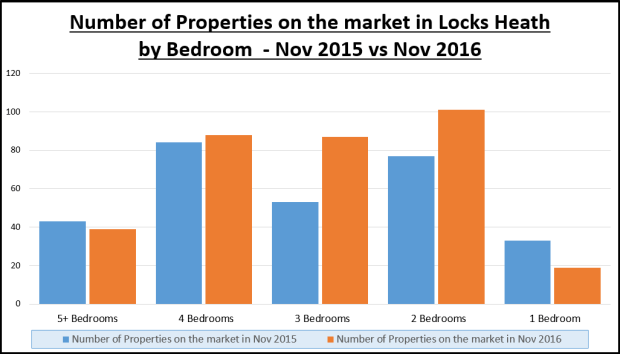
In November 2016, according to the three main property portals (Rightmove, Zoopla and OnTheMarket) there were a total of 335 properties for sale in Locks Heath. In November 2015, there were only 293 properties for sale, a rise of 14%.

When I split it down into bedrooms (note things like building plots and part commercial/part residential etc won’t be in these figures so the numbers below wont exactly match up to those in the above paragraph).

# Properties on the market in Nov 2015 # Properties on the market in Nov 2016 Percentage Change
5+ Bedrooms 43 39 -9%
4 Bedrooms 84 88 +5%
3 Bedrooms 53 87 +64%
2 Bedrooms 77 101 +31%
1 Bedroom 33 19 -42%

147-graph

… and when I looked at type of properties it got even more interesting…

Type of Property # Properties on the market in Nov 2015 # Properties on the market in Nov 2016 Percentage Change
Detached 139 149 +7%
Semi 37 48 +30%
Terraced 7 27 +286%
Flat 79 76 -4%

As the number of Locks Heath properties put up for sale has risen by 14%, homeowners have become more realistic about how much their homes are worth.  This increase in homeowners wanting to sell suggests there is renewed confidence in the Locks Heath property market and there are also signs that people are being more realistic about pricing their property.

As you can see, there has been a significant uplift in terraced properties, which means they are a great choice for first time buyers and Landlords.  So with a combination of realistic pricing and more properties on the market – both first time buyers and Landlords alike might be able to pick up a few bargains!

‘Deal of the Week’ -4.7% Gross Yield in Locks Heath

pennycress

I have been taking a look at the latest properties to come to the market since we all returned after the festive break and come across this exciting prospect that I thought I would share with you.

It is a three bedroom end of terrace house in Pennycress, Locks Heath with a garage in a block.  From the pictures online with Purple Bricks the property looks in decent order to let straight out with little fuss.

Three bedroom houses have Tenants fighting over them in Locks Heath currently so finding a Tenant quickly won’t be a problem.  A monthly rent of £995 will give you a gross yield of 4.7% based on the asking price of £250,000 (OIEO).

I realise that yields aren’t the only point of interest for Landlords and that capital growth is a major factor to consider.  This property last sold in October 2012 for £181,000 meaning that in just over 4 years the property has increased in value by 38.12%.

Full details can be found HERE but this one shouldn’t be around for long so be quick.

I am always happy to give you my unbiased opinion on any properties that you are thinking of purchasing so feel free to give me a call on 01489 570011 or send me the details through to james.hill@brooklettings.co.uk.

Locks Heath property price rises set to be more restrained in 2017 due to Brexit

belt-wordingWhile Brexit has not yet had a sizeable impact on the Locks Heath housing market, my analysis is pointing to the fact that the economic viewpoint still remains uncertain and Locks Heath property price growth is likely to be more subdued in 2017 – although that isn’t a bad thing so let me explain.

Since the summer, apart from a little wobble of uncertainty a few weeks after the Referendum vote, property values (and the economy), on the whole has outperformed what most people were anticipating.  In fact, when I looked at the property prices for our Fareham Borough Council area, these were the results…

146-graph

October 2016               – drop of 1.42%

September 2016         – drop of 0.48%

August 2016                 – rise of 0.47%

July 2016                       – rise of 1.23%

June 2016                      – rise of 1.78%

The UK property market continues to perform robustly (because we can’t just look at Locks Heath as if in its own little bubble) with annual price growth set to end 2016 at 6.91% and the South East region property market at 9.1%.

Talking to fellow agents in London, the significant tidal wave of growth seen from 2013 through to 2015 in the capital has subdued over the last six months.  However, as that central London house price wave has started to ripple out, agents are starting to see stronger property growth values in East Anglia and the South East regions outside of London, than what is being seen within the M25.  So, fellow Locks Heath Landlords and homeowners, is this the time to get your surfboards ready for the London wave?

Well, we in Locks Heath haven’t really been affected by what is happening in the central London property mega bubble (i.e. Kensington, Chelsea, Marylebone, Mayfair etc.).  The property market locally is more driven by sentiment, especially the ‘C’ word… confidence. The main forces for a weaker Locks Heath Property market relate to economic uncertainty surrounding the Brexit process, which I believe will impact unhelpfully on consumer confidence in the run up to and just after the serving of the Section 50 Notice by the end of Q1 2017.

In addition, the influence of reforms to the taxation of Landlords is expected to result in a reduced demand from buy to let Landlords, which will limit upward pressure on property values.  However, on the other side of the coin, demand from Tenants has been strong, but this has been counterbalanced by a strong supply of rental properties.  In my opinion, there is a slight risk of rents not growing as much in 2017 as they did in 2016, but by 2018 they will rise again to counteract Philip Hammond’s changes to Tenant fees.

The broader Locks Heath rental market looks relatively positive with modest rental growth expected and rents might rise further if Landlords begin to sell properties in an effort to offset to the impact of tax rises.

But these predictions do not take into account any effect of a possible snap General Election or further referendum on ratifying any Brexit deal (if that comes to pass in the future).