

‘Flipping’ Heck – Locks Heath Property Values Rise by £35.95 a day

Flipping propertyInvesting in Locks Heath buy to let property is different from investing in the stock market or depositing your hard-earned cash in the Building Society.  When you invest your money in the Building Society, this is considered by many as the ‘safe option’ but the returns you can achieve are awfully low (the best 2-year bond rate from Nationwide is a whopping 0.75% a year!).  Another investment is the Stock Market, which can give good returns, but unless you are on the phone every day to your Stockbroker, most people invest in stock market funds, making the investment quite hands-off and one always has the feeling of not being in control.

However, with buy to let, things can be more hands on.  One of the things many landlords like is the tactile nature of property – the fact that you can touch the bricks and mortar.  It is this factor that attracts many of Locks Heath’s Landlords – they are making their own decisions rather than entrusting them to city whizz kids in Canary Wharf playing roulette with their savings.

I always say investing in property is a long-term game.  When you invest in the property market, you can earn from your investment in two ways.  When a property increases in value over time, it is known as ‘capital growth’.  Capital growth, also known as capital appreciation, has been strong in recent times in Locks Heath, but the value of property does go up as well as down just like shares do but the initial purchase price rarely decreases.   Rental income is what the Tenant pays you – hopefully this will also grow over time.  If you divide the annual rent into the value (or purchase price) of the property, this is your yield, or annual return.  So, over the last 5 years, an average Locks Heath property has risen by £65,600 (equivalent to £35.95 a day), taking it to a current average value of £319,600.  Yields can range from 4.5% a year and can reach double digits’ percentages (although to achieve those sorts of returns, the risks are higher).

However, something I haven’t spoken of before is the more specialist area of flipping property to make money (flipping – buying a property, carrying out some minor cosmetics and re selling it quickly).  I have seen several investors recently who have made decent returns from this strategy.

This demonstrates how the Locks Heath property market has not only provided very strong returns for the average investor over the last five years but how it has permitted a group of motivated buy to let Locks Heath landlords and investors to become particularly wealthy.

As my article mentioned a few weeks ago, more and more Locks Heath people may be giving up on owning their own home and are instead accepting long term renting whilst buy to let lending continues to grow from strength to strength.  If you want to know what (and what would not) make a decent buy to let property in Locks Heath, then one place for such information would be the Locks Heath Property Blog.

Locks Heath’s ‘Generation Trapped’ and the £4.77bn legacy

Generation Trapped.pngTwo weeks ago I wrote an article on the plight of the Locks Heath 20 something’s often referred to by the press as ‘Generation Rent’.  Attitudes to renting have certainly changed over the last twenty years and as my analysis suggested, this change is likely to be permanent.  In the article, whilst a minority of this Generation Rent feel trapped, the majority don’t – making renting a choice not a predicament.  The Royal Institution of Chartered Surveyors (RICS) predicted that the private rental sector is likely to grow substantially by 1.8m households across the UK in the next 8 years, with demand for rental property unlikely to slow and newly formed households continuing to choose the rental market as opposed to buying.

However, my real concern for Locks Heath homeowners and Locks Heath landlords alike is our mature members of the population of Locks Heath.  The ‘Baby Boomers’, the 50yr to 64yr old Locks Heath people and what their properties are worth – and more importantly, how the current state of affairs could be holding back those younger Generation Renters.

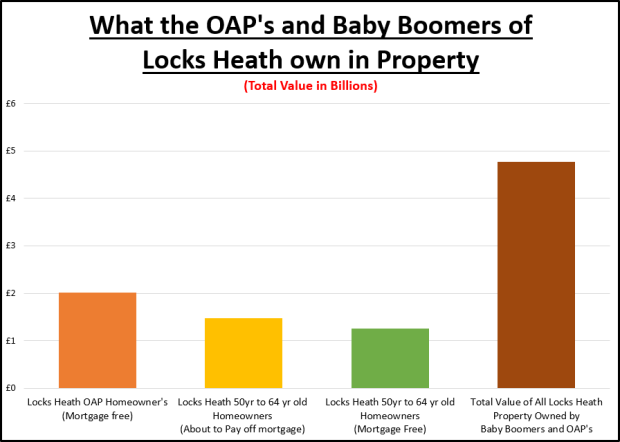
In Locks Heath (SO31), there are 4,236 households whose owners are aged between 50yrs and 64yrs and about to pay their mortgage off.  That property is worth, in today’s prices, £1.48bn.  There are an additional 3,617 mortgage free Locks Heath households, owned by 50yr to 64yr olds, worth £1.26bn in today’s prices, meaning…

Locks Heath Baby Boomers and Locks Heath OAP’s are sitting on £4.77bn worth of Locks Heath Property

156 Graph

These Locks Heath Baby Boomers and OAP’s are sitting on 13,654 Locks Heath properties and many of them feel trapped in their homes, and hence I have dubbed them ‘Generation Trapped’.

Recently, the English Housing Survey stated 49% of these properties owned by the ‘Generation Trapped’ are ‘under-occupied’ (under-occupied classed as having at least two bedrooms more than needed).  These houses could be better utilised by younger families, but research carried out by the Prudential suggest in Britain it’s estimated that only one in ten older people downsize while in the USA for example one in five do so.

The growing numbers of older homeowners who want to downsize their home are often put off by the difficulties of moving.  The charity United for all Ages, suggested recently many are put off by the lack of housing options, 19% by the hassle and cost of moving, 14% by having to declutter their possessions and 14% by family reasons such as staying close to children and grandchildren.

Helping mature Locks Heath (and the Country) homeowners to downsize at the right time will also enable younger Locks Heath people to find the homes they need – meaning every generation wins, both young and old.  However, to ensure downsizing works, as a Country, we need more choices for these ‘last time buyers’.

Theresa May and Philip Hammond can do their part and consider stamp duty tax breaks for downsizers, our local Council in Locks Heath and the Planning Department should play their part, as should Landlords and property investors to ensure Locks Heath’s ‘Generation Trapped’ can find suitable property locally – close to friends, family and facilities.

How The Rented Sector Has Transformed The Property Market In Locks Heath

Crowd blur - WordingThe Locks Heath housing market has gone through a sea of change in the past decades with the Buy-to-Let (BTL) sector evolving as a key trend, for both Locks Heath Tenants and Locks Heath Landlords.

A few weeks ago, the Government released a White Paper on housing.  I have had a chance now to digest the report and wish to offer my thoughts on the topic.  It was interesting that the private rental sector played a major part in the future plans for housing.  This is especially important for our growing Locks Heath population.

In 1981, the population of Fareham stood at 89,000 and today it stands at 114,800.

157 Graph

Currently, the private rented (BTL) sector accounts for 12.1% of households in the town.  The Government want to assist people living in the houses and help the economy by encouraging the provision of quality homes, in a housing sector that has grown due to worldwide economic forces, pushing home ownership out of the reach of more and more people.  Interestingly, when we look at the 1981 figures for homeownership, a different story is told.

79.38% Locks Heath people owned their own home in 1981

13.8% Locks Heath people rented from the Council or Housing Association in 1981

and 6.82% Locks Heath rented from a Private Landlord

The significance of a suitable housing policy is vital to ensure suitable economic activity and create a vibrant place people want to live in.  With the population of Fareham set to grow to 130,000 by 2037 it is imperative that Fareham Borough Council and Central Government all work actively together to ensure the residential property market doesn’t hold the area back, by encouraging the building and provision of quality homes for its inhabitants.

One idea the Government has proclaimed is a variety of measures aimed at encouraging the Build-to-Rent (BTR) sector (instead of the BTL sector). These include allowing local authorities to proactively plan for BTR schemes, and making it simpler for BTR developers to offer inexpensive private rented homes.

To do this, the government will invent a distinct affordable housing class for BTR, called ‘Affordable Private Rent’, which will oblige new homes builders to provide at least 1 in 5 of a new home development at a 20% discount on open-market rents and three year tenancies for Tenants.  In return, the new homebuilders will get better planning assurances.

Private Landlords will not be expected to offer discounts, nor offer 3-year tenancies – but it is something Locks Heath Landlords need to be aware of as there will be greater competition for tenants.

Over the last ten years, home ownership has not been a primary goal for young adults as the world has changed. These youngsters expect ‘on demand’ services from Click and Collect, Amazon, Dating Apps and TV with the likes of Netflix.  Many Locks Heath youngsters see that renting more than meets their accommodation needs, as it combines the freedom from a lifetime of property maintenance and financial obligations, making it an attractive lifestyle option.

Private rented housing in Locks Heath and Fareham, be it BTL or BTR, has the potential to play a very positive role.

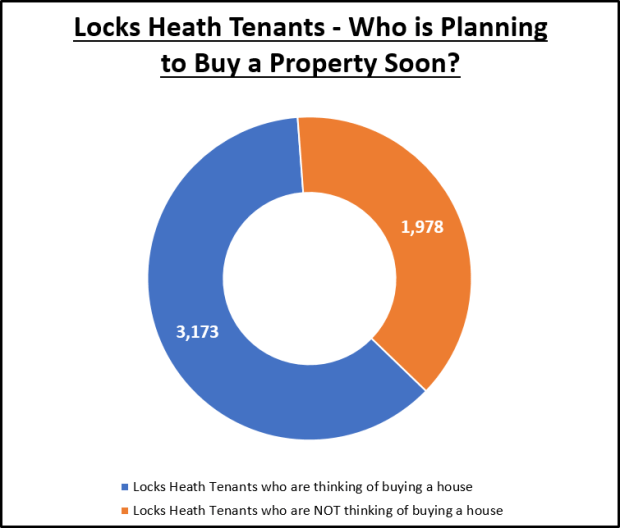
‘Generation Rent (Forever)’ – 1,978 Locks Heath Tenants have no intention of ever buying a property to call home

TeenagerThe good old days of the 1980’s eh… with such highlights lowlights as 17% interest rates,  13% unemployment, power cuts – Those were the days (not)!  But at least people could afford to buy their own home.  So why aren’t the 20 and 30 something’s buying in the same numbers as they were 30 or 40 years ago?
Many people blame the credit crunch and global recession of 2008, which had an enormous impact on the Locks Heath (and UK) housing market.  Predominantly, the 20 something first-time buyers who, confronting a problematic mortgage market, the perceived need for big deposits, reduced job security and declining disposable income, discovered it challenging to assemble the monetary means to get on to the Locks Heath property ladder.

However, I would say there has been something else at play other than the issue of raising a deposit – having sufficient income and rising property prices in Locks Heath.  Whilst these are important factors and barriers to home ownership, I also believe there has been a generational change in attitudes towards home ownership in Locks Heath (and in fact the rest of the Country).

Back in 2011, the Halifax did a survey of thousands of Tenants and 19% of Tenants said they had no plans to buy a home for themselves.  A recent, almost identical survey of Tenants, carried out by The Deposit Protection Service revealed, in late 2016, that figure had risen to 38.4%, with many no-longer equating home ownership to success and believing renting to be better suited to their lifestyle.

You see, I believe renting is a fundamental part of the housing sector, and a meaningful proportion of the younger adult members of the Locks Heath population choose to be Tenants as it better suits their plans and lifestyle.  Local Government in Locks Heath (including the planners – especially the planners), land owners and Landlords need an adaptable Locks Heath residential property sector that allows the diverse choices of these Locks Heath 20 and 30 year olds to be met.

This means, if we applied the same percentages to the current 5,151 Locks Heath Tenants in their 2,299 private rental properties, 1,978 tenants have no plans to ever buy a property – good news for the Landlords of those 883 properties.  Interestingly, in the same report, just under two thirds (62%) of tenants said they didn’t expect to buy within the next year.

155 Graph

But does that mean that the other third will be buying in Locks Heath in the next 12 months?

Some will, but most won’t.  In fact, the Royal Institution of Chartered Surveyors (RICS) predicts that, by 2025, that the number of people renting will increase, not drop.  Yes, many Tenants might hope to buy but the reality is different for the reasons set out above.  The RICS predicts the number of Tenants looking to rent will increase by 1.8 million households by 2025, as rising house prices continue to make home ownership increasingly unaffordable for younger generations.  So, if we applied this rise to Locks Heath, we will in fact need an additional 985 private rental properties over the next eight years (or 123 a year)… meaning the number of private rented properties in Locks Heath is projected to rise to an eye watering 3,284 households.

For more insight and thoughts like this on the Locks Heath Property Market – please visit The Locks Heath Property Blog.