
Supply and Demand Issues mean Locks Heath Property Values Rise by 8.07% in the Last 12 Months

Brick wall - TEXTThe most recent set of data from the Land Registry has stated that property values in Locks Heath and the surrounding area were 8.07% higher than 12 months ago and 19.8% higher than January 2015.

Despite the uncertainty over Brexit Locks Heath (and most of the UK’s) property values continue their medium and long-term upward trajectory.  As economics is about supply and demand, the story behind the Locks Heath property market can also be seen from those two sides of the story.

Looking at the supply issues of the Locks Heath property market, putting aside the short-term shortage of property on the market, one of the main reasons of this sustained house price growth has been down to of the lack of building new homes.

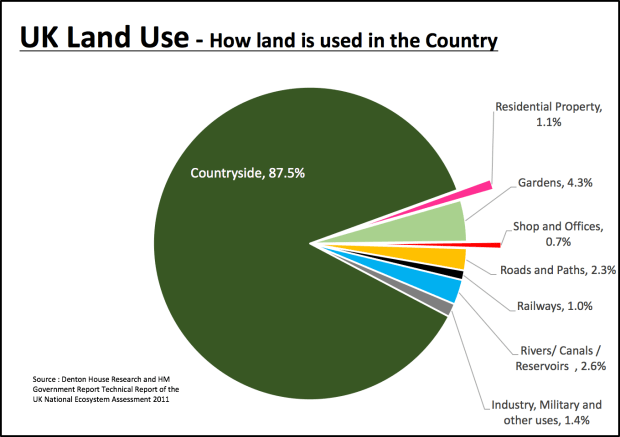
The draconian planning laws, that over the last 70 years (starting with The Town and Country Planning Act 1947) has meant the amount of land built on in the UK today, only stands at 1.8% (no, that’s not a typo – it is one point eight percent) and that is made up of 1.1% with residential property and 0.7% for commercial property.  Now I am not advocating building modern ugly carbuncles and high-rise flats in the Cotswolds, nor blot the landscape with the building of massive out of place ugly 1,000 home housing estates around the beautiful countryside of such villages as Botley and Curdridge.
182 graph

The facts are, with the restrictions on building homes for people to live in, because of these 70-year-old restrictive planning regulations, homes that the youngsters of Locks Heath badly need, aren’t being built.

Looking at the demand side of the equation, one might have thought property values would drop because of Brexit and buyers uncertainty.  However, certain commenters now believe property values might rise because of Brexit.  Many people are risk adverse, especially with their hard-earned savings.  The stock market is at an all-time high (ready to pop again?) and many people don’t trust the money markets.  The thing about property is it is tangible, bricks and mortar, you can touch it and you can easily understand it.

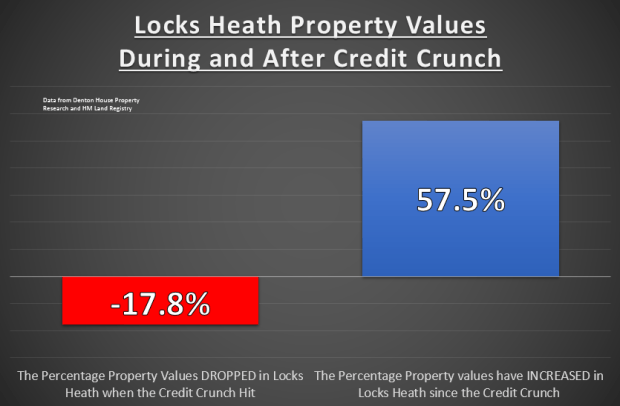
The Brits have historically put their faith in bricks and mortar, which they expect to rise in value, in numerical terms at least.  Nationally, the value of property has risen by 635.4% since 1984 whilst the stock market has risen by a very similar 593.1%.  However, the stock market has had a roller coaster of a ride to get to those figures.  For example, in the dot com bubble of the early 2000’s, the FTSE100 dropped 126.3% in two years and it dropped again by 44.6% in 9 months in 2007… the worst drop Locks Heath saw in property values was just 17.88% in the 2008/9 credit crunch.

Despite the slowdown in the rate of annual property value growth in Locks Heath to the current 8.07%, from the heady days of 12.21% annual increases seen in mid 2010, it can be argued the headline rate of Locks Heath property price inflation is holding up well. Especially with the squeeze on real incomes, new taxation rules for landlords and the slight ambiguity around Brexit. With mortgage rates at an all-time low and tumbling unemployment, all these factors are largely continuing to help support property values in Locks Heath (and the UK).

For more thoughts on the Locks Heath Property Market, please visit The Locks Heath Property Blog.
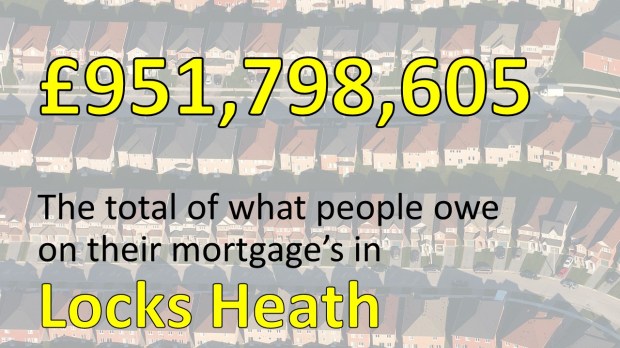
Locks Heath Homeowners and their £951.7 million Debt

179 pptOver the last 12 months, the UK has decided to leave the EU, have a General Election with a result that didn’t go to plan for Mrs May and to add insult to injury, our American cousins elected Donald Trump as the 45th President of the United States.  It could be said this should have caused some unnecessary unpredictability into the UK property market.

The reality is that the housing and mortgage market (for the time being) has shown a noteworthy resilience.  Indeed on the back of the Monetary Policy pursued by the Bank of England there has been a notable improvement of macro-economic conditions!  In July for example it was announced that we are witness to the lowest levels of unemployment for nearly 50 years.  Furthermore, despite the UK construction industry building 21% more properties than same time the previous year, there has still been a disproportionate increase in demand for housing, particularly in the most thriving areas of the Country.  Repossessions too are also at an all-time low at 3,985 for the last Quarter (Q1 2017) from a high of 29,145 in Q1 2009.  All these things have meant that…

Property values in Locks Heath, according to the Land Registry, are 8.07% higher than a year ago.

So, what does all this mean for the homeowners and Landlords of Locks Heath, especially in relation to property prices moving forward?

One vital bellwether of the property market (and property values) is the mortgage market.  The UK mortgage market is worth £961,653,701,493 (that’s £961bn) and it is representative of 13,314,512 mortgages (interestingly, the UK’s mortgage market is the largest in Europe in terms of amount lent per year and the total value of outstanding loans).  Uncertainty causes banks to stop lending – look what happened in the credit crunch and that seriously affects property prices.

Roll the clock back to 2007 and nobody had heard of the term ‘credit crunch’, but now the expression has entered our everyday language.  It took a few months throughout the autumn of 2007 before the crunch started to hit the Locks Heath property market, but in late 2007, and for the following year and half, Locks Heath property values dropped each month like the notorious heavy lead balloon, meaning…

The credit crunch caused Locks Heath property values to drop by 17.8%

Under the sustained pressure of the Credit Crunch, the Bank of England realised that the UK economy was stalling in the early autumn of 2008.  Loan book lending (sub-prime phenomenon) in the US and across the world was the trigger for this pressure.  In a bid to stimulate the British economy there were six successive interest rates drops between October 2008 and March 2009; this resulted in interest rates falling from 5% to 0.5%!

Thankfully, after a period of stagnation, the Locks Heath property market started to recover slowly in 2011 as certainty returned to the economy as a whole and Locks Heath property values really took off in 2013 as the economy sped upwards. Thankfully, the ‘fire’ was taken out of the property market in Spring 2015 (otherwise we could have had another boom and bust scenario like we had in the 1960’s, 70’s and 80’s), with new mortgage lending rules.  Throughout 2016, we saw a return to more realistic and stable medium term property price growth.  Interestingly, property prices recovered in Locks Heath from the post Credit Crunch 2009 dip and are now 57.5% higher than they were in 2009.

179 Graph

Now, as we enter the summer of 2017, with the Conservatives having been re-elected on their slender majority, the Locks Heath property market has recouped its composure and in fact there has been some aggressive competition among mortgage lenders, which has driven mortgage rates down to record lows.  This is good news for Locks Heath homeowners and Landlords, over the last few months a mortgage price war has broken out between lenders, with many slashing the rates on their deals to the lowest they have ever offered.  For example, last month, HSBC launched a 1.69% five-year fixed mortgage!

Interestingly, according to the Council of Mortgage Lenders, the level of mortgage lending had soared to an all-time high in the UK.

In the Locks Heath postcode of SO31, if you added up everyone’s mortgage, it would total £951,798,605!

Since 1977, the average Bank of England interest rate has been 6.65%, making the current 323 year all time low rate of 0.25% very low indeed.  Thankfully, the proportion of borrowers fixing their mortgage rate has gone from 31.52% in the autumn of 2012 to the current 59.3%.

In my modest opinion, especially if things do get a little rocky and uncertainty seeps back in the coming years (and nobody knows what will happen on that front), one thing I know is for certain, interest rates can only go one way from their 300 year ultra 0.25% low level… and that is why I consider it important to highlight this to all the homeowners and Landlords of Locks Heath.  Maybe, just maybe, you might want to consider taking some advice from a qualified mortgage adviser? There are plenty of them in Locks Heath.

If you are interested in the Locks Heath Property Market visit The Locks Heath Property Blog.

Locks Heath Property Market and Mysterious Politics of the General Election

CinderellaAs the dust starts to settle on the various unread General Election party manifestos, with their ‘bran-bucket’ made up numbers, life goes back to normal as political rhetoric on social media is replaced with pictures of cats and people’s lunch.  Joking aside though, all the political parties promised so much on the housing front in their manifestos, should they have been elected at the General Election.  In hindsight, irrespective of which party, they seldom deliver on those promises.

Housing has always been the Cinderella issue at General Elections.  Policing, NHS, Education, Tax and Pensions etc., are always headline grabbing stuff and always seem to go ‘the ball’. However, housing, which affects all our lives, always seems to get left behind and forgotten.

Nonetheless, the way the politicians act on housing can have a fundamental effect on the wellbeing of the UK plc and the nation as a whole.

One policy that comes to mind is Margaret Thatcher’s Council House sell off in the 1980’s, when around 1.4m council houses went from public ownership to private ownership.  It was a great vote winner at the time (it helped her win three General Elections in a row) but it has meant the current generation of 20 somethings in Locks Heath (and elsewhere in the Country) don’t have that option of going into a council house.  This has been a huge contributing factor in the rise of the private renting and buy to let in Locks Heath over the last 15 years.

Nevertheless, looking back to the start of the Millennium, Labour set the national target for new house building at 200,000 new homes a year (and at one point that increased to 240,000 under Gordon Brown for a couple of years).  In terms of what was actually built, the figures did rise in the mid Noughties from 186,000 properties built in 2004 to an impressive 224,000 in 2007 (the highest since the early 1980’s) as the economy grew.

Then the Credit Crunch hit.  It is interesting, that the 2010 Cameron/Clegg government did things a little differently.  The fallout of the Credit Crunch meant a lot less homes were built, so instead of tackling that head on, the coalition side-stepped the target of the number of new homes to build and offered a £400m fund to help kick start the housing market (a figure that was a drop in the ocean when you consider an average UK property was worth around £230,000 in 2010).  The number of new houses being completed dipped from 146,800 in 2011 to 135,500 the subsequent year.

So, one might ask exactly how many new homes do we need to build per year?  It is commonly accepted that not enough new properties are being built to meet the rising need for homes to live in.  A report by the Government in 2016, showed that on average 210,000 net additional households will be formed each year) up to 2039 (through increased birth rates, immigration, people living longer, lifestyle (i.e. divorce) and people living by themselves more than 30 years ago).  In 2016, only 140,600 homes were built… simply not enough!

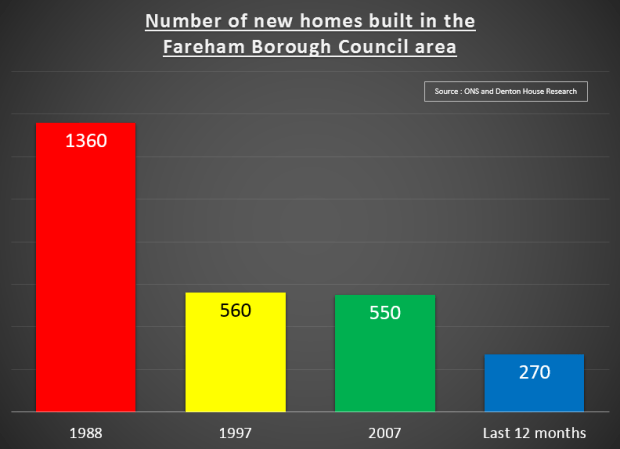
Looking at the numbers locally in Locks Heath and the surrounding area, contrary to local belief, we as an area, are not pulling our weight either when it comes to building new homes.  In the 12 months up to the end of Q1 2017, only 270 properties were built in the Fareham Borough Council area.  Go back to 2007, that figure was 550, 10 years before that in 1997, 560 new homes and further back to 1988, 1,360 new homes were built.

180 Graph

Who knows if Teresa May’s Government will last the five years?  She will think she has bigger fish to fry with Brexit to get bogged down with housing issues.  But let me leave you with one final thought.

The conceivable rewards in providing a place to live for the public on a massive house building programme can be enormous, as previous Tory PM’s have found out.  Winston Churchill in 1951, asked his Minister for Housing (Harold Macmillan) if he could guarantee the construction of 300,000 new properties a year, he was notoriously told: “It is a gamble—it will make or mar your political career, but every humble home will bless your name if you succeed.”

Isn’t it interesting, that the Tories remained in power until 1964!  Mrs May will have to work out if she wants to be the heiress to Harold Macmillan or David Cameron.

Locks Heath’s 1,810 Mortgage Time-Bombs?

LionAccording to my research, of the 18,587 properties in Locks Heath, 8,378 of those properties have mortgages on them.  90.9% of those mortgaged properties are made up of owner-occupiers and the rest are buy to let landlords (with a mortgage).
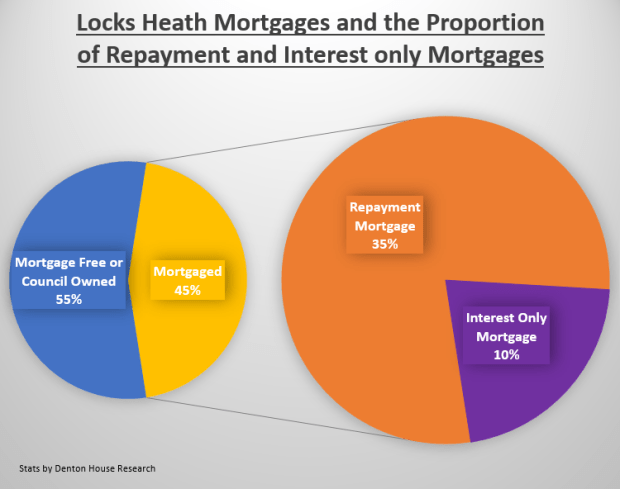
…but this is the concerning part… 1,810 of those Locks Heath mortgages are Interest Only.  My research also shows that, each year between 2017 and 2022, 22 of those households with interest only mortgages will mature, and of those, 5 households a year will either have a shortfall or no way of paying the mortgage off.  Now that might not sound a lot – but it is still someone’s home that is potentially at risk.

178 Variable graph

Theoretically this is an enormous problem for anyone in this situation as their home is at risk of repossession if they don’t have some means to repay these mortgages at the end of the term (the typical term being 25 to 35 years).  Banks and Building Societies are under no obligation to lengthen the term of the mortgage and, when deciding whether they are prepared to do so or not, will look at it in the same way as someone coming to them for a new mortgage.

Back in the 1970’s and 1980’s, when endowment mortgages were all the rage, having an endowment meant you were taking out an interest only mortgage and then paying into an endowment policy which would pay the mortgage off (plus hopefully leave some profit) at the end of the 25/35 year term.  There were advantages to that type of mortgage as the monthly repayments were lower than with a traditional Capital Repayment and Interest mortgage.  Only the interest, rather than any capital, is paid to the mortgage company – but the full debt must be cleared at the end of the 25/35 year term.

Historically plenty of Locks Heath homeowners bought an endowment policy to run alongside their Interest Only mortgage.  However, because the endowment policy was a stock market linked investment plan and the stock market poorly performed between 1999 and 2003 (when the FTSE dropped 49.72%), the endowments of many of these homeowners didn’t cover the shortfall.  Indeed, it left them significantly in debt!

Nonetheless, in the mid 2000’s, when the word endowment had become a dirty word, the banks still sold ‘Interest Only’ mortgages, but this time with no savings plan, endowment or investment product to pay the mortgage off at the end of the term.  It was a case of ‘we’ll sort that nearer the time’ as property prices were on the rampage in an upwards direction!

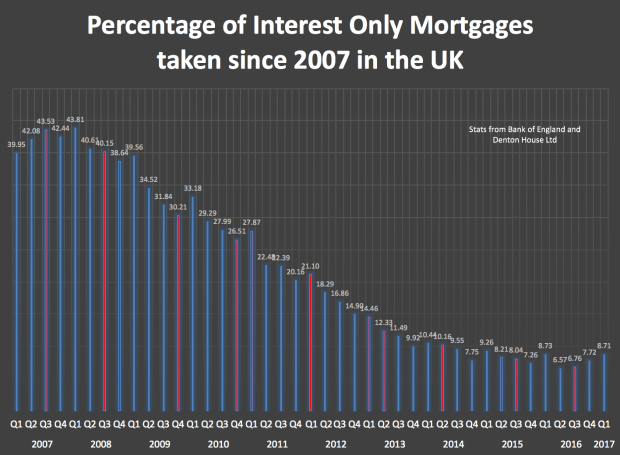
Thankfully the proportion of Interest Only mortgages sold started to decline after the Credit Crunch, as you can see looking at the graph below, from a peak of 43.81% of all mortgages to the current 8.71%.

178 fixed graph

Increasing the length of the mortgage to obtain more time to raise the money has gradually become more difficult since the introduction of stricter lending criteria in 2014, with many mature borrowers considered too old for a mortgage extension.

Locks Heath people who took out Interest Only mortgages years ago and don’t have a strategy to pay back the mortgage face a ticking time bomb.  It would either be a choice of hastily scraping the money together to pay off their mortgage, selling their property or the possibility of repossession (which to be frank is a disturbing prospect).

I want to stress to all existing and future homeowners who use mortgages to go in to them with your eyes open.  You must understand, whilst the banks and building societies could do more to help, you too have personal responsibility in understanding what you are signing yourself up to.  It’s not just the monthly repayments, but the whole picture in the short and long term.  Many of you reading my blog ask why I say these things.  I want to share my thoughts and opinions on the real issues affecting the Locks Heath property market, warts and all.  If you want fluffy clouds and rose tinted glasses articles – then my articles are not for you.  However, if you want someone to tell you the real story about the Locks Heath property market, be it good, bad or indifferent, then maybe you should start reading my blog regularly.

For more thoughts on the Locks Heath Property Market – visit The Locks Heath Property Blog.