

Locks Heath Rents Set to Rise to £855 pm in Next 5 Years

194 rocketIt’s now been a good 12/18 months since annual rental price inflation in Locks Heath peaked at 3.4%.  Since then we have seen increasingly more humble rent increases.  In fact, in certain parts of the Locks Heath rental market over the autumn, the rental market saw some slight falls in rents.  So, could this be the earliest indication that the trend of high rent increases seen over the last few years, may now be starting to buck that trend?

Well, possibly in the short term, but in the coming few years, it is my opinion Locks Heath rents will regain their upward trend and continue to increase as demand for Locks Heath rental property will outstrip supply, and this is why….

The only counterbalance to that improved rental growth would be to meaningfully increase rental stock (i.e. the number of rental properties in Locks Heath).  However, because of the Government’s new taxes on Landlords being introduced between 2017 and 2021, that means buy-to-let has (and will) be less attractive in the short term for certain types of Landlords (meaning less new properties will be bought to let out).

Interestingly, countless market experts assumed at the start of 2017 that the number of rental properties would in fact drop throughout the year.  The assumption being as the new tax rules for Landlords started to kick in, Landlords looked to kick their tenants out, sell up and invest their capital elsewhere.  (Although ironically that would lower supply of rental properties, decreasing the supply, meaning rents would increase again!).

Anecdotal evidence suggests, confirmed by my discussions with fellow property, accountancy and banking professionals in Locks Heath, that Locks Heath Landlords are (instead of selling up en masse), actually either (1) re-mortgaging their Locks Heath buy-to-let properties instead or (2) converting their rental portfolios into limited companies to side step the new taxation rules.

The sentiment of many Locks Heath Landlords is that property has always weathered the many stock market crashes and runs in the last 50 years.  There is something inherently understandable about bricks and mortar – compared to the voodoo magic of the stock market and other exotic investment vehicles like debentures and crypto-currency (e.g. BitCoin).

Remarkably, there is some good news for Tenants, as Tory’s recently published the draft Tenants’ Fee Bill, which is designed to prohibit the charging of Tenants lettings fees on set up of the tenancy.  However, looking at evidence in Scotland, I expect rents to rise to compensate Landlords, thus hammering faithful Tenants looking for long-term tenancy agreements the hardest.  This growth will be on top of any usual organic rent growth.  It really is swings and roundabouts!

So, what does this all mean for Landlords and Tenants in Locks Heath?  In my considered opinion….

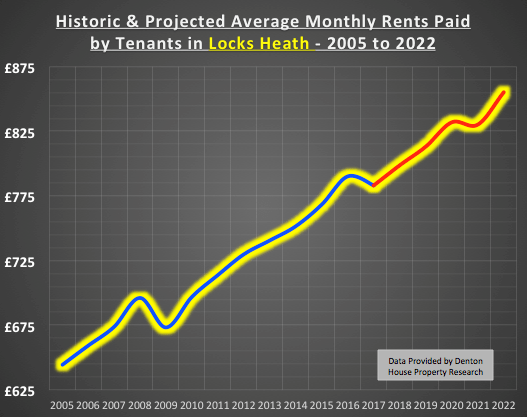
Rents in Locks Heath over the next 5 years will rise by 9.2%, taking the average rent for a Locks Heath property from £783 per month to £855 per month.

To put all that into perspective though, rents in Locks Heath over the last 12 years have risen by 21.5%.  In fact, that rise won’t be a straight-line growth either, because I have to take into account the national and local Locks Heath economy, demand and supply of rental property, interest rates, Brexit and other external factors. Please see the graph for my projections:
194 Graph

In the past, making money from Locks Heath buy-to-let property was as easy as falling off a log.  But with these new tax rules, new rental regulations and the overall changing dynamics of the Locks Heath property market, as a Locks Heath Landlord, you are going to need work smarter and have every piece of information, advice and opinion to hand on the Locks Heath, Regional and National property market’s, to enable you to continue to make money.
Increase in Interest Rates to cost Locks Heath Home Owners £312.31 a year

193Locks Heath homeowners will be among those affected by the latest rise in the Bank of England interest rates. The first increase in 10 years; they have just been raised from 0.25 percent to 0.5 per cent. This uplift comes as inflation hits a 51-month high of 2.9 per cent whilst the national unemployment rate is at an all-time low of 4.3 per cent.

Interestingly, the Governor of the Bank of England has indicated that the interest rate is likely to increase again over the next couple of years, but Mr Carney said mortgages and savings would not be affected in the short term. However, look at all the big banks and just about all of them have increased their standard variable mortgage rate.

The average Locks Heath mortgage is £124,924

I have to ask by how much Locks Heath homeowners (on variable rate or tracker mortgages) will see their repayments increase?

In the SO31 postcode there are 7,619 homeowners with a mortgage, of which 3,273 have a variable rate mortgage (the remaining have fixed rate mortgages).  The total amount owed by those SO31 homeowners with those variable rate mortgages is £408,892,681, meaning the average monthly mortgage payment for those home owners on variable rate mortgages before the interest rate rise was £974.06 per month and now its £1,000.09 per month… meaning

The interest rate rise will cost Locks Heath homeowners on average an extra £312.31 per year

Whilst this is the first raise in interest rates in over 10 years, it must be noted it is at a significantly low level compared to figures in the 1970s and early 1990s.  Many of my readers talk of interest rates at 17 per cent when Sir Geoffrey Howe increased them to try and combat the hyperinflation (from the fallout of the financial crisis that hit Britain in the 1970’s) and Norman Lamont in September 1992 with the infamous Black Wednesday crisis, when interest rates were raised from 10% to 15% in just one day.

So, what will this interest rate actually do to the Locks Heath housing market?

Well, if I’m being frank, not a great deal. The proportion of Locks Heath homeowners with variable rate mortgages (and thus directly affected by a Bank of England rate rise) will be smaller than in the past, in part because the vast majority of new mortgages in recent years were taken on fixed interest rates.  The proportion of outstanding mortgages on variable rates has fallen to a record low of 42.3 per cent, down from a peak of 72.9 per cent in the autumn of 2011.

If more Locks Heath people are protected from interest rate rises, because they are on a fixed rate mortgage, then there is less chance of those Locks Heath people having to sell their Locks Heath properties because they can’t afford the monthly repayments or even worse case scenario, have them repossessed.

However, and this will be of interest to both Locks Heath homeowners and Locks Heath buy to let landlords…

 For every 1% increase in the Bank of England interest rate, it will cost the average Locks Heath homeowner on a variable rate mortgage £104.10 per month

So, what next?  Because UK inflation levels are at 2.9 per cent (the country’s highest rate since April 2012) and the Bank of England is tasked by HM Government to keep inflation at 2 per cent using various monetary tools (one of which is interest rates) – you can see why interest rate rises might be on the cards in the future as increasing interest rates tends to dampen inflation.

Now of course there is a certain amount of uncertainty with regard to Brexit and the negotiations thereof, but fundamentally the British economy is in decent shape. People will always need housing and as we aren’t building enough houses (as I have mentioned many times in the Locks Heath Property Blog), we might see a slight dip in prices in the short term, but in the medium to long term, the Locks Heath property market will always remain strong for both Locks Heath homeowners and Locks Heath Landlords alike.

One in 35 rental properties in the Locks Heath area will be illegal in 2018

Illegal BTL LLsAs the winter months draw in and the temperature starts to drop, keeping one’s home warm is vital.  Yet, with the price of gas and electricity rising quicker than a Saturn V rocket and gas, oil and electricity taking on average 4.4% of a typical Brit’s pay packet (and for those Brit’s with the lowest 10% of incomes, that rockets to an eye watering 9.7%), whether you are a tenant or homeowner, keeping your energy costs as low as possible is vital for the household budget and the environment as a whole.

For the last 10 years, every private rental property must have an Energy-Performance-Certificate (EPC) rating.  The property is given an energy rating, very similar to those on washing machines and fridges with the rainbow coloured graph, of between A to G (A being the most efficient and G the worst).  New legislation comes in to force next spring (2018) for English and Welsh private landlords making it illegal to let a property that does not meet a certain energy rating.  After the 1st of April next year, any new tenant moving into a private rented property or an existing tenant renewing their tenancy must have property with an energy performance rating of E or above on the property’s EPC and the new law will apply for all prevailing tenancies in the spring of 2020.  After April 2018, if a Landlord lets a property in the ‘F’ and ‘G’ ratings (i.e. those properties with the worst energy ratings) Trading Standards could fine the Landlord up to £4,000.

Personally, I have grave apprehensions that many Locks Heath Landlords may be totally unaware that their Locks Heath rental properties could fall below these new legal minimum requirements for energy efficiency benchmarks.  Whilst some households may require substantial works to get their Locks Heath property from an F/G rating to an E rating or above, my experience is most properties may only need some minor work to lift them from illegal to legal.  By planning and acting now, it will mitigate the need to find tradespeople in the spring when every other Locks Heath landlord will be panicking and paying top dollar for work to comply.

Whilst there is money and effort involved in upgrading the energy efficiency of rental property, a property that is energy efficient will have greater appeal to tenants and other buy-to-let landlords/investors and this will enable you to obtain higher rents and sale price (when you come to sell your investment).

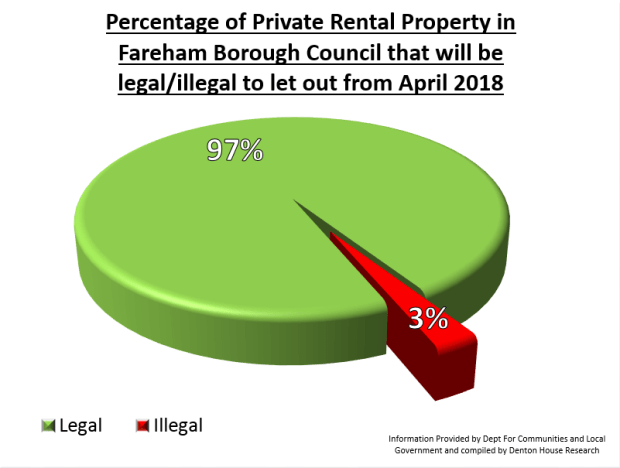
So, how many properties are there in the area that are F and G rated?  Well quite a few in fact.  Looking at the whole of the Fareham Borough Council area, of the 4,645 privately rented properties, there are:

101 rental properties in the F banding

32 rental properties in the G banding

192 Graph

That means just under one in 35 rental properties in the Locks Heath and surrounding area has an Energy Performance Certificate (EPC) rating of F or G.  From April next year it will be illegal to rent out those homes rated F and G with a new tenancy.

Talking with the Energy Assessor that carries out our EPC’s, they tell me most of a building’s heat is lost through draughty windows/doors or poor insulation in the roof and walls.  So why not look at your EPC and see what the assessor suggested to improve the efficiency of your property?  I can find the EPC of every rental property in Locks Heath, so irrespective of whether you are a client of mine or not, don’t hesitate to contact me via email (or phone) if you need some guidance on finding out the EPC rating or need a trustworthy contractor that can help you out.

james.hill@brooklettings.co.uk

01489 570011

Locks Heath Homeowners Are Only Moving Every 17.5 Years (part 2)

CycleIn the credit crunch of 2008/9 the rate of home moving plunged to its lowest level ever. In 2009 the rate at which a typical house would change hands slumped to only once every 23 years.  The biggest reason being that confidence was low and many homeowners didn’t want to sell their home as Locks Heath property prices plunged after the onset of the financial crisis in 2008.  However, since 2009, the rate of home moving has increased (see the table and graph below), meaning today:
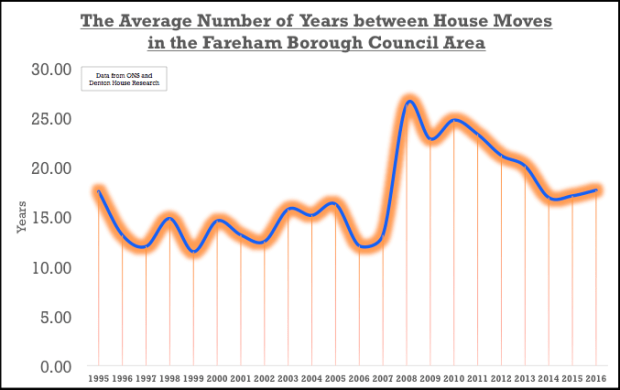
The average period of time between home moves in Locks Heath is now 17.5 years.

This is an increase of 29.25 per cent between the credit crunch fallout year of 2009 and today, but still it is a 29.21 per cent drop in moves by homeowners, compared to 15 years ago (The Noughties).

Average Length of Time (In Years) between Home Moves in Locks Heath and the Fareham Borough Council Area

1995 1996 1997 1998 1999 2000 2001 2002 2003 2004 2005
17.55 13.14 12.01 14.81 11.47 14.58 13.16 12.50 15.75 15.14 16.26
 
2006 2007 2008 2009 2010 2011 2012 2013 2014 2015 2016
12.07 13.15 26.29 22.83 24.73 23.30 21.16 20.10 16.93 17.10 17.66

190 Graph

So why aren’t Locks Heath homeowners moving as much as they did in the Noughties?

The causes of the current state of play are numerous.  In last weeks article I talked about how ‘real’ incomes and savings had been dropping.  Another issue is the long-term failure in the number of properties being built.

Back in the 1960’s and 1970’s, as a country, we were building on average 300,000 and 350,000 households a year.  The Barker Review a few years ago said that for the UK to stand still and keep up with housing demand (through immigration, people living longer, a just under 50% increase in the number of households with a single person since the 1980’s and family makeup (i.e. divorce makes one household now two)) we needed to build 240,000 households a year.  Over the last few years, we have only been building between 135,000 and 150,000 households a year.

Finally, as the UK Population gets older, there is no getting away from the fact that a maturing population is a less mobile one.

So, what does this mean for Locks Heath homeowners and Landlords?

Well, if Locks Heath people are less inclined to move or find it hard to sell a property or acquire a new one, they are probably less likely to move to an improved job or a more prosperous part of the UK.

Many of the older generation in Locks Heath are stuck in property that is simply too big for their needs.  The fact is that, in Locks Heath and Fareham Borough, more than five out of every ten (or 51.9 per cent) owned houses has two or more spare bedrooms; or to be more exact …

19,575 of the 37,737 owned households in the Fareham Borough have two or more spare bedrooms.

So, as their children and grandchildren struggle to move up the housing ladder, with those young families bursting at the seams in homes too small for them i.e. overcrowding, we have a severe case of under-occupation with the older generation – grandparents staying put in their bigger homes, with a profusion of spare bedrooms.

Regrettably, I cannot see how the rate of properties being sold will rise any time soon. Many commentators have suggested the Government should give tax breaks to allow the older generation to downsize, yet in a recent White Paper on housing published just weeks before the General Election, there was no reference of any thoughtful and detailed policies to inspire or support them to do so.

This means that there could be an opportunity for Locks Heath buy to let Landlords to secure larger properties to rent out, as the demand for them will surely grow over the coming years.  As for homeowners; well those in the lower and middle Locks Heath market will find it a balanced sellers/buyers market, but will find it slightly more a buyers market in the upper price bands.

Interesting times ahead!

Locks Heath Home Owners Are Only Moving Every 17.5 Years (Part 1)

90s

As I mentioned in a previous article, the average house price in Locks Heath is 9.28 times the average annual Locks Heath salary.  This is higher than the last peak of 2008, when the ratio was 8.48.  A number of City commentators anticipated that in the ambiguity that trailed the Brexit vote, UK (and hence Locks Heath) property prices might drop like a stone.  The point is – they haven’t.

Now it’s true the market for Locks Heath’s swankiest and poshest properties looks a little fragile (although they are selling if they are realistically priced) and overall, Locks Heath property price growth has slowed, but the lower to middle Locks Heath property market appears to be quite strong.

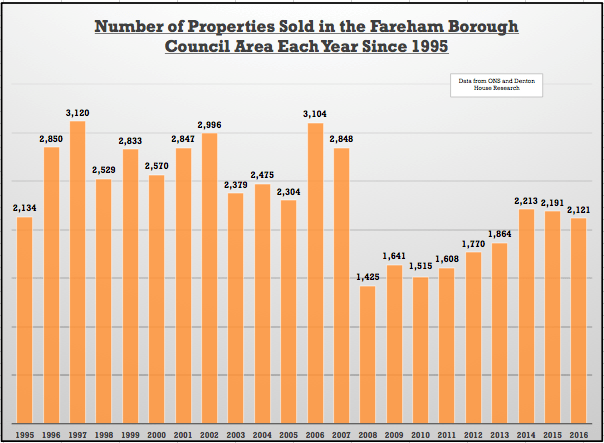
Scratch under the surface though, and a different long-term picture is emerging away from what is happening to property prices. Locks Heath people are moving home less often than they once did. Data from the Office of National Statistics shows that the number of properties sold in 2016 is again much lower than it was in the Noughties. My statistics show…

The Total Number of Property Sales Per Annum in Locks Heath and the Fareham Borough Council Area Since 1995

1995 1996 1997 1998 1999 2000 2001 2002 2003 2004 2005
2,134 2,850 3,120 2,529 2,833 2,570 2,847 2,996 2,379 2,475 2,304
                     
2006 2007 2008 2009 2010 2011 2012 2013 2014 2015 2016
3,104 2,848 1,425 1,641 1,515 1,608 1,770 1,864 2,213 2,191 2,121

189 Graph

Even though we are not anywhere near the post credit crunch (2008 and 2009) low levels of property sales, the lethargy of the Locks Heath housing market following the 2016 Brexit vote has seen the number of property sales in Locks Heath and the surrounding local authority area level off to what appears to be the start of a new long term trend (compared the Noughties).

Interestingly, it was the 1980’s that saw the highest levels of people moving home.  Nationally, everyone was moving on average every decade.  Even though it was during the Labour administration of the late 1970’s where the right to buy one’s council house started, it was the Housing Act of 1980 that that really got council tenants moving. Thatcher’s Tory government financially encouraged council tenants to buy their council-rented homes – for which countless then sold them on for a profit and moved elsewhere.  The housing market was awash with money as banks were allowed to offer mortgages as well as the existing building societies, meaning it made it simpler for Brits to borrow even more money on mortgages and to climb up the housing ladder.

But coming back to today, looking at the property sales figures in the Locks Heath area since 2010/11, a new trend of number of property sales appears to have started.  Interestingly, this has been mirrored nationally.  The reasons behind this are complex, but a good place to start is the growth rate of real UK household disposable income, which has fallen from 5.01% a year in 2000 to 1.68% in 2016.  Also, things have deteriorated since the country voted to leave the EU as consumer price inflation has risen to 2.7% per annum, meaning inflation has eaten away at the real value of wages (as they have only grown by 1.1% in the same time frame).

With meagre real income growth, it has become more difficult for homeowners to accumulate the savings needed to climb up the housing ladder as the level of saving has also dropped from 4.26% of household income to -1.11% (i.e. people are eating into their savings).

Next week I will be discussing how these (and other issues) has meant the level of Locks Heath people moving home has slumped to once every 17.5 years.