
Locks Heath Property Market – What is going to happen to Stamp Duty on 11th March?

296If you are buying a home in England costing more than £125,000, you will have to pay Stamp Duty Land Tax on the purchase of your new home. In the provinces, it’s called something slightly different, so if you are buying a property in Scotland over £145,000 you will pay Land and Buildings Transaction Tax (LBTT) and for any property over £180,000 in Wales you will pay Land Transaction Tax (LTT). Whatever the tax is called, it is an important factor when moving, when you consider that

Last year the average UK house buyer paid £10,150 in Stamp Duty Tax alone

Now as soon as the date for Rishi Sunak’s budget was set for 11th March 2020, conjecture in the Press began about what stamp duty changes he may disclose on budget day. The Chancellor only sets the budget for England and Northern Ireland, yet this is just as relevant for Wales and Scotland. Even though Derek Mackay, the Scottish Finance Secretary said on 6th February he has no plans to change Scotland’s version of Stamp Duty (LBTT), more often than not, Stamp Duty rule changes in England are often adopted in Wales and Scotland at a future date.

Some are asking if Sunak will impose what was promised in the Conservative manifesto with the 3% additional Stamp Duty surcharge on non-UK resident buyers? I have certainly heard in the Estate Agent community that foreign buyers are trying to rush through their sales in central prime London (Park Lane/Mayfair etc etc) before 11th March to ensure they don’t get hit with a new tax. Or will he go even further, and will we see a reappearance of Boris Johnson’s previously specified aim of eliminating Stamp Duty below £500k, consequently theoretically saving homebuyers many thousands of pounds?

However, opinions are divided on what, if anything, will be included in the budget.

Most believe that the extra 3% for foreign nationals is an almost certainty, and if it isn’t implemented straight away, it will be in the Autumn Statement. Many believe the Chancellor could also decide to repay the favour to those in the North who turned the Election map ‘blue’ on the evening of 12th December with actions to enhance the housing market north of the M62 with stamp duty changes. The best way he could do that is to raise the threshold from the current £125k.

When Boris ran for Tory leadership back in May 2019, he said that he wanted to expand the threshold at which you begin paying stamp duty from £125k to £500k, which when you consider 7 out of 8 residential sales in 2019 were for homes below £500k, that would have a considerable effect. If the Stamp Duty threshold had been raised to £500k in 2019, then 700,400 homebuyers in England would not have paid any Stamp Duty Tax.

97.1% of Locks Heath properties sold last year were below £500k

Of the 526 properties sold in the last 12 months within a 1-mile radius of Locks Heath, only 15 of those properties sold were over £500,000 (interesting when compared with Greater London where 44.9% of properties were below the £500k level).

Yet the cost to the HM Treasury would be significant. If all properties below £500k were exempt, the government would lose £2.22bn in tax receipts according to Savills. Of course, this could be made up with extra tax on empty properties or increasing the second homes Stamp Duty levy from the current 3% to say 5%, which would raise an additional £1.12bn on top of the current £1.68bn it raises for the Treasury, yet it would have a negative effect on buy-to-let landlords buying additional homes.

What almost unquestionably won’t happen is the earlier idea of switching the Stamp Duty liability from homebuyer to home seller

…this would stall the property market, would probably cause political fallout among 688,300 homebuyers who paid Stamp Duty last year alone, make homes ‘appear’ more expensive as house sellers would inflate the asking price to try and recoup some of the tax, yet ultimately could be seen as ‘re-arranging the deckchairs on the Titanic’.

The 3% additional levy for foreign buyers is almost certain (of which we don’t get many in Locks Heath – as they tend to buy in prime London areas which is of course the City of Westminster and the Royal Borough of Kensington & Chelsea, and parts of the boroughs of Hammersmith and Fulham, and Camden), yet I have a feeling that ultimately the Government doesn’t want to rock the boat on the wave that is being rode by the property market on the ‘Boris Bounce’ since December. I also doubt any changes will be made to first time buyer Stamp Duty relief, as 22% of all property transactions in 2019 were to first-time buyers, and whilst it cost the Treasury (or saved the first-timer buyers) a total of £539m in Stamp Duty relief (an average of £2,411 each), the Government are keen for first time buyers to get onto the housing ladder.

Ultimately, we can only wait until Mr Sunak opens his red leather box on 11th March to find out what will happen. I will of course report back after 11th of March on what (if any) changes to the tax regime will affect the Locks Heath property market going forward.

Locks Heath Property Values 1.6% Lower Year-on-Year

283It seems that quite a few Locks Heath homeowners and Locks Heath Landlords have become acclimatised to living with the uncertainty of Brexit throughout most of 2019, as figures show many of them decided to get on with living life, started reinvesting their money into Locks Heath property and buying and selling their Locks Heath homes and BTL investments. Land Registry stats confirm that. Current data shows that…

Locks Heath property values are 1.6% lower than 12 months ago

Whilst the newspapers were stating prime central London property values were now 17% below the levels being achieved a couple of years ago, that message seems not to have been heard by certain sectors of the Locks Heath property market!

Speaking with other property professionals in Locks Heath, many weren’t expecting the usual autumn rebound after the summer holidays.  Many were anticipating a dormant Locks Heath property market on the run up to Christmas believing many Locks Heath home-movers would put off the their home moving activities until the new year.  Yet in many sectors of the local property market, I have seen (and the stats back this up) that those Locks Heath property buyers who are able to hold their nerve (whereas others were hesitant) have found themselves in a better negotiating position to get a great property deal.  Putting aside the fluff of newspaper headlines, the real foundations of Locks Heath housing market remain sound with record low unemployment, ultra-low interest rates and low inflation.

Interestingly, there are 17% more homes for sale in Locks Heath (SO31) compared to two years ago, meaning more choice for buyers

However, there are still parts of the Locks Heath property market that remain stagnant, with some homeowners being slightly unrealistic with their marketing pricing.  To them, the property market appears to be slow, as they stare at their ‘for sale’ board for months on end, yet nothing could be further from the truth.

The key to a balanced (and healthy) property market is realistic pricing by the homeowners when they place the property on the market, mortgage affordability for buyers and buy to let Landlord activity which creates and maintains forward momentum.  One measure of momentum is how long a property remains on the market, and interestingly…

The current average length of time a Locks Heath (SO31) property remains on the market is 91 days, up slightly from 80 days two years ago

Now the number of properties sold locally is slightly down year on year (even though we had a burst of property sales in the summer locally) and interestingly, Rightmove reported recently that nationally, the number of properties sold in the UK was only just over 3% less year on year, so a similar picture nationally.

So, what does all this mean for Locks Heath homeowners and Locks Heath Landlords?

We have always had issues that were game changers for the housing market; for the last few years it’s been Brexit, 10 years ago the credit crunch, 18 years ago the dot com crash, the ERM and 15% interest rates issue 27 years ago, dual MIRAS 32 years ago, hyper-inflation 40 years ago, the 3 day week 45 years ago – the list goes on.  Everyone needs a home to live in, the local authority just has not got the money to build council houses, so buy to let will continue to grow for the foreseeable future which in turn creates a stable foundation for all homeowners.  Maybe you should use this time, like many are in Locks Heath to take advantage of the property deals to be had in Locks Heath.

Locks Heath Buy to Let – Past, Present and Future

284Investing in a Locks Heath buy to let property has become a very different sport over the last few years.
In the glory days of the five years after the turn of the Millennium, where we had double-digit house price growth, mortgage companies (notably Northern Rock, HBOS and their ilk) desperate to get on the buy to let mortgage bandwagon with rates so low it would make the belly of a snake seem high, and an open mildness to give loans away with not so much more than a note from your Mum and with hardly any regulatory intervention… anyone could make money from investing in property.  In fact it was easier to make money than fall off a log!  Then we had the unexpected flourish of the property market, with the post credit crunch jump in the property market after 2010, when everything seemed rosy in the garden.

Yet, over the past five years, the thumbscrews on the buy to let market for British (and de facto) Locks Heath investors have slowly turned with new barriers and challenges for buy to let investors.  With the change in taxation rules on mortgage relief starting to bite, plus a swathe of new rules and regulations for Landlords and mortgage companies, it cannot be denied that some Locks Heath landlords are leaving the buy to let sector, whilst others are putting a pause on their portfolio expansion.

With the London centric newspapers talking about a massive reduction in house prices (mainly in Mayfair and Prime London – not little old Locks Heath) together with the red-tape that Westminster just keeps adding to the burden of Landlords’ profit, it’s no wonder it appears to be dome and gloom for Locks Heath Landlords.… or is it?

One shouldn’t always believe what one reads in the newspaper.  It’s true, investing in the Locks Heath buy to let property market has become a very different ball game in the last five years thanks to all the changes and a few are panicking and selling up.

Locks Heath Landlords can no longer presume to buy a property, sit on it and automatically make a profit

Locks Heath Landlords need to see their buy to let investments in these tremulous times in a different light.  Before Landlords kill their fatted calves (i.e. sell up) because values are, and pardon the metaphor, not growing beyond expectation (i.e. fattening up), let’s not forget that properties produce income in the form of rent and yield.  The focus on Locks Heath buy to let property in these times should be on maximising your rents and not being preoccupied with just house price growth.

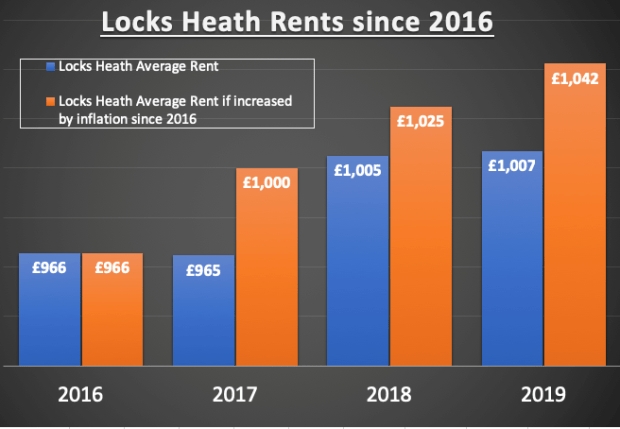
Rents in Locks Heath’s private rental sector increased by 0.19% in the past 12 months

Rents in Locks Heath since 2008 have not kept up with inflation, it is cheaper today in REAL TERMS than it was 11 years ago and some landlords are beginning to realise that fact with our help.

284 Graph

Looking at the last few years, it can be seen that there is still a modest margin to increase rents to maximise your investment (and it can be seen some Locks Heath Landlords have already caught on), yet still protect your tenants by keeping the rents below those ‘real spending power terms’ of the 2008 levels.

Buy to let must be seen as a medium and long-term investment….

Rents in Locks Heath are 4.29% higher than they were 3 years ago and property values are 14.10% higher than Jan 2016

… and for the long term, even with the barriers and challenges that the Government is putting in your way the future couldn’t be brighter if you know what you are doing.

Investment is the key word here…  In the old days, anything with a front door and roof made money – yet now it doesn’t.  Tenants will pay top dollar for the right property but in the right condition.  Do you know where the hot spots are in Locks Heath, whether demand is greater for 2 beds in Locks Heath or 3 beds?  Whether terraced houses offer better ROI than semis?  With all the regulations many Locks Heath Landlords are employing us to guide them by not only managing their properties, taking on the worries of property maintenance, the care of property and their Tenants’ behaviour but also advising them on the future of their portfolio.  We can give you specialist support (with ourselves or people we trust) on the future direction of the portfolio to meet your investment needs (by judging your circumstances and need between capital growth and yields), specialist finance and even put your property empire into a limited company.

If you are reading this and you know someone who is a Locks Heath buy to let Landlord, do them a favour and share this article with them – it could save them a lot of worry, heartache, money and time.