

The Future of the Locks Heath Buy-To-Let Market in 2022

The headlines …

  • Locks Heath rents up by 3.3% in the last 12 months
  • Locks Heath house prices up 10.0% in the last 12 months
  • Locks Heath landlords helped by ultra-low mortgage rates and a stamp duty holiday 
  • Yet, some landlords in Locks Heath anxious about a possible end to no fault evictions
  • New EPC rules could cost Locks Heath landlords £10,000+ per property 

In this article, I will look at what happened in 2021 in the Locks Heath buy-to-let property market and give you my opinion as to what lies ahead for Locks Heath Landlords in 2022 and beyond.

On a positive note, Locks Heath house prices have rocketed, rents have risen faster than inflation, at the start of the year we had the benefit of a stamp duty holiday and finally, ultra-low mortgage rates, meaning Locks Heath Landlords had lots to be happy about in 2021.  

On a more cautious note, the laws regarding renting are currently being debated in Parliament which will see the end of no-fault tenant evictions and changes in regulations will require Locks Heath Landlords to make their buy-to-let rental properties more eco-friendly at a cost of up to £10,000+ each.

So, let’s have a look at these points …

Locks Heath Rents will Continue to Rise in 2022

Locks Heath buy-to-let Landlords have seen the average rent of a Locks Heath rental property rise by 3.3% in the last 12 months.  

The number of Locks Heath properties available to rent on the property portals (e.g. Rightmove etc) at any one time is roughly 35% to 40% below the last decade’s average, meaning there is much greater competition for each rental property.

Demand has increased for several reasons:

Firstly, some homeowners cashed in on the high prices, sold up and moved into rented property.

Secondly, some Locks Heath buy-to-let Landlords have also cashed in on the buoyant property market and sold their rental property when their existing Tenant handed in their notice.

Finally, the rental sector has an inverse relationship to the state of the general British economy, meaning with the uncertainty in the British economy in the early part of 2021, this meant more people decided to rent rather than tie themselves into a mortgage.

Looking at the supply side of the Locks Heath rental market, in the short term, rents will continue to grow as some Locks Heath Landlords are abandoning the rental market – some because of the impending regulation changes which I will talk about later and others with the natural flow of people cashing in their investments on retirement.

With increased demand and restricted supply, this will only lead to competition becoming more severe between renters, thus making Locks Heath rents continue to rise.

Locks Heath House Price Growth Will Slow

For those that own property, the way house prices grew in 2021 surprised most people.

Locks Heath house prices, according to the Land Registry, grew by 10% in 2021, with the typical Locks Heath home reaching £376,000.

Many local Landlords have been helped by this increase in Locks Heath house prices and will be in a place to cash in on those capital gains by either selling their buy-to-let property (as mentioned in the previous section) or releasing some equity by re-mortgaging.

Whether Locks Heath house price rises carry on at such a rate in 2022 will mainly depend on whether the imbalance between the number of properties that come on to the market (supply) is by the number of buyers (demand).

Most commentators believe that nationally house prices will be between 3% and 5% higher by the end of 2022 and I can see no reason why Locks Heath house prices won’t be in that range by the end of the year either.

Mortgage Rates Will Rise

The reduction in tax relief for Locks Heath buy-to-let Landlords with mortgages in the last five years hit some landlords hard, yet this has been tempered by the inexpensive ultra-low mortgages available to buy-to-let Landlords.

Yet even with the Bank of England increase in base rates, Locks Heath Landlords with big deposits of 40% or more can benefit from low rates. For example, at the time of writing, you can get a BTL mortgage at 1.49% fixed for 5 years with a 40% deposit (meaning borrowing £180,000 on a £300,000 purchase would only cost you £719 per month on a 25-year mortgage – or £224 per month on interest only).

However, those with only a 25% deposit must pay slightly more, but only at a mortgage rate of 1.64% – who can remember mortgage rates of 14% to 15% in 1992?

With inflation rising, the Bank of England has already indicated further interest rate rises are on the cards. I suspect they will be around the 1% mark by Christmas 2022. Therefore, if you are one of the one in five Landlords on a variable rate mortgage, your margins will be squeezed as your variable rate mortgage will rise in line with the Bank of England interest rate rise.

Maybe it’s time to consider fixing your mortgage?

The End of No-fault Evictions?

The Renters’ Reform Bill in England and The Renting Homes Act in Wales are both set to abolish Section 21 (no fault eviction). Section 21 laws allow Landlords to take back possession of their rental properties without having to prove fault by the tenant.

Yet in 2022, Westminster will issue plans for a change of this law which will probably incorporate the eradication of Section 21, which would signify a major change in the balance of power between the Landlord and Tenant. 

Some doom mongers are worried that with the abolition of Section 21, Locks Heath Landlords may be unenthusiastic about renting and therefore sell up and leave the rental sector altogether. Yet these people said the same when tax relief for Landlords was changed five years ago.

The Scottish equivalent of Section 21 was abolished at the end of 2017.

At the time, there was some anxiety about how this would affect the Scottish rental market, as anxious Landlords and letting agents felt that they could lose control of their rental properties under this new law. Nonetheless, just over four years later, the rental sector has not collapsed in Scotland. The buy-to-let market remains upbeat, and there are signs that a Scottish Landlords’ right to evict their tenant has been reinforced by these changes in the law.

The reason the Scottish changes worked was the new grounds for repossessing rental properties was clear and wide-ranging. The Scots sped up the slow and unwieldy eviction process where the Landlord had a legal and genuine reason to re-claim their property.

All I hope is the same changes are made south of the border to the court procedure.

New EPC Rules Could Cost Locks Heath Landlords £10,000+ per Property

The law currently stands that Locks Heath Landlords need an Energy Performance Certificate (EPC) with at least a rating of E.

Westminster is anticipated to increase the EPC requirement for private rental properties in England and Wales to an EPC rating of C for all new rental tenancies by 2025/6, and for all existing Tenancies by 2028, whilst Scottish Landlords are also expected to see energy efficiency measures in their new proposed Housing Bill.

The problem is 1,959,045 of the 2,965,455 registered rental properties on the EPC database have an energy rating of D or below. 

To take a property from an EPC D rating to a C rating might only cost a few hundred pounds, yet the average for all rental D and E rated properties has been calculated at just over £10,000 per property.

My advice to every Locks Heath Landlord is to look at the full EPC report of their rental property (and if you haven’t got it, contact me and I will send it to you – whether you are a client or not) as that will tell you whether this will be a big or small job.

Renovating the UK’s rental stock to meet the Government’s carbon neutral targets will be a big trial for Landlords. There is talk of exemptions, as there currently is for the existing minimum EPC E rating – yet only time will tell on that front.

Maybe those Locks Heath Landlords currently buying properties to add to their rental portfolio should reconsider their buying strategy? In the past, it has been normal for Locks Heath buy-to-let investors to be attracted to the inexpensive older properties that need an overhaul. However, with the potential energy efficiency laws coming into the game, it’s rational to suggest that buy-to-let Landlords will be more predisposed to buying slightly newer properties rather than have the cost for the upgrades to meet the potential energy targets.

Conclusion

Roll the clock back 20 years and making money from buy-to-let in Locks Heath was as easy as falling off a log. Yet with increased legislation and regulation, together with the changing dynamics of the British economy and the requirements Tenants want in a rental property, making money won’t be as easy over the next 20 years.

It amazes me that 11 out of 20 Landlords do not use a letting agent to help them with their rental portfolio, considering the cost can be offset against your tax.

Moving forward, the savvy Locks Heath Landlords will more and more utilise their letting agent not only to collect the rent and manage the property but also build up their portfolio to withstand the regulatory and demographic changes on the horizon, and to ensure that their investment is fit for purpose in the medium to long-term.

If your existing letting agent does not offer such advice, or you are a self-managing Landlord, let’s have a chat about the future of the Locks Heath rental market.

Whether you are a client of mine or not, if you would like me to look at your rental portfolio and see where you stand, then drop me a line and maybe we can meet for a coffee (or we can meet virtually over Zoom) to discuss the matter – all at no charge.

Should Locks Heath Landlords Be Worried About These New Rental Regulations?

Everyone should be doing their bit to help reduce the UK’s carbon footprint on the globe – yet the question is, is that burden being put too much on the shoulders of Locks Heath landlords with potential bills of £7,600+ in the next four years?

The background – the UK has obligated itself to a legally binding target to be carbon neutral by 2050. One of the biggest producers of greenhouse gasses is residential homes.

To hit that carbon-neutral target (as one-fifth of the UK’s carbon output comes from residential property), every UK home will need to achieve a minimum grade of ‘C’ on their Energy Performance Certificate (EPC) by 2035. Each EPC has a rating between ‘A’ and ‘G’ – ‘A’ being the best energy rating and ‘G’ the worst – like an energy rating on a fridge or washing machine.

All UK rental properties have required an EPC. Yet, from April 2020, the Minimum Energy Efficiency Standards (MEES) regulations have required all private rental properties (including rental renewals) to have a minimum EPC rating of ‘E’ or above.

Yet new legislation being discussed by the Government’s Climate Change Committee has suggested that landlords should play their part and increase the energy efficiency of their private rented homes. Sounds fair until you dive into the details.

The Government is muting the idea that all new tenancies (i.e. when a new tenant moves in) in private rented properties should be at an EPC rating of ‘C’ or above by 2025 (and all existing tenancies by 2028). The issue is…

57.24% of all private rented properties in Fareham have an EPC rating of ‘D’ or below.

The problem is some Locks Heath landlords will find it very expensive, neigh impossible, to improve the energy efficiency of their Locks Heath rented properties, especially those Locks Heath landlords who hold older housing stock such as terraced properties built in the 1800s. These Victorian terraced houses never perform well on EPC ratings as they have solid walls.

Now, of course, you can improve the EPC rating of a terraced house by improving roof insulation, boiler replacement, solar heating, and high-grade uPVC windows. Yet, with some terraced houses, there will come the point where you will be unable to get to the haloed ‘C’ rating without installing external or internal wall insulation, sometimes even floor insulation.

With wall insulation costing between £5k and £15k and floor insulation around £5k…

the bill to improve all Fareham private rented properties will be a minimum of £18,221,400.

But before I talk about what the options are for Locks Heath landlords, here’s the weird part of EPC’s. An EPC rating is calculated on the cost of running a property and not the carbon output or energy efficiency, despite its name.My advice to Locks Heath landlords – although it’s correct to create a future strategy, all I can say at this point is ‘more haste less speed’. These rule changes are only a discussion paper, and it remains open for consultation by any member of the British public until 30th December 2021. That means the Government’s strategies and tactics may change.

Given that 57% of private rented properties are below a ‘C’ EPC grade, it is hard to believe the Government could achieve this without making big cash grants available.

For example, there is presently a cap of £3,500 for energy improvements that Locks Heath landlords have to spend to get it to the existing EPC ‘E’ target grade on private rented homes (i.e. if you have a privately rented home at an ‘F’ or ‘G’ EPC rating, you only need to spend a maximum of £3,500 as a landlord on improving your EPC rating and still being legal even if those £3,500 don’t get you to the current ‘E’ rating minimum). So, if the current rules allow an exemption to the EPC renting rules, if a Locks Heath landlord can’t improve their Locks Heath property enough, conceivably, could this be extended?

So, what are Locks Heath landlord’s options?

One thing you could do is put your head in the sand and hope it all goes away!

Another thing some savvy Locks Heath landlords do (be they my client, clients of other letting agents in Locks Heath or even self-managing landlords) is to sit down and plan a strategy for their Locks Heath rental portfolio. I print off all the EPCs of their rental portfolio, look at the recommendations, then discuss a plan to ensure they are covered whatever the Government decides to make the new EPC rules. Like all things in life, plan for the worst and hope for the best.

If your agent isn’t offering that service, please drop me a line because I would hate for you to miss out on the advice and opinion that so many Locks Heath landlords have already had from me. The choice is yours.

Is This a Good Time to Buy Your First Home in Locks Heath?

305Should you wait to buy your first home in Locks Heath or buy now? What sort of mortgages are available? What sort of deposit is required? These are questions all Locks Heath buyers are asking at the moment, yet this week I would like to focus on Locks Heath first time buyers and what it means directly and indirectly to Locks Heath homeowners looking to move up the property ladder and Locks Heath buy to let Landlords.

Well quite frankly, to answer that question it’s dependent on what Locks Heath property you are looking to move into and, even more significantly, how long you are hoping to live in that property.

We have many armchair economists and even professional economists predicting Armageddon when it comes to the property market, yet the Locks Heath (and UK) property market is essentially very sound. Don’t forget the Chancellor himself, George Osborne warned that if we voted to leave the EU two things would happen. Firstly, the UK property market would crash and property values would drop by 18% in the two years after the vote. Secondly, there would be an ‘economic shock’ to the country’s economy that would increase the cost of mortgages (through increased interest rates as there would be a run on the Pound). UK GDP rose by £132bn in the two years after the referendum and interest rates actually dropped locally.  With regard to property values…

Locks Heath house prices rose by 9.8% in the 2 years following the Brexit vote

Lloyds have predicted an enormous 30% fall in property prices over the next 36 months whilst Savills have suggested a short dip of 5% during the summer, based on very low transactions numbers, with property prices bouncing back to be just over 15% higher in 5 years’ time. This assumes that the UK plc economic downturn is short & sharp, and that no substantial gap opens up between supply and demand in the property market.

Locks Heath Property Values after the 2008 Credit Crunch crisis plummeted 8.7% between 2008 and the end of 2009.

Yet, the circumstances of the 2008/9 property crash were fundamentally different to today. Many ‘armchair economists’ assume there will be a re-run of the 2008/9 and 1988 property crashes in the coming 12 months in terms of house value falls. Yet, dissimilar to the last recession, this dip has not been led by previous years of strong property price growth like the other two crashes. House prices in many parts of the UK have been down in the last 12 months.

You would think Locks Heath first-time buyers who have already saved their deposit could grab a bargain in the coming months, you would believe they would have less competition in the market because of Landlords holding back buying additional rental properties. This is because of the press speculation that rent arrears are sky high from Tenants who are unable to pay their rent. Yet evidence from many professional bodies in the private rental sector state rent arrears across the whole of the Country are appearing to be very low indeed, despite Covid-19.

Interestingly, the firm Yomdel who handles ‘web live chat’ and ‘phone support’ for thousands of Estate and Letting Agents have reported national activity is higher than the two months of the Boris Bounce (in January and February 2020). The number of new buyer enquiries for the last two weeks is double (108.9% higher to be precise) than the 2019 yearly rolling average. New Landlord enquiries are 32.1% higher than the 2019 average and Tenants are 150.1% higher than the 2019 average… these are all great signs and go against the doom monger economists.

My best advice to all Locks Heath property buyers is, be they second time buyers, first time buyers, Landlords… whatever number buyers, they should buy with a medium-term view of future Locks Heath property values, instead of an expectation of always looking to making a quick few pounds flipping a property (i.e. selling it quickly).

Let’s not forget that mortgage interest rates are another important factor: they are at a 325-year low, so borrowing money has never been so inexpensive. If you know you are going to be living in your first (or second) Locks Heath home for five years and you want the peace of mind of knowing precisely what your mortgage payments will be, then it’s very attractive. At the time of writing, Barclays are offering any first-time buyer a 95% mortgage on a 5-year fixed rate of 2.95%. The average value of an average terraced house in Locks Heath is £248,600 and so with the 5% deposit of £12,000 on a 35-year term the …

Mortgage payments on a typical Locks Heath terraced house would only be £904 per month

Many lenders are lending money even if you are on furlough, yet you may find you won’t be able to borrow as much pre Covid-19. Interestingly, some mortgage companies will even take into account total income, where your employer is topping up the Government’s furloughed amount, whilst other lenders will consider mortgage applications on a case-by-case basis. The best advice I can give is, don’t assume what you can or can’t borrow. Speak to a whole of market mortgage broker, to see what is possible – not what your friend on Facebook tells you, what you can or can’t borrow.

You only need to put down a 5% deposit for the property you would like to buy

If you think about it, it’s inconsequential if Locks Heath property values drop or not, or if they do drop whether they bounce back quickly (or not as the case maybe) because it’s impossible to know the bottom of the property market. I would say if you find the right Locks Heath property for you, at the price that feels right, that will be your home together and you are going live in that Locks Heath property for the next five to ten years, it’s not a bad time to be buying.  It is like waiting for the next piece of tech – there will always be a better model or an assumed better time. We are talking about your home here – a home for you and your partner and family, be that your kids, dog, cat, pet or favourite pot plant.

So many first-time buyers use the Bank of Mum and Dad to help with their deposit, yet I have spoken to many parents who wouldn’t want to interfere in their mature children’s life and subsidise day to day expenditure, yet are embarrassed to offer their help with the deposit. If you don’t ask you don’t get!

11.5% of Locks Heath Workers Worked from Home Before Covid-19 – Wonder How Many More do Now?

302Before the Covid-19 pandemic hit, 2,690 Locks Heath people worked mainly from home, or about 11.5% of Locks Heath’s 23,360 workforce (compared to the national average of 14.9%). Yet over the last few weeks many hundreds, even thousands more Locks Heath workers have joined them in their spare rooms or at their kitchen or dining room tables.

Amongst warnings from the Government that some lockdown constraints could stay in place into 2021, businesses are dealing with an unexpected cultural shift in how many of us do our work. Talking to many Locks Heath people who have been asked to work from home, for many it has been a pleasant success.

Working from home does have some negatives though. Whilst many people might think working from home means doing less work, more often than not, the reverse is true for industrious and hardworking employees. When you don’t have that break of the commute to the office, the workday can blend into ones home life. Talking of commuting, the average British worker has a daily commute of 11.9 miles, whilst locally…

The average daily commute for a Locks Heath worker is 10.6 miles

At least working from home, the commute is only to the dining room table or spare bedroom. Speaking to some friends of mine that are new to working from home, they said to me that they can feel out of the office-loop as they miss the ‘water-cooler’ moments or spur-of-the-moment brainstorming session over a brew, it’s tough to reproduce that from home.

Don’t forget to get into your garden (if you have one), stretch those legs. Ensure you are taking advantage of the daily exercise allowance. I see so many people walking, cycling and running around our neighbourhood daily who I haven’t seen before. Let’s hope they keep up the habit once lockdown is removed. You have to admit, it’s quite nice especially as there are far less cars on the road.

Locks Heath workers commute 199,206 miles a day to work.  That’s more than three quarters of the way to the moon – every day!

Some people find it difficult to adjust to working from home and feel guilty if they don’t reply to co-workers emails or phone calls straight away. My friends have said that they didn’t want their team-mates to wonder if they were taking it easy rather than pulling their weight. The best advice I can give from working with my team, is to over communicate, and I suggested (as I do to you) to tell their bosses and colleagues what they are doing and share their accomplishments using those video conferencing software packages.

The really hard part is having a dedicated space in your home.  Attempt to set up a workspace and make it out of bounds to the rest of your household while you are working (although that is very difficult when you have children or your partner is having to work from home as well). Is there anything worse than being on an important call to your boss or a client, only to have a delivery driver knocking on the door or having your kids and dogs yelling and barking in the background? It is certainly a balancing act!

Interestingly, looking at the stats and this internment in Locks Heath people’s homes could be a catalyst for people wanting to move home later in the year be it for rent or for sale, thus giving a vital boost to the Locks Heath property market. Would it surprise you that…

2,606 Locks Heath households are either at full capacity or officially overcrowded?

The definition of full capacity is when the household has enough bedrooms for the occupants. The definition is set out in ‘The Allocations Code of Guidance’, which recommends that the ‘bedroom standard‘ is adopted as a minimum measure of overcrowding.

This means one bedroom should be provided for

  • each adult couple.
  • any other adult aged 21 or over.
  • two adolescents of the same sex aged 10 to 20.
  • two children regardless of sex under the age of 10

That means 14.96% of Locks Heath households do not have a spare bedroom for their occupants to work from

(compared to the national average of 16.64% of household)

Even worse, I suspect there are many Locks Heath families with two teenage boys or two teenage girls, and guidance is suggesting they can share a bedroom – do they live in the real world? This means there are probably even more Locks Heath households that are at full capacity or even more overcrowded than the stats suggest, meaning plenty of people will be working from dining room tables (if they have a dining room that is) and quite probably the kitchen table… a recipe for even more people wanting to move home later in the year.

So, I don’t know how many Locks Heath people are working from home, yet looking at the press the consensus is that it has at least doubled. For all the reasons mentioned in this article, this looks like we could have a pressure cooker scenario of demand for Locks Heath property once the restrictions have been fully lifted.

Meanwhile, a message to all you new homeworkers in Locks Heath. Working from home is a tough one. The best advice I can give is to change your way of thinking.  I know many friends who are missing their offices right now, yet is office-working really so great? Consider the relentless risk of disturbance when you are trying to finish that important project, the recirculated air conditioning, the shortage of quiet meeting rooms and as I have already mentioned before, the drawn-out and expensive commute.

Try breaking the cycle of thinking that being at work – time is productive and not being at work – time is only leisure. The new way of thinking that accepts the concessions of home-working and discards the traditional 20th Century conventions of office working. Yes, the downside is that as humans we are very sociable creatures and we acutely feel the need to be in face to face contact with each other often, meaning lockdown is quite tough for many of us. Yet, if we are able to connect the positive prospects for the future working and the situation that Covid-19 offers us, then together as a society we should be able to find the right balance between working from home and coming together. In the meantime, be considerate of each other and keep safe we are all in this together and we will all overcome this together.

What Will Be the Effect of Covid-19 on the Locks Heath Property Market?

301So now we are only a matter of a couple of weeks into lockdown, yet can you believe it I am still speaking with agents from all over the UK, and I do not jest, properties are still being sold and let even in these unprecedented times. Yet I would like to address the question I have been asked many times recently “What will be the effect of Covid-19 on the Locks Heath property market in the short, medium and long term?”
These are obviously unchartered times, yet we can look back in history to give us clues and more recently, the bounce back that is happening in China (and their property market). The Covid-19 situation will touch all parts of the Locks Heath and UK property market, and so in this article, I will be considering its impact on Locks Heath property prices, transaction numbers (i.e. the number of people that move home), Locks Heath buy to let Landlords and finally Tenants and the rents they pay.

The Three Issues with the Virus and the Property Market

The first issue has to be the lockdown itself. Limitations on society’s capability to go about their normal working life will hinder the house buying/selling process. The practical difficulties of moving home and expediting the property sale; from the viewing itself, the Energy Performance Certificate being carried out, the surveyor checking the property for the lender etc., are all issues. Yet the estate agency and legal industries are coming up with some innovative solutions, from virtual viewings to legally watertight delayed completions, where the old owners stay in the house under licence during the lockdown, and the move will take place after the lockdown period.

Secondly, the UK housing market has never liked ambiguity or uncertainty and this virus will play a part on people’s feelings and sentiment towards moving home (or not).

Thirdly and finally, there is the issue with the money people have, be that wages, whether they have a job (or not) and their overall affluence, on the back of the 29.4% stock market decrease in the last two months (correct at the time of writing this article).

The Background Economics

The economy drives everything including the housing market – and the overall measure of the economy is the Gross Domestic Product figure or the GDP (the GDP is basically the total value of all the goods and services created by the whole UK economy in one year and it currently stands at £2.15 trillion).

Looking at what has happened in China, most economists believe the UK will experience a short, yet sharp economic shrinkage in Q2 2020 with GDP set drop by 4% to 7% in the one quarter depending on the extent of the lockdown. Then GDP is expected to level out in Q3 2020, and then a significant ricochet (how significant depends who you listen to) in Q4 2020/Q1 2021.

Now putting politics aside, I have been impressed with Boris Johnson’s response with wide-ranging support for the UK economy and businesses, and whilst it’s far from perfect, help has been in the guise of the Bank of England reactivating its Contingent Term Repo Facility increasing liquidity and keeping the money markets going (important as that was what the issue was with the Credit Crunch), business grants and Government backed loans, together with telling lenders to take a compassionate line to those unable to make mortgage holidays and finally the furloughing of staff, therefore allowing a quicker recovery in the economy.

What Will Happen to Locks Heath Property Values?

There are a few doom-monger economists predicting Armageddon, yet I feel a lot of that is to get column inches in the newspapers. The Locks Heath property market is less exposed than it was in the previous four historical property crashes in 1972, 1979, 1988 and 2008. This is because of the following reasons..

  1. Before each of the four crashes, there had been a significant upward spike in property values prior to the crash. We have not experienced that over the last 12 months.
  2. Mortgage interest as a percentage of household income (nationally) was a massive 32% in 1988, 18% in 2008 – yet now it stands at just under 8% (because interest rates are so low).

This is all assuming we don’t have high unemployment. Yet historically, it has been proved house price falls are not caused by high unemployment. It is in fact, that it happens the other way round, that a housing downturn can (not always) create unemployment – yet with the Government furloughing people – this shouldn’t be such so much of an issue.

The value of an average Locks Heath home currently stands at £358,900

As I will explain in the next section, the biggest effect will be on transaction numbers, not on property values. I suspect in the summer there will be some Locks Heath homeowners who will want to sell at all costs, and not care what price they achieve. Savvy property buyers will swoop on those properties and drive a hard bargain, meaning there will be some short-term localised reductions in what properties sell in the summer for those that want to sell at any cost.

Yet, these reductions will artificially amplify the property value indexes in a downward direction in the autumn (the ones the newspapers mention when they talk about property value changes) because they will be based on the very low levels of property transactions that will take place in the summer (because there is always a lag). Interestingly we have seen this many times over the years because just about every spring for the last 20 years, we have often seen negative or very subdued figures in the House Price Indexes in the months of January/February. This is because of the lack of property sales on the run up to Christmas a few months before. To give this all some context, property values in Locks Heath are 36.3% higher than 10 years ago – and nobody was complaining about those. To give you an idea what that is in pound notes …

The average Locks Heath home has risen in value by £95,600 in the last 10 years

The swiftness of recovery in the autumn/winter from that point will depend on the state of the wider economy. With the measures (mentioned above) implemented by the Government, household incomes should continue to remain steady, and whilst holidays and luxuries may be shelved for a year, those Locks Heath people who have been locked up in their Locks Heath homes for weeks on end, might just consider making that move later in 2020, taking advantage of the ultra-low interest rates. This in turn ought to encourage a return to sturdier levels of house-price growth in the medium term (2021/2 onwards).

The Number of People Moving Home in Locks Heath Will Significantly Drop in 2020

I foresee the number of people moving home (i.e. the number of household transactions) in Locks Heath will significantly drop in 2020. This will only really affect the pockets of Estate Agents (as they charge their fee when people move – so if less people are moving, they will earn less) and the people associated with house moving.

Even with virtual viewings and creative legal work, the number of property transactions will be considerably obstructed over the next couple of months. Interestingly, in the Chinese cities that removed the lockdown first (in the middle of March) I have read in the press the number of property transactions has already bounced back to around half of the medium-term average after only three weeks!

This was caused by people delaying their move because of the ‘B’ word (Brexit) over the last 12/18 months, which interestingly saw a massive upsurge with the Boris Bounce in December/January and February.

Worse case scenarios suggested by economists state transactions will drop to 20% of the normal 10 year average number of transactions until the end of Q3 2020, return to 65% by Q1 2021, increase to 100% by the end of Q2 2021 and then 120% in 2022, yet most sensible economists (and often those that stay out of the limelight and don’t go chasing headlines), believe transactions will reduce to 45% to 50% of the 10 year average until the end of Q3 2020, improve to 80% in Q4 2020 and 100% by Q2 2021 with potential for higher transactions numbers in the order of 110% to 130% in 2022.

It all sounds rather grim doesn’t it, until you dig deeper…

Remarkably, it must be stated the number of property transactions over the last 12 months in Locks Heath are only at 65.0% of the 10-year Locks Heath average … and this was before Covid-19

In the last 12 months, there have been 132 property transactions in Locks Heath, compared to a 10-year average of 203 per year

Yet, let’s not forget, these predictions are from the 10-year long term average, and as it can quite clearly be seen, transaction levels are already at a low, even without Covid-19 and nobody was complaining about that apart from estate agents and removal vans!

With the number of Locks Heath people moving being held back, I would anticipate seeing a build-up of supressed demand for Locks Heath property from Covid-19, on top of the pent-up demand from Brexit, especially with many Locks Heath families realising their Locks Heath homes aren’t large enough to contain them as the lockdown experience will push many Locks Heath households to move in late 2020 or possibly 2021 …and as every economics student knows, when demand outstrips supply (because we can’t all of a sudden build more houses), prices go up.

How Will This Affect Locks Heath First Time Buyers, Those Trading up, Downsizers and Landlords & Tenants?

FIRST TIME BUYERS – I believe the banks will be a little more wary when lending money to first buyers with their need for large percentage mortgages. The demand for the Help-to-Buy Scheme has been increasing year-on-year, yet its pace of growth has been declining in the last couple years – I foresee demand accelerating in the later parts of 2020. There could be some good deals to be had from new homes builders looking to release cash in Q3 and Q4 later in the year? Maybe the Bank of Mum and Dad might be able to help, yet they too will be stretched, although they might be able to release equity down the generations to their children and grandchildren (see the downsizers section).

TRADING UP – Many Locks Heath homeowners in their starter homes will be going stir-crazy in their smaller homes, and with interest rates at ultralow levels, some Locks Heath homeowners might forgo holidays and entertaining, and consider putting their weight and finances into moving up market in Locks Heath. That might also be easier, if the Locks Heath downsizers start to move as well.

DOWNSIZERS – There are many Locks Heath retired people, rattling around their large Locks Heath home, with their children having flown the nest and possibly moved away years ago. These Locks Heath people don’t need to move, and so are considered ‘optional home-movers’ – yet the Covid-19 crisis could be the catalyst to make them finally move to be nearer their family around the UK – releasing good sized Locks Heath family homes onto the property market for the ‘Trading Uppers’ to buy.

LANDLORDS & TENANTS – I suspect there won’t be many Locks Heath Tenants moving in the next three to four months. Tenants have the peace of mind with a cessation on evictions until the summer and buy-to-let mortgage payment holidays for buy-to-let Landlords whose tenants are in financial difficulty (note the Tenants have to give proof to their Landlord that they are unable to pay with their applications to Universal Credit etc. etc.). There might be small reductions in average rents, as some Locks Heath Landlords undertake to help their tenants in these chastened financial times, yet for most people, rents will continue to be paid, making no major impression on rental prices in 2020.

Let’s not forget, the level of average rents is directly related to Tenants wages and I can’t see why this relationship between rents and Tenants wages should break after Covid-19, so as wages are held back in the latter parts of 2020 the growth rents over the next year will be subdued. Finally, those Locks Heath buy-to-let Landlords sitting on cash might be able to bag a bargain in the summer from a desperate seller, before normality returns in Q3 and Q4 2020.

Conclusion

We are in unchartered territory, yet for the reasons explained in this article and, assuming there are no other seismic shocks in the coming weeks and months – in a few years’ time – this will be seen as a bump (albeit a rather big bump)  – another part of the roller coaster ride of the UK and Locks Heath property market.

53 Locks Heath Landlords each risk a £5,000 fine in Spring 2020

290Washing Machine Energy Ratings for Houses was the phrase one Locks Heath Landlord told me a few years ago when we were talking about the colour bar chart graphs that every property has had for over 10 years now.  Now these weren’t brought in to use the whole palate of ink in people’s printers, but to increase the energy efficiency of the UK’s housing stock.  The vast majority of Locks Heath Landlords are, by now, acquainted with the legislation that came into force on the 1st of April 2018, that means all new and renewed private tenancy agreements must have an Energy Performance Certificate (EPC) rating of E or above, otherwise it would be illegal to rent the property out (EPC ratings go A to G – A being the best and G the worst).
Yet, from 1st April 2020, those rules will be extended to also cover existing Locks Heath tenancies, meaning that under the new legislation, properties with an EPC rating of F or G will be classed as unrentable – meaning it will be illegal to rent the property and the landlord will be liable for a fine of £5,000.

It will be illegal for any landlord to let any Locks Heath Rental property with an EPC rating of F & G from April 2020

Back in 2018, there was a loophole for Locks Heath Landlords of F & G rated rental homes on new tenancies, where they did not need to upgrade the property for five years if it cost them money (called the ‘no cost to Landlord’ exemption rule) – yet back in April 2019 this exemption to improve rental properties was removed – so they too are included in these new rules.

Therefore, this means that Locks Heath Landlords must use their own cash to cover the cost of improving their Locks Heath property to at least an EPC band E….

53 Locks Heath (SO31) properties will be illegal to rent out from the 1st April 2020

… as they have energy ratings of F and G.

Now this requirement to upgrade the property is subject to a spending cap of £3,500 (including VAT) for each rental property, as Landlords only need to spend what they need to, to improve their Locks Heath property to EPC rating E.

In cases where a Locks Heath Landlord is unable to improve their Locks Heath property to EPC rating E within the £3,500 cap, then they still need to spend their hard earned cash and carry out the most appropriate measures which can be installed up to the £3,500 cap, and then register an exemption (with 3 quotes from 3 contractors) for their property on the basis that all relevant improvements have been installed and the property remains below an E.

Locks Heath homes such as an F rated house on Heath Road North or some F rated flats on Yarrow Way will be illegal to rent out by April

If you are a self-managing Locks Heath Landlord or a Landlord with another Locks Heath agent, then feel free to pick up the phone and chat through any concerns with regard to these new regulations, how to read a EPC graph, how to find the EPC rating of your home, in fact anything – call me. The last thing you need is a £5,000 fine on top of the £3,500 improvement bill.

One final thought though – it might be wise for Locks Heath Landlords who have had their rental properties for a while now to get a new EPC carried out on their property (something we can help with irrespective of whether you are a Landlord of ours or not) as recent research has also acknowledged that some early EPC’s understated the thermal efficiency of solid walls.  As countless Locks Heath rental properties are pre 1925, which is when most (not all) new properties were built with cavity walls, the Dept for Business, Energy and Business Strategy have now recalibrated EPC’s to give a truer result. This probably means that some solid wall properties, Victorian and Edwardian terraced houses and converted flats, presently rated F under an EPC will no longer demand any improvement works and certainly less building work may be required in the case of a G rated rental property.

Locks Heath Property Market – What is going to happen to Stamp Duty on 11th March?

296If you are buying a home in England costing more than £125,000, you will have to pay Stamp Duty Land Tax on the purchase of your new home. In the provinces, it’s called something slightly different, so if you are buying a property in Scotland over £145,000 you will pay Land and Buildings Transaction Tax (LBTT) and for any property over £180,000 in Wales you will pay Land Transaction Tax (LTT). Whatever the tax is called, it is an important factor when moving, when you consider that

Last year the average UK house buyer paid £10,150 in Stamp Duty Tax alone

Now as soon as the date for Rishi Sunak’s budget was set for 11th March 2020, conjecture in the Press began about what stamp duty changes he may disclose on budget day. The Chancellor only sets the budget for England and Northern Ireland, yet this is just as relevant for Wales and Scotland. Even though Derek Mackay, the Scottish Finance Secretary said on 6th February he has no plans to change Scotland’s version of Stamp Duty (LBTT), more often than not, Stamp Duty rule changes in England are often adopted in Wales and Scotland at a future date.

Some are asking if Sunak will impose what was promised in the Conservative manifesto with the 3% additional Stamp Duty surcharge on non-UK resident buyers? I have certainly heard in the Estate Agent community that foreign buyers are trying to rush through their sales in central prime London (Park Lane/Mayfair etc etc) before 11th March to ensure they don’t get hit with a new tax. Or will he go even further, and will we see a reappearance of Boris Johnson’s previously specified aim of eliminating Stamp Duty below £500k, consequently theoretically saving homebuyers many thousands of pounds?

However, opinions are divided on what, if anything, will be included in the budget.

Most believe that the extra 3% for foreign nationals is an almost certainty, and if it isn’t implemented straight away, it will be in the Autumn Statement. Many believe the Chancellor could also decide to repay the favour to those in the North who turned the Election map ‘blue’ on the evening of 12th December with actions to enhance the housing market north of the M62 with stamp duty changes. The best way he could do that is to raise the threshold from the current £125k.

When Boris ran for Tory leadership back in May 2019, he said that he wanted to expand the threshold at which you begin paying stamp duty from £125k to £500k, which when you consider 7 out of 8 residential sales in 2019 were for homes below £500k, that would have a considerable effect. If the Stamp Duty threshold had been raised to £500k in 2019, then 700,400 homebuyers in England would not have paid any Stamp Duty Tax.

97.1% of Locks Heath properties sold last year were below £500k

Of the 526 properties sold in the last 12 months within a 1-mile radius of Locks Heath, only 15 of those properties sold were over £500,000 (interesting when compared with Greater London where 44.9% of properties were below the £500k level).

Yet the cost to the HM Treasury would be significant. If all properties below £500k were exempt, the government would lose £2.22bn in tax receipts according to Savills. Of course, this could be made up with extra tax on empty properties or increasing the second homes Stamp Duty levy from the current 3% to say 5%, which would raise an additional £1.12bn on top of the current £1.68bn it raises for the Treasury, yet it would have a negative effect on buy-to-let landlords buying additional homes.

What almost unquestionably won’t happen is the earlier idea of switching the Stamp Duty liability from homebuyer to home seller

…this would stall the property market, would probably cause political fallout among 688,300 homebuyers who paid Stamp Duty last year alone, make homes ‘appear’ more expensive as house sellers would inflate the asking price to try and recoup some of the tax, yet ultimately could be seen as ‘re-arranging the deckchairs on the Titanic’.

The 3% additional levy for foreign buyers is almost certain (of which we don’t get many in Locks Heath – as they tend to buy in prime London areas which is of course the City of Westminster and the Royal Borough of Kensington & Chelsea, and parts of the boroughs of Hammersmith and Fulham, and Camden), yet I have a feeling that ultimately the Government doesn’t want to rock the boat on the wave that is being rode by the property market on the ‘Boris Bounce’ since December. I also doubt any changes will be made to first time buyer Stamp Duty relief, as 22% of all property transactions in 2019 were to first-time buyers, and whilst it cost the Treasury (or saved the first-timer buyers) a total of £539m in Stamp Duty relief (an average of £2,411 each), the Government are keen for first time buyers to get onto the housing ladder.

Ultimately, we can only wait until Mr Sunak opens his red leather box on 11th March to find out what will happen. I will of course report back after 11th of March on what (if any) changes to the tax regime will affect the Locks Heath property market going forward.

Locks Heath Property Values 1.6% Lower Year-on-Year

283It seems that quite a few Locks Heath homeowners and Locks Heath Landlords have become acclimatised to living with the uncertainty of Brexit throughout most of 2019, as figures show many of them decided to get on with living life, started reinvesting their money into Locks Heath property and buying and selling their Locks Heath homes and BTL investments. Land Registry stats confirm that. Current data shows that…

Locks Heath property values are 1.6% lower than 12 months ago

Whilst the newspapers were stating prime central London property values were now 17% below the levels being achieved a couple of years ago, that message seems not to have been heard by certain sectors of the Locks Heath property market!

Speaking with other property professionals in Locks Heath, many weren’t expecting the usual autumn rebound after the summer holidays.  Many were anticipating a dormant Locks Heath property market on the run up to Christmas believing many Locks Heath home-movers would put off the their home moving activities until the new year.  Yet in many sectors of the local property market, I have seen (and the stats back this up) that those Locks Heath property buyers who are able to hold their nerve (whereas others were hesitant) have found themselves in a better negotiating position to get a great property deal.  Putting aside the fluff of newspaper headlines, the real foundations of Locks Heath housing market remain sound with record low unemployment, ultra-low interest rates and low inflation.

Interestingly, there are 17% more homes for sale in Locks Heath (SO31) compared to two years ago, meaning more choice for buyers

However, there are still parts of the Locks Heath property market that remain stagnant, with some homeowners being slightly unrealistic with their marketing pricing.  To them, the property market appears to be slow, as they stare at their ‘for sale’ board for months on end, yet nothing could be further from the truth.

The key to a balanced (and healthy) property market is realistic pricing by the homeowners when they place the property on the market, mortgage affordability for buyers and buy to let Landlord activity which creates and maintains forward momentum.  One measure of momentum is how long a property remains on the market, and interestingly…

The current average length of time a Locks Heath (SO31) property remains on the market is 91 days, up slightly from 80 days two years ago

Now the number of properties sold locally is slightly down year on year (even though we had a burst of property sales in the summer locally) and interestingly, Rightmove reported recently that nationally, the number of properties sold in the UK was only just over 3% less year on year, so a similar picture nationally.

So, what does all this mean for Locks Heath homeowners and Locks Heath Landlords?

We have always had issues that were game changers for the housing market; for the last few years it’s been Brexit, 10 years ago the credit crunch, 18 years ago the dot com crash, the ERM and 15% interest rates issue 27 years ago, dual MIRAS 32 years ago, hyper-inflation 40 years ago, the 3 day week 45 years ago – the list goes on.  Everyone needs a home to live in, the local authority just has not got the money to build council houses, so buy to let will continue to grow for the foreseeable future which in turn creates a stable foundation for all homeowners.  Maybe you should use this time, like many are in Locks Heath to take advantage of the property deals to be had in Locks Heath.

Locks Heath Buy to Let – Past, Present and Future

284Investing in a Locks Heath buy to let property has become a very different sport over the last few years.
In the glory days of the five years after the turn of the Millennium, where we had double-digit house price growth, mortgage companies (notably Northern Rock, HBOS and their ilk) desperate to get on the buy to let mortgage bandwagon with rates so low it would make the belly of a snake seem high, and an open mildness to give loans away with not so much more than a note from your Mum and with hardly any regulatory intervention… anyone could make money from investing in property.  In fact it was easier to make money than fall off a log!  Then we had the unexpected flourish of the property market, with the post credit crunch jump in the property market after 2010, when everything seemed rosy in the garden.

Yet, over the past five years, the thumbscrews on the buy to let market for British (and de facto) Locks Heath investors have slowly turned with new barriers and challenges for buy to let investors.  With the change in taxation rules on mortgage relief starting to bite, plus a swathe of new rules and regulations for Landlords and mortgage companies, it cannot be denied that some Locks Heath landlords are leaving the buy to let sector, whilst others are putting a pause on their portfolio expansion.

With the London centric newspapers talking about a massive reduction in house prices (mainly in Mayfair and Prime London – not little old Locks Heath) together with the red-tape that Westminster just keeps adding to the burden of Landlords’ profit, it’s no wonder it appears to be dome and gloom for Locks Heath Landlords.… or is it?

One shouldn’t always believe what one reads in the newspaper.  It’s true, investing in the Locks Heath buy to let property market has become a very different ball game in the last five years thanks to all the changes and a few are panicking and selling up.

Locks Heath Landlords can no longer presume to buy a property, sit on it and automatically make a profit

Locks Heath Landlords need to see their buy to let investments in these tremulous times in a different light.  Before Landlords kill their fatted calves (i.e. sell up) because values are, and pardon the metaphor, not growing beyond expectation (i.e. fattening up), let’s not forget that properties produce income in the form of rent and yield.  The focus on Locks Heath buy to let property in these times should be on maximising your rents and not being preoccupied with just house price growth.

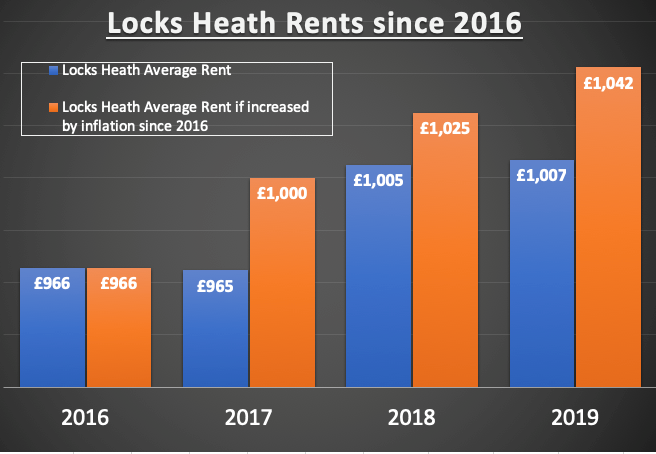
Rents in Locks Heath’s private rental sector increased by 0.19% in the past 12 months

Rents in Locks Heath since 2008 have not kept up with inflation, it is cheaper today in REAL TERMS than it was 11 years ago and some landlords are beginning to realise that fact with our help.

284 Graph

Looking at the last few years, it can be seen that there is still a modest margin to increase rents to maximise your investment (and it can be seen some Locks Heath Landlords have already caught on), yet still protect your tenants by keeping the rents below those ‘real spending power terms’ of the 2008 levels.

Buy to let must be seen as a medium and long-term investment….

Rents in Locks Heath are 4.29% higher than they were 3 years ago and property values are 14.10% higher than Jan 2016

… and for the long term, even with the barriers and challenges that the Government is putting in your way the future couldn’t be brighter if you know what you are doing.

Investment is the key word here…  In the old days, anything with a front door and roof made money – yet now it doesn’t.  Tenants will pay top dollar for the right property but in the right condition.  Do you know where the hot spots are in Locks Heath, whether demand is greater for 2 beds in Locks Heath or 3 beds?  Whether terraced houses offer better ROI than semis?  With all the regulations many Locks Heath Landlords are employing us to guide them by not only managing their properties, taking on the worries of property maintenance, the care of property and their Tenants’ behaviour but also advising them on the future of their portfolio.  We can give you specialist support (with ourselves or people we trust) on the future direction of the portfolio to meet your investment needs (by judging your circumstances and need between capital growth and yields), specialist finance and even put your property empire into a limited company.

If you are reading this and you know someone who is a Locks Heath buy to let Landlord, do them a favour and share this article with them – it could save them a lot of worry, heartache, money and time.

The £1 billion mortgage debt of Locks Heath homeowners

287Irrespective of the shenanigans and political goings on in Westminster recently, the housing market (for the time being anyway) shows a striking resilience, fostered by the on-going wide-ranging monetary policy by the Bank of England. With interest rates and unemployment low, UKplc is heading into 2020 in reasonable condition.  Additionally, despite the UK’s new homes industry improving its year on year new build figures (building 173,660 new homes this year to date – notably 8% more new homes than at the same time last year), there has been an unequal increase in demand for housing, especially in the most thriving areas of the Country.

With the discussion on whether the younger generation can afford to buy, it is true the average cost of a UK property in the early 1970’s was 3.8 times the average salary yet, nationally, it now stands at 8.4 times. On the face of it that doesn’t look good in anyone’s books – yet that isn’t the full story because it doesn’t reflect inflation and interest rates when it comes to the cost of borrowing money in relation to a mortgage for property.

The current level of mortgage interest rates has not been seen for many generations, meaning there are whole cohorts of the Locks Heath home-owning population who have no appreciation of the pandemonium that will eat into their household budgets should we ever return to the average historical cost of borrowing (interest rates jumped to 15% in 1992 – which wasn’t that long ago and between 2003 and 2007 they were on average 4.9%).

Now, once first-time buyers have jumped the hurdle of saving enough for a 5% deposit, which is hard with rents and many carrying loans of personal debt (unsecured loans), first-time buyers are currently spending an average one sixth of their salary on their mortgage, meaning mortgage arrears are at historical lows. However, on the other side of the coin repossessions have started to grow, with 6,180 repossession orders made in the last quarter, a 55% jump from 2017, yet nowhere near the 2009 high of 29,145 in the first quarter of 2009.

Therefore, this week’s discussion on the Locks Heath property market is – where are we with lending (mortgages and unsecured loans) and how is it affecting the Locks Heath, and national, property market?

One vital measure of the property market (and economy) is the mortgage market. If all the mortgages were added up, they would total £968.1bn; a lot when you consider the UK’s GDP is only £2,190.1bn. Mortgages are important as uncertainty causes building societies and banks to curtail lending (remember what happened in the Credit Crunch) and that seriously affects property prices. Then we have unsecured personal loans; interestingly the average Brit owes £991.42 in unsecured loans, a total of £36.1bn.

Lending is the lifeblood of our economy. Go back to 2007, and the phrase ‘Credit Crunch’ hadn’t been invented, yet now the term has entered our everyday language. In the autumn of 2007 it took a couple months before the crunch began to affect the Locks Heath property market, but in early 2008, and for the following year and half, Locks Heath property values dropped each month like a stone.

Mercifully, after a phase of sluggishness, in 2011 the Locks Heath property market started to recover slowly as certitude returned to the economy as a whole and in 2012 Locks Heath property values started to rise as the economy sped upwards. Happily, the Bank of England recognised the start of another boom and bust cycle, so in Spring of 2015, new rules for mortgage lending were introduced and for the following few years we have seen a reappearance to more credible and steady medium-term property price growth.

Locks Heath Property Values are 46.6% higher since the Credit Crunch

And what of the other side of the coin in terms of excess lending in Locks Heath?

Since 1977, the average Bank of England interest rate has been 6.65%, making the current low rate of 0.75% very low indeed. Yet the issue isn’t the amount of lending, as much as the persons ability to pay. Therefore, whether a person’s mortgage is fixed or not is more important than the amount owed.

Thankfully, the proportion of borrowers fixing their mortgage rate has gone from 31.5% in the autumn of 2012 to the current 70.2%. If you haven’t fixed your mortgage – maybe you should follow the majority?

The total cost of mortgages owed by people in Locks Heath is £1,028,077,294

(Based on the SO31 postcode)

In my modest opinion, if things do get a little rocky and uncertainty seeps back in the coming years (and nobody knows what will happen on that front), interest rates can only go one way from their current ultra low level of 0.75% ….and that is why I consider it important to highlight this to all the homeowners and Landlords of Locks Heath. Maybe, just maybe, you might want to consider taking some advice from one of the many qualified mortgage advisors locally?

If you are interested in the Locks Heath Property Market The Locks Heath Property Blog is worth a visit.