Locks Heath Property Market Sees An Unpredicted Autumn Boost of 14%

shuttle-wording

Well, it doesn’t seem like two minutes ago that it was Christmas – and now it’s all over! One cold December afternoon, after arranging the office’s Christmas cards I thought I would nip out to Waitrose to get some lunch.  I met an old client of mine in there and we got talking about the Locks Heath property market.  I had just completed my research for my next blog article and I would like to share with you the parts of the conversation relating to the Locks Heath property market.

He asked me what my thoughts were about the last half of the year in regard to the Locks Heath property market and if there were any great buy to let deals around.  In reply I said that, in my view, shrugging off the uncertainty of the initial post Brexit vote, I have seen an increase in supply and a rise in the number of properties selling at the lower to middle end of the market, meaning both first time buyers and buy to let Landlords have been returning in the last few months – proof the market is beginning to bounce back.

So let’s look at the numbers…

In November 2016, according to the three main property portals (Rightmove, Zoopla and OnTheMarket) there were a total of 335 properties for sale in Locks Heath. In November 2015, there were only 293 properties for sale, a rise of 14%.

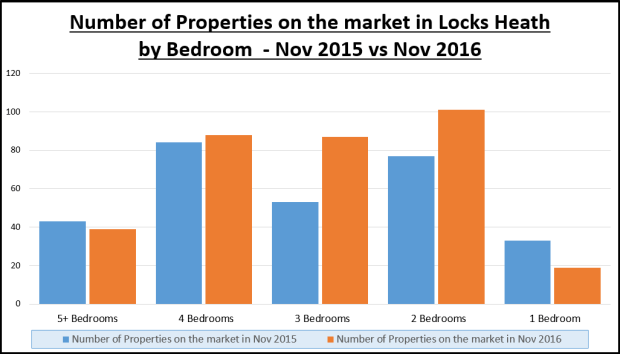
When I split it down into bedrooms (note things like building plots and part commercial/part residential etc won’t be in these figures so the numbers below wont exactly match up to those in the above paragraph).

# Properties on the market in Nov 2015 # Properties on the market in Nov 2016 Percentage Change
5+ Bedrooms 43 39 -9%
4 Bedrooms 84 88 +5%
3 Bedrooms 53 87 +64%
2 Bedrooms 77 101 +31%
1 Bedroom 33 19 -42%

147-graph

… and when I looked at type of properties it got even more interesting…

Type of Property # Properties on the market in Nov 2015 # Properties on the market in Nov 2016 Percentage Change
Detached 139 149 +7%
Semi 37 48 +30%
Terraced 7 27 +286%
Flat 79 76 -4%

As the number of Locks Heath properties put up for sale has risen by 14%, homeowners have become more realistic about how much their homes are worth.  This increase in homeowners wanting to sell suggests there is renewed confidence in the Locks Heath property market and there are also signs that people are being more realistic about pricing their property.

As you can see, there has been a significant uplift in terraced properties, which means they are a great choice for first time buyers and Landlords.  So with a combination of realistic pricing and more properties on the market – both first time buyers and Landlords alike might be able to pick up a few bargains!
Locks Heath property price rises set to be more restrained in 2017 due to Brexit

belt-wordingWhile Brexit has not yet had a sizeable impact on the Locks Heath housing market, my analysis is pointing to the fact that the economic viewpoint still remains uncertain and Locks Heath property price growth is likely to be more subdued in 2017 – although that isn’t a bad thing so let me explain.

Since the summer, apart from a little wobble of uncertainty a few weeks after the Referendum vote, property values (and the economy), on the whole has outperformed what most people were anticipating.  In fact, when I looked at the property prices for our Fareham Borough Council area, these were the results…

146-graph

October 2016               – drop of 1.42%

September 2016         – drop of 0.48%

August 2016                 – rise of 0.47%

July 2016                       – rise of 1.23%

June 2016                      – rise of 1.78%

The UK property market continues to perform robustly (because we can’t just look at Locks Heath as if in its own little bubble) with annual price growth set to end 2016 at 6.91% and the South East region property market at 9.1%.

Talking to fellow agents in London, the significant tidal wave of growth seen from 2013 through to 2015 in the capital has subdued over the last six months.  However, as that central London house price wave has started to ripple out, agents are starting to see stronger property growth values in East Anglia and the South East regions outside of London, than what is being seen within the M25.  So, fellow Locks Heath Landlords and homeowners, is this the time to get your surfboards ready for the London wave?

Well, we in Locks Heath haven’t really been affected by what is happening in the central London property mega bubble (i.e. Kensington, Chelsea, Marylebone, Mayfair etc.).  The property market locally is more driven by sentiment, especially the ‘C’ word… confidence. The main forces for a weaker Locks Heath Property market relate to economic uncertainty surrounding the Brexit process, which I believe will impact unhelpfully on consumer confidence in the run up to and just after the serving of the Section 50 Notice by the end of Q1 2017.

In addition, the influence of reforms to the taxation of Landlords is expected to result in a reduced demand from buy to let Landlords, which will limit upward pressure on property values.  However, on the other side of the coin, demand from Tenants has been strong, but this has been counterbalanced by a strong supply of rental properties.  In my opinion, there is a slight risk of rents not growing as much in 2017 as they did in 2016, but by 2018 they will rise again to counteract Philip Hammond’s changes to Tenant fees.

The broader Locks Heath rental market looks relatively positive with modest rental growth expected and rents might rise further if Landlords begin to sell properties in an effort to offset to the impact of tax rises.

But these predictions do not take into account any effect of a possible snap General Election or further referendum on ratifying any Brexit deal (if that comes to pass in the future).

Locks Heath Property Market – Q4 Update

Santa - Wording.pngWell, hasn’t 2016 been eventful.  The ups and downs of Brexit, the Queen’s 90th, Andy Murray winning Wimbledon, Trump, Bake Off to Channel 4 and something close to the hearts of every buy to let Landlord and homeowner in Locks Heath … the Locks Heath property market.
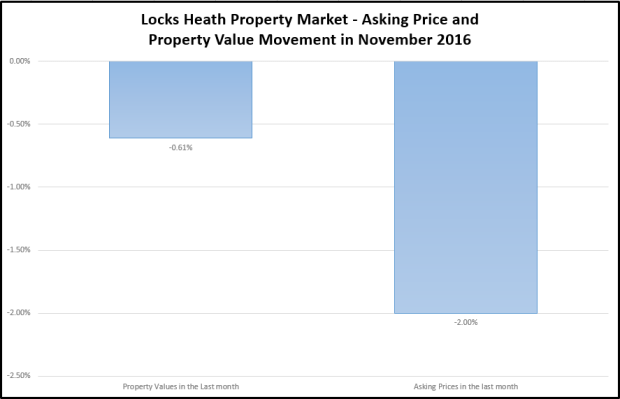
So, let’s look at the headlines for the Locks Heath property market…

144-graph

In the last month, Locks Heath property values dropped by 0.61%, leaving them, year on year 10.1% higher, whilst interestingly, Locks Heath asking prices are down 2.0% month on month.  All three statistics go to show the Locks Heath property market has recovered well after the summer lull, which was worsened by the uncertainty surrounding the EU vote back in June.  Irrespective of all the issues, the average value of a Locks Heath home now stands at £344,700.

Generally, Locks Heath asking prices continue to hold up well, as asking prices are 4.7% higher year on year.  At this time of year, asking prices tend to drop on the run up to Christmas, and locally they dropped by 2.0% in November 2016, although this still compares well with last year’s drop in Locks Heath asking prices, as we saw asking prices drop by 1.1% in November 2015.

It is also interesting to take note from a recent survey by the Royal Institution of Chartered Surveyors, stating new buyer enquiries and new instructions are falling at the same rate, suggesting that there will not be a downward pressure on property values.

Looking at the figures for the UK (as we can’t just look at Locks Heath in isolation), property values are generally rising slower than a few years ago, but on a positive note, there is still growth across the UK.  You see, slowing property value growth isn’t solely Brexit related, but after a number years of double digit rises in property values, affordability has weakened and cooling price growth is widely seen to be a natural correction of the market.

On the other hand, interest rates being at a record low of 0.25% are helping the property market.  The cut in interest rates in the late summer was the medicine for the post-Brexit worry and will, as a consequence, ensure that the UK economy continues to be underpinned by buoyant property prices.

So, what will happen in 2017 in the Locks Heath property market?

Some say until we know what type of exit the UK will make from the EU it is hard to evaluate the outcome.  Although, I believe, the whole Brexit issue is a sideshow to the main issue in the UK (and Locks Heath) housing market as a whole.  As I have mentioned time and time again over the last few months, the biggest issue is demand outstripping supply when it comes to the number of households required to house us all.  Locks Heath has an ever-growing population: with immigration (we still have at least two years of free movement from EU members into the UK), people living longer and the fact we need thousands of additional households as the country has nearly 115,000 divorces a year (where one household becomes two households).  These are interesting times ahead!

£10m paid in Stamp Duty by Locks Heath Residents

paid-wordingApart from some minor exemptions, Stamp Duty is paid by anyone buying a property over £125,000 in the UK.  It presently raises £10.68bn a year for the HM Treasury (interesting when compared with £27.6bn in fuel duty, £10.69bn in alcohol duty and £9.48bn in tobacco duty).
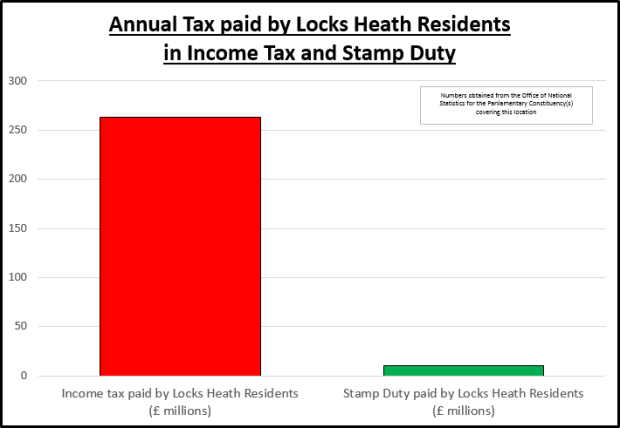
In the latest set of data from HMRC, in the MP constituency that covers Locks Heath, property buyers paid £10m stamp duty in one year alone – a lot of money in anyone’s eyes (although not as much as the £263m in income tax that all of us in the same area paid last year).

141-graph

However, as you may know, George Osborne introduced an additional tax for landlords and from 1st April 2016 they had to pay an additional 3% stamp duty surcharge on top of the normal stamp duty rate when purchasing a buy to let property.  There were tales of woe and Armageddon with a report by Deutsche Bank suggesting that the new surcharge could see house prices fall by as much as 20%.

HMRC data released in the Summer for Quarter 2 (Q2) of 2016 did seem to back up those fears as they published some worrying figures; only one in seven properties purchased was a second home or buy-to-let (in real numbers, only 30,300 of the 207,900 properties in Q2 were bought by Landlords).

In previous articles, I spoke about the slump of property transactions after the 1st of April (as Landlords rushed through their property purchases in March to beat the April deadline).  In Q2 of 2016, £1.976bn was raised in Stamp Duty from Residential Property.  Of that £1.976bn, £652m was paid by buy to let Landlords (£424m in normal stamp duty and £228m in the additional 3% surcharge).

However, looking at Q3, the numbers have improved significantly.  Of the 235,000 property sales, nearly one in four of them (56,100 to be precise) were bought by buy to let Landlords and of the £2.208bn in stamp duty, £864m was paid in ‘normal’ stamp duty by BTL Landlords and an impressive £442m paid by those same Landlords in the additional stamp duty surcharge.

The statistics suggest buy to let investors have thankfully not been deterred by the stamp duty surcharge introduced in April this year.  The figures also show that 65.4% of “buy to let” purchases cost less than £250,000, 23.7% of properties were in the £250k to £500k range and 10.9% (or 6,100 additional properties) of buy to let properties bought cost over £500k – interestingly nearly one in four (22.2%) of £500k properties purchased in Q3 were buy to let properties.

It just goes to back up what I stated a few weeks ago when I suggested that many investors had rushed to make purchases before 31st March, making figures in the following months (Q2) artificially low when the 3% supplement was introduced, but in Q3 the number of buy to let properties purchased increased by 85%.

It just goes to show you shouldn’t believe everything you read in the newspapers! I can assure you the Locks Heath property market is doing just fine.  For more thoughts on the Locks Heath Property Market like this visit the Locks Heath Property Blog.

Locks Heath First Time Buyers Are Paying 12.9% More Than 12 Months Ago

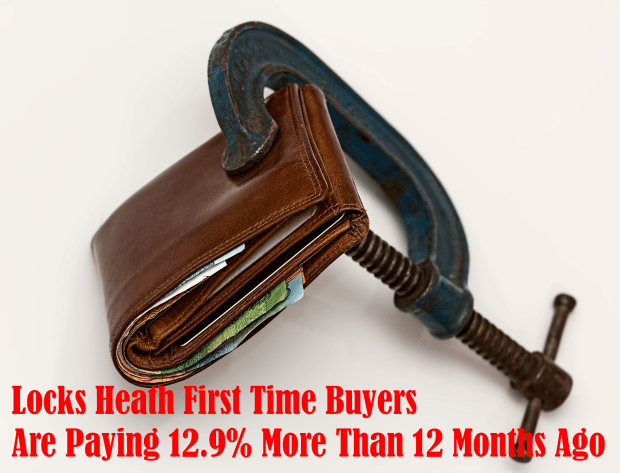
wallet-clamp-wordingFigures just released by the Bank of England, show that for the first half of 2016, £128.73bn was lent by UK banks to buy UK property – impressive when you consider only £106.7bn was lent in the first half of 2015.  Even more interesting, was that most of the difference was in Q2, as £68.12bn was lent by UK banks in new mortgages for house purchases, which is the highest it has been for two years.  Looking locally, in Locks Heath last quarter, £939.9m was loaned on SO31 properties alone!
Even though the Bank won’t be releasing the Q3 figures until December 2016, as I discussed a few weeks ago, HMRC have published their own preliminary data to suggest Q3 will be even better, with a massive growth of buy-to-let landlords to the housing market in that time frame.  Fascinating, as it seems to fly in the face of the popular narrative – that the uncertainty surrounding Brexit would negatively impact buyer sentiment.

And it’s not just buy-to-let Landlords that seem to be flourishing.  I am finding that first-time buyers are also a lot more confident too.  Low, and now negative, inflation has had a tangible impact on household finances and first-time buyers feel more secure in their jobs. Couple with a low interest rate environment and you have all the ingredients for a strengthening property market.  To back that up with numbers, of the £68.12bn of mortgages lent in the Quarter (Q2), £14.9bn was lent to first-time buyers (the highest proportion of that overall lending for over two years at 21.99%).

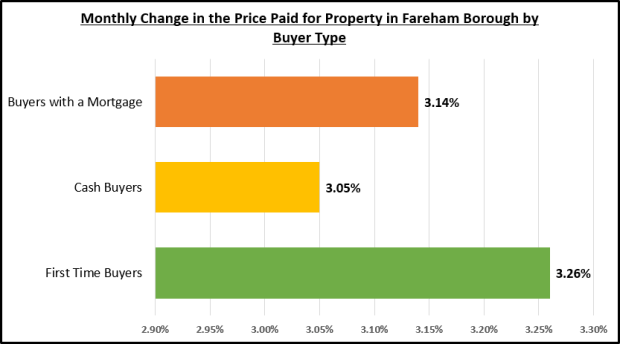
When I looked at the data for Fareham Borough Council area, the average price paid by first-time buyers (FTB’S) was £218,832, which is a rise of 3.26% from last month and a rise of 12.91% from twelve months ago.  The Land Registry then categorise the remaining buyers into cash buyers or those buying with a mortgage.  The average price paid by cash buyers was £254,319, a rise of 3.05% from last month and a rise of 12.62% from twelve months ago, whilst buyers with mortgages (but not FTB’s), the average price paid by them was £284,969, a rise of 3.14% from last month and a rise of 12.82% from twelve months ago.

142-graph

What surprised me with these figures was how close the property prices, values and percentages were to each other.  It just goes to show the combination of low mortgage rates and a stable job market will continue to have a positive effect on the Locks Heath and UK market.  And that is why, while there is undoubtedly more cautiousness in the market at present than a year or so ago (among borrowers and mortgage companies alike) – mortgage rates are so competitive that they are inducing people to commit to a home purchase.

It seems the great Brexit uncertainty was over hyped, and house price growth as well as mortgage approvals, could pick up pace into 2017.

Locks Heath Housing Crisis? Only 2.31% of Locks Heath Homes Are For Sale

panic-wordingThe Locks Heath Property Market continues to disregard the end of the world prophecies of a post Brexit fallout with a return to business as usual after the summer break.
The challenge every Locks Heath property buyer has faced over the last few years is a lack of choice – there simply hasn’t been much to choose from when buying (be it for investment or owner occupation). Levels are still well down on what would be considered healthy levels from earlier in this decade, as there is still a substantial demand/supply imbalance. Until we start to see consistent and steady increases in properties coming on to the market in Locks Heath, the market is likely to see upward pressure on property values continue.

However, there may be hope for first time buyers, with homeowners looking to move upmarket and buy to let Landlords looking for their next investment, the Locks Heath property supply crisis just might be starting to ease, as the number of new properties coming onto the market in Locks Heath has increased.

For example, in the last month or so, SO31 has seen an average of 128 new properties coming on to the market.  Not bad when you consider for some months in the last year the average has been in low 80’s. With the average Locks Heath property value hitting a record high, reaching almost £334,700 according to my research, this shortage of properties on the market over the last two years has contributed to this ‘fuller’ average property figure, but there is a glimmer of hope that the Locks Heath’s supply crisis may be starting to ease.

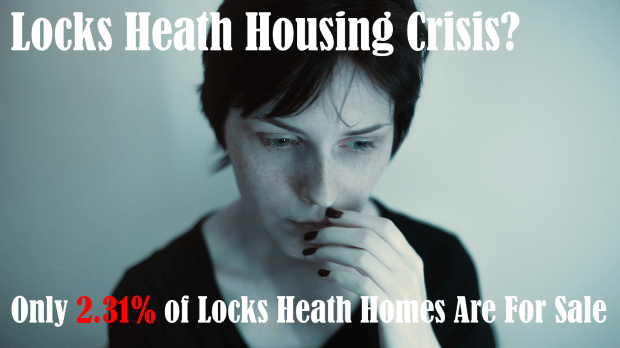
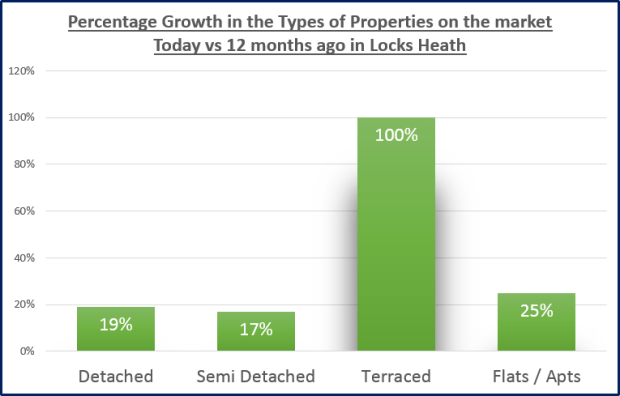
As I write this article, 2.31% of Locks Heath (or SO31 to be exact) properties are up for sale. In terms of actual chimney pots, that equates to 370 properties on the market in Locks Heath – which, when compared to only a year ago when that figure stood at 310, is a steady increase in the number of properties available to buy. Split down into the type of property, it makes even more fascinating reading…

  • Detached Properties in SO31 – 138 on the market a year ago compared to 164 on the market now – an increase of 19%
  • Semi Detached Properties in SO31 – 46 on the market a year ago compared to 54 on the market now – an increase of 17%
  • Terraced Properties in SO31 – 11 on the market a year ago compared to 22 on the market now – an increase of 100%
  • Flats / Apartments Properties in SO31 – 71 on the market a year ago compared to 89 on the market now – an increase of 25%

138-graph

This is evidence of strength in the Locks Heath housing market that many didn’t expect. Many believed that the Locks Heath property market wasn’t going to be strong enough post Brexit – as what was a sellers’ market before the Brexit vote and Buyers’ market in the early months after it, may now be somewhere in between and the market might just be coming back into balance.

However, all this will mean property values won’t continue to grow at the same extent they have been over the last 12 to 18 months, and in some months (especially on the run up to Christmas and early in the New Year), values might dip slightly. This won’t be down to Brexit but a re-balancing of the Locks Heath Property Market – which is good news for everyone.

For more thoughts on the Locks Heath Property Market, please visit the The Locks Heath Property Blog

Average Rent Paid by Tenants in Locks Heath rise to £1,206 per month

balloon-wordingBack in the Spring there was a surge in Locks Heath Landlords buying buy to let property in Locks Heath as they tried to beat George Osborne’s new stamp duty changes which kicked in on the 1st April 2016.  To give you an idea of the sort of numbers we are talking about, below are the property statistics for sales either side of the deadline in SO31.
Jan 2016 – 59 properties sold

Feb 2016 – 54 properties sold

March 2016 – 115 properties sold

April 2016 – 33 properties sold

May 2016 – 52 properties sold

Normally, the number of sales in the Spring months is very similar, irrespective of the month.  However, as you can see, this year was a completely different picture as Landlords moved their purchases forward to beat the stamp duty increase.  You would think that even with a basic knowledge of supply and demand economics, rents would be affected in a downwards direction?

However, there appears to be no apparent effect on the levels of rent being asked in Locks Heath, and more importantly achieved, and this direction of rents is not likely to reverse any time soon.  Particularly as legislation planned for 2017 might reduce rental stock and push property values ever upward.  The decline of buy to let mortgage interest tax relief will make some properties lossmaking, forcing Landlords to pass on costs to Tenants in the form of higher rents just to stay afloat.  Even those who can still operate may be deterred from making further investments, reducing rental stock at a time of severe property shortage.

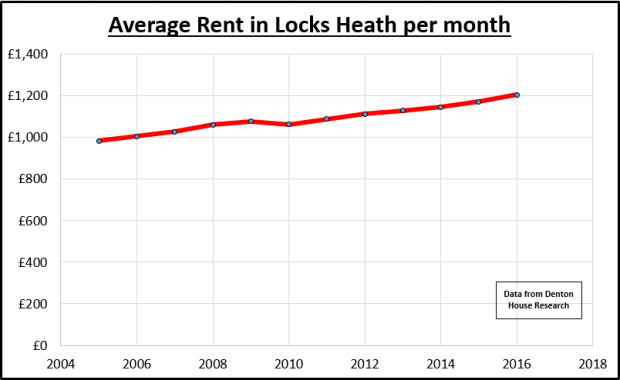
… But it’s not all bad news for Tenants. Whilst average rents in Locks Heath since 2005 have increased by 22.6%, inflation has been 38.5% over the same time frame, meaning Locks Heath Tenants are 15.9% better off in real terms when it comes to their rent (which is a sizeable chunk of most people’s monthly household budgets).

Year Average Rent in Locks Heath per month
2005 983
2006 1006
2007 1028
2008 1062
2009 1078
2010 1064
2011 1089
2012 1114
2013 1130
2014 1147
2015 1173
2016 1206

140-graph

I found it particularly interesting looking at the rent rises over the last five years in Locks Heath, as it was five years ago we started to see the very early green shoots of growth of the Locks Heath economy.  As a whole, following the Credit crunch (2011), rents in Locks Heath have risen by an average of 2.4% a year – fascinating don’t you think?

The view I am trying to portray is that while renting is often portrayed as the unfavorable alternative to home ownership, many young Locks Heath professionals like renting as it gives them adaptability with their life.  Rents will continue to rise which is good news for Landlords as buy to let is an investment but, as can be seen from the statistics, Tenants have also had a good deal with below-inflation increases in rents in the past.  It’s a win-win situation for everyone although, on another note, it’s imperative in the future that Tenants are not thwarted from saving for a deposit by excessive rental hikes – there has to be a balance.

For more thoughts and opinions on the Locks Heath Property Market, if you are a Locks Heath Homeowner or Locks Heath Landlord, please visit the The Locks Heath Property Blog.

Private Renting Set To Grow By 1,000 Locks Heath Households By 2025

forest-wordingI was having an interesting chat the other day with a Locks Heath landlord. We got talking about the Locks Heath Property Market and this landlord brought up the subject of a report he had read from the Royal Institution of Chartered Surveyors (RICS) and PricewaterhouseCoopers (PwC) that stated that almost 1.8m new rental homes are needed by 2025 to keep up with current demand from tenants. He wanted to know what this meant for Locks Heath.
Well my blog reading friends, some commentators said last Winter that buy to let was about to die, what with the new stamp duty changes and how mortgage tax relief will be calculated.  Others even said 500,000 rental properties would flood the market nationally in the 12 months after the new Stamp Duty rules came into force on the 1st April 2016 as landlords left the rental market.  Well, all I can say is, I wish all the landlords of those half a million properties would hurry up and put them on the market – because I have plenty of other potential landlords wanting to buy them!

Back to the matter in hand; If the RICS and PwC are indeed correct, what does this mean for Locks Heath?  The fact is, as a country, we are facing a precarious rental shortage and need to get Locks Heath building in a way that benefits a cross-section of Locks Heath society, not just the fortunate few.  I call on the Prime Minister to drop the higher stamp duty tax on buy to let purchases to ease the pressure on the rental market.

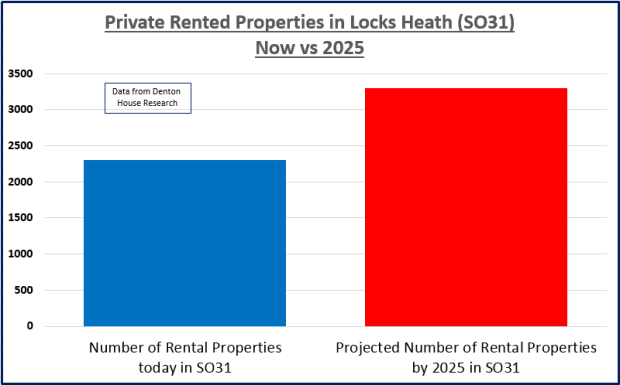
Of the 18,600 households in Locks Heath (SO31), currently 5,100 tenants live in 2,300 private rented properties.  If we apportion those 1.8m households equally around the Country, that means in nine years’ time, the number of rental properties in Locks Heath needs to rise by 1,000 (i.e. 42.8%)… taking the total number of rented properties in the area to 3,300.

137-graph

That means Locks Heath landlords need to buy around 100 properties a year between now and 2025 to meet that demand.  Because according to my calculations, an additional 2,200 people will want to live in all those ‘additional’ Locks Heath rental properties – so why is the government penalising landlords?

Thankfully the new housing minister Gavin Barwell detached Teresa May’s new administration from the Cameron/Osborne laser-like focus of just home ownership to solve our housing issues, saying “we need to build more homes for every single type of person needing a home and not focus on one single tenure”.  The private rented sector became a stooge under David Cameron’s watch and still, with increasingly unaffordable Locks Heath house prices, the majority of new Locks Heath households will be relying on the rental sector in the future to house them.  I can only say Westminster must put in place the measures that will allow the rental sector to flourish.  Any restrictions on the supply of rental property will push up rents (bad news for tenants), thus side-lining those members of Locks Heath society who are already struggling.  Let’s hope this new Government continues to see the contribution landlords give to the country as a whole.

As I am sure you are aware, I am always happy to cast my eye over any potential buy to let purchase in Locks Heath or surrounding areas, be that you emailing me a Rightmove link, a brochure in the post or even treading the carpet and seeing it together.  I don’t charge for that, and you don’t even need to be a client of mine.

What will the 0.25% Interest Rate do to the Locks Heath Property Market?

question-child-wordingI had an interesting chat with a Warsash landlord who owns a few properties in the area this week – He popped his head in to my office whilst he was in Park Gate on some errands. We had never spoken before (because he uses another agent in the suburb to manage his Locks Heath properties) yet, after reading my blog on the Locks Heath Property Market for a while, the landlord wanted to know my thoughts on how the recent interest rate cut would affect the Locks Heath property market.  I would also like to share these thoughts with you…
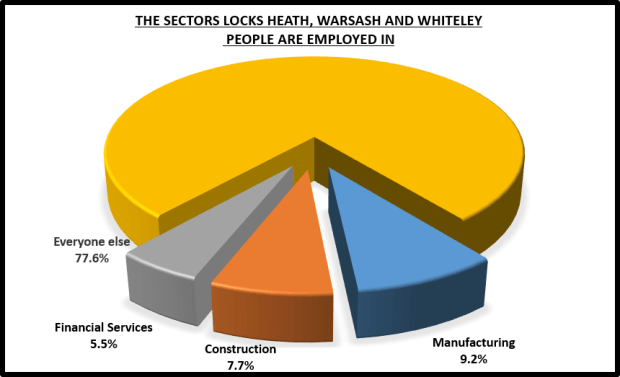
Well it’s been a few weeks now since interest rates were cut to 0.25% by the Bank of England as the Bank believed Brexit could lead to a materially lower path of growth for the UK, especially for the manufacturing and construction industries.  You see for the country as a whole, the manufacturing and construction industries are still performing well below the pre credit crunch levels of 2008/09, so the British economy remains highly susceptible to an economic shock.  This is especially important in Locks Heath, because even though we have had a number of local success stories in manufacturing and construction, a large number of people are employed in these sectors.  In Locks Heath, Warsash and Whiteley, of the 23,360 people who have a job, 2,145 are in the manufacturing industry and 1,803 in Construction meaning…

9.2% of Locks Heath, Warsash and Whiteley workers are employed in the Manufacturing sector and 7.7% of workers are in Construction.

The other sector of the economy the Bank is worried about, and an equally important one to the Locks Heath economy, is the Financial Services industry.  Financial Services in Locks Heath, Warsash and Whiteley employ 1,289 people, making up 5.5% of the working population.

130-graph

Together with a cut in interest rates, the Bank also announced an increase in the quantity of money via a new programme of Quantitative Easing to buy £70bn of Government and Private bonds.  Now that won’t do much to the Locks Heath property market directly, but another measure also included in the recent announcement was £100bn of new funding to banks.  This extra £100bn will help the High St banks pass on the base rate cut to people and businesses, meaning the banks will have lots of cheap money to lend for mortgages.  This should have a huge effect on the Locks Heath property market (as that £100bn would be enough to buy half a million homes in the UK).

It will take until early in the New Year to find out the real direction of the Locks Heath property market and the effects of Brexit on the economy as a whole, the subsequent recent interest rate cuts and the availability of cheap mortgages.  However, something bigger than Brexit and interest rates is the inherent undersupply of housing (something I have spoken about many times in my blog and the specific affect on Locks Heath).  The severe under-supply means that Locks Heath property prices are likely to increase further in the medium to long term, even if there is a dip in the short term.  This only confirms what every homeowner and landlord has known for decades – investing in property is a long term project and as an investment vehicle, it will continue to outstrip other forms of investment due to the high demand for a roof over people’s heads and the low supply of new properties being built.

For more thoughts on the Locks Heath Property Market, please visit the Locks Heath Property Blog www.thelocksheathpropertyblog.co.uk.

942% Rise in Locks Heath Property Prices Since 1981

rocket-wordingRoll the clock back 35 years to 1981, and Mrs. Thatcher was in power, we had a Royal Wedding, Britain won the Ashes and Bucks Fizz won Eurovision with ‘Making your Mind up’.   Haven’t things changed?  The number of homeowners and property investors who said they wish they had hindsight and bought up every house in Locks Heath all those years ago, especially when you consider what has happened to Locks Heath property values, as…
Locks Heath Property Values since 1981 have risen by 942%.

Not bad when you consider inflation over the same time period has been 271.9%, meaning in real terms (i.e. after inflation), property values in Locks Heath are 670.1% higher.   It’s no wonder people can’t afford to buy property anymore and Landlords are attracted by bricks and mortar.  Yet the changes to the Locks Heath property market run much deeper than property value changes as no one could have predicted how the property market has changed in Locks Heath over the last 30 years.

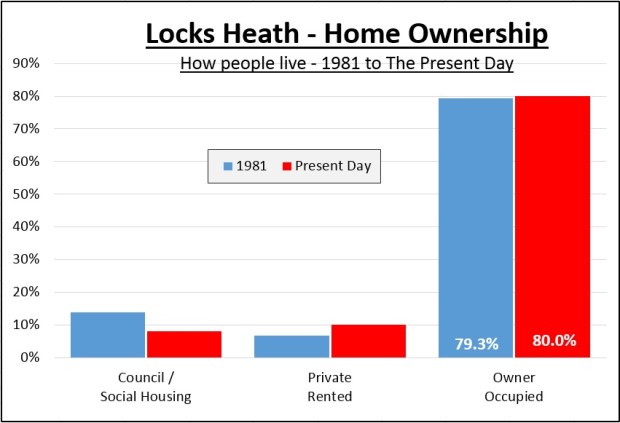
Looking at the Local Authority data for Fareham Borough Council in 1981, 13.8% of Locks Heath people lived in a Council House, whilst today its 8.1%… a drop which can mostly be attributed to Margaret Thatcher allowing Council tenants the right to buy their Council House.  The private rental sector since 1981 has, as one would have expected, also changed.  The proportion of properties privately rented in the Locks Heath area (i.e. through a private Landlord or a Letting Agency) has almost doubled, rising from 6.8% to 10% of property.

So, let us consider those people who own their own home, surely that has had a massive drop?  In 1981, the proportion of people who lived in the Fareham Borough Council area who owned their own home was 79.3% … and today its … 80%. Not the seismic change most of you were expecting (including myself!).

131-graph

Homeownership in the 1980’s and 1990’s in Locks Heath did in fact rise, but as I have discussed in previous articles in the ‘Locks Heath Property Blog’, that was because nearly every Council tenant was buying their council house. Now there are hardly any Council houses for the younger generation to move into (because of the right to buy scheme) so they have no choice but to privately rent.

… and this is why the buy to let market in Locks Heath is an investment sector that will continue to grow as councils aren’t building council houses in their thousands each year (like they were in the 1950’s/60’s and 70’s).  The Locks Heath property market is constantly changing and buy to let for too long has been heavily dependent on house price growth, where yield has been almost forgotten.  I see the changes in tax and Landlord and Tenant law in a different perspective to the sooth-sayers and see it as bringing many opportunities where yield will become more important.  You might need to change your buy to let targets, your methodology to financing or even consider places other than Locks Heath in which to invest your money.  But this will shine a light on investing in properties with healthier yields and create more realistic long term buy to let opportunities, instead of short term growth bets and wagers.

Like Bucks Fizz said in their song, it’s time to make your mind up. The advice I give to my landlords, and also to you my blog reading friends is this; these changes will make some landlords panic, meaning competition for decent Locks Heath buy to let bargains will reduce as fear of change kicks in and amateur investors flee the market.  These opportunities will provide a more stable platform for knowledgeable and wise Locks Heath buy to let Landlords to thrive in.

If you want to learn more about the Locks Heath Property Market, feel free to pop in for a coffee at our office for a chat with me, or failing that, visit the Locks Heath Property Blog, where you will find many more articles like this solely on the one topic of the Property Market in Locks Heath www.thelocksheathpropertyblog.co.uk.