

Additional 985 Locks Heath Rented Homes Required by 2027

223I have been doing some research, looking both at National and Regional reports on the demand and supply of property and people together with future projections on the economy, population and family demographics with some interesting results.  According to the Office of National Statistics, in the last financial year nationally, private renting grew by 74,000 households, whilst the owner occupied dwelling stock increased by 101,000 and social (aka council and housing association) stock increased by 12,000 dwellings.

It was the private rental figures that caught my eye.  With eight or nine years of recovery since the Credit Crunch, economic recovery and continuing low interest rates have done little to setback the mounting need for rented housing.  In fact, with house price inflation pushing upwards much quicker than wage growth, this has made owning one’s home even more out of reach for many Millennials. All this at a time when the number of council/social housing has shrunk by just over 2.5% since 2003, making more households move into private renting.

There are 5,151 people living in 2,299 privately rented properties in Locks Heath.

In the next nine years, looking at the future population growth statistics for the Locks Heath area and making careful and moderate calculations of what proportion of those extra people due to live in Locks Heath will rent as opposed to buy, in the next ten years, 2,208 people (adults and children combined) will require a private rented property to live in.

Therefore, the number of Private Rented homes in Locks Heath will need to rise by 985 households over the next nine years.

That’s 109 additional Locks Heath properties per year that will need to be bought by Locks Heath Landlords, for the next nine years to meet that demand.

… and remember, I am being conservative with those calculations, as demand for privately rented homes in Locks Heath could still rise more abruptly than I have predicted and I would ask if Theresa May’s policies of building 400,000 affordable homes (which would syphon in this 5-year Parliamentary term) is rather optimistic, if not fanciful?

So, one has to wonder if it was wise to introduce a buy to let stamp duty surcharge of 3% and the constraint on mortgage tax relief could curtail and hold back the ability of private Landlords to expand their portfolios?

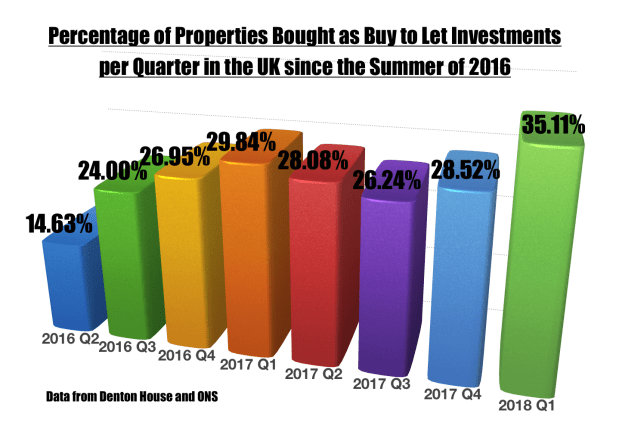
Well a lot of Landlords are taking on these new hurdles to buy to let and working smarter.  Buying the property at the right price and using an agent to negotiate on your behalf (we do this all the time)… and the 3% stamp duty level isn’t an issue.  Incorporating your property portfolio into a Limited Company is also a way to circumnavigate the issues of mortgage tax relief (although there are other hurdles that need to be navigated on that tack), but just look at the growth of the proportion of Buy to Let properties in the Country since the Summer of 2016… something tells me smart Landlords are seeing these challenges as just that… challenges which can be overcome by working smarter.
223 Graph

I have a steady stream of Locks Heath Landlords every week asking me my opinion on the future of the Locks Heath property market and their individual future strategy and, whether you are a Landlord of mine or not, if you ever want to send me an email or pop into my office to chat on how you could navigate these new Buy to Let waters… it will be good to speak to you (because you wouldn’t want other landlords to have an advantage over you – would you?).

Locks Heath Property Values 3.1% higher than year ago – What’s the PLAN to fix the Locks Heath Property Market?

220It’s been nearly 18 months since Sajid Javid, the Tory Government’s Housing Minister published the White Paper “Fixing the Broken UK Housing Market”, meanwhile Locks Heath property values continue to rise at 3.1% (year on year for the council area) and the number of new homes being constructed locally bumps along at a snail’s pace, creating a potential perfect storm for those looking to buy and sell.

The White Paper is important for the UK and Locks Heath people, as it will ensure we have long-term stability and longevity in the property market as whole.  Locks Heath homeowners and Locks Heath Landlords need to be aware of these issues in the report to ensure they don’t lose out and ensure the local housing market is fit for purpose.  The White Paper wanted more homes to be built in the next couple of decades, so it might seem counter-intuitive for existing home-owners and landlords to encourage more homes to be built and a change in the direction of housing provision – as this would appear to have a negative effect on their own property.

Yet the country needs a diversified and fluid property market to allow the economy as a whole to grow and flourish… which in turn will be a greater influence on whether prices go up or down in the long term.  I am sure every homeowner or Landlord in Locks Heath doesn’t want another housing crisis like we had in 1974, 1988 and most recently in 2008.

Now, as Sajid Javid has moved on to the Home Secretary role, the 17th Housing Minister in 20 years (poisoned chalice or journeyman’s cabinet post) James Brokenshire has been given the task of making this White Paper come alive.  The White Paper had a well-defined notion of what the issues were.

The first of the four points brought up was to give local authorities powers to speed up house building and ensure developers complete new homes on time.  Secondly, statutory methods demanding local authorities and builders build at higher densities (i.e. more houses per hectare) where appropriate.  The other two points were incentives for smaller builders to take a larger share of the new homes market and help for people renting.

However, lets go back to the two initial points of planning and density.

1. Planning

For planning to work, we need a robust Planning Dept. Looking at data from the Local Government’s Association, in Fareham, the council is below the regional average, only spending £28.84 per person for the Planning Authority, compared the regional average of £38.14 per head – which will mean the planning department will be hard pressed to meet those targets.

220 Graph 1

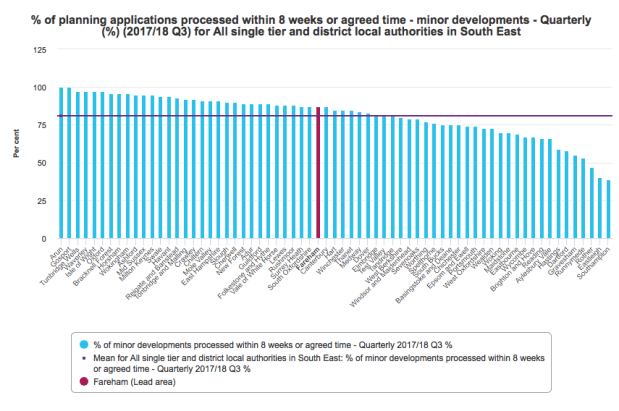
However, 87% of planning applications are decided within the statutory 8-week initial period, above the regional average of 81% (see the graph below).  I am slightly disappointed and also pleased with the numbers for our local authority when it comes to the planning and the budget allowed by our Politician to this vital service.

220 Graph 2

2. Density of Population

15 people live in every hectare (or 2.471 acres) in Fareham

It won’t surprise you that 110,929 of 111,581 Fareham residents live in the urban conurbations of the authority, giving a density of 18.1 people per hectare (again – much lower than I initially thought), whilst the villages have a density of 0.5 people per hectare.

I would agree with the Governments’ ambition to make more efficient use of land and avoid building homes at low densities where there is a shortage of land for meeting identified housing needs, ensuring that the density and form of development reflect the character, accessibility and infrastructure.

It’s all very good building lots of houses – but we need the infrastructure to go with it.

Talking to a lot of Locks Heath people, their biggest fear of all this building is a lack of infrastructure for those extra houses (the extra roads, doctors surgeries, schools etc.).  I know most Locks Heath homeowners and Landlords want more houses to be built to house their family and friends… but irrespective of the density… it’s the infrastructure that goes with the housing that is just as important… and this is where I think the White Paper failed to go as far as I feel it should have done.

Interesting times ahead I believe!

Nearly Four Babies Born for Every New Home Built in the Past Five Years in Fareham

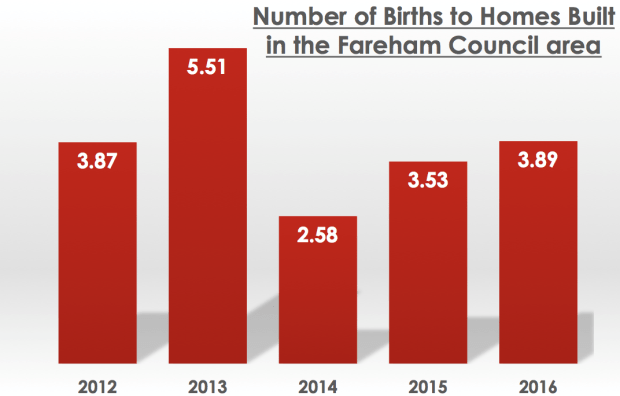
219Nearly 4 babies have been born for every new home that has been built in Fareham since 2012, deepening the Locks Heath housing shortage.

This discovery is an important foundation for my concerns about the future of the Locks Heath property market – when you consider the battle that today’s twenty and thirty somethings face in order to buy their first home and get on the Locks Heath property ladder.  This is particularly ironic as these Locks Heath youngsters’ are being born in an age when the number of new babies born to new homes was far lower.

This will mean the babies being born now, who will become the next generation’s first-time buyers will come up against even bigger competition from a greater number of their peers unless we move to long term fixes to the housing market, instead of the short term fixes that successive Governments have done since the 1980’s.

Looking at the most up to date data for the area covered by Fareham Council, the numbers of properties-built versus the number of babies born together with the corresponding ratio of the two metrics …

219 Graph 1

219 Graph 2

It can be seen that in 2016, 3.89 babies had been born in Fareham for every home that had been built in the five years to the end of 2016 (the most up to date data).  Interestingly, that ratio nationally was 2.9 babies to every home built in the ‘50s and 2.4 in the ‘70s.  I have seen the unaudited 2017 statistics and the picture isn’t any better! (I will share those when they are released later in the year).

Our children, and their children, will be placed in an unprecedented and unbelievably difficult position when wanting to buy their first home unless decisive action is taken. You see it doesn’t help that with life expectancy growing year on year, this too is also placing excessive pressure on homes to live in availability, with normal population growth nationally (the number of babies born less the number of people passing away) accumulative by two people for every one home that was built since the start of this decade.

Owning one’s home is a measure many Brits to aspire to.  The only long-term measure that will help is the building of more new homes on a scale not seen since the 50’s and 60’s, which means we would need to aim to at least double the number of homes we build annually.

In the meantime, what does this mean for Locks Heath Landlords and Homeowners? Well the demand for rental properties in Locks Heath in the short term will remain high and until the rate of building grows substantially, this means rents will remain strong and correspondingly, property values will remain robust.

How Affordable is Property for Locks Heath’s Average Working Families?

218The simple fact is we are not building enough properties.  If the supply of new properties is limited and demand continues to soar with heightened divorce rates, i.e. one household becoming two, people living longer and continued immigration, this means the values of those existing properties continues to remain high and out of reach for a lot of people, especially the blue collar working families of Locks Heath.
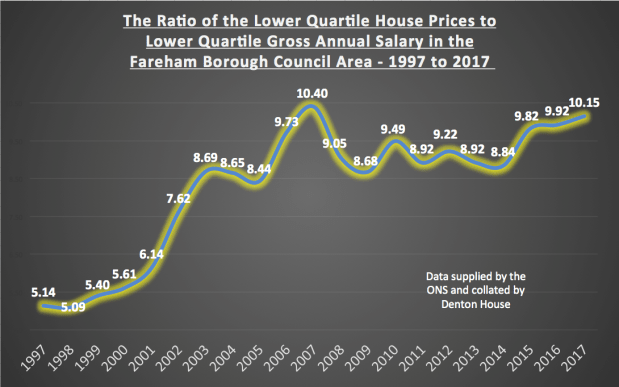
Looking at some recent statistics released by the Government, the ratio of the lower quartile house prices to lower quartile gross annual salaries in Fareham Borough Council has hit 10.15 to 1.

What does that mean exactly and why does it matter to Locks Heath landlords and homeowners?

If we ordered every property in the Fareham Borough Council area by the value of those properties, the average value of the lower quartile properties (i.e. lowest 25%) would be £222,000. If we then did the same, and ordered everyone’s salary in the same council area, the average of the lowest quartile (lowest 25%), the average salary of the lowest 25% is £21,879 pa, therefore dividing one with the other, we get the ratio of 10.15 to 1.

Assuming there is one wage earner in the house, the chances of a Locks Heath working family being able to afford to buy their own home, when it’s over ten times their annual salary, is very slim indeed.  The existing affordability crisis of people wanting to buy their own home is the unavoidable outcome of the decade on decade failure to build enough homes to keep up with demand. Nevertheless, improving affordability is not a case of just constructing more homes.  Fareham Borough Council needs to ensure more properties are not only built, but built in the right locations and of the right type and at the right price to ensure the needs of these lower income working families are met.  Because at the moment they presently have few options apart from the private rental sector.

Looking at the historic nature of the ratio, it can clearly be seen in the graph below that this has been an issue since the early to mid 2000’s.

218 Graph

However, if we look at the historic data, those on the bottom rung of the ladder (those in the lower quartile of wage earners) used to be housed by the local authority instead of buying.  However, the vast majority of council houses were sold off in the 1980’s, meaning there are much fewer council houses today to house this generation.

Many of the lower quartile working class families were given a lifeline to buy their own homes in middle 2000’s, with 100% mortgages, but the with the credit crunch in 2009, that rug (of 100% mortgages) was rudely pulled from under their feet.  You see it is cheaper to buy than rent… it’s the finding of the 5% deposit that is the challenging issue for these Locks Heath working class families. So unless the Government allow 100% mortgages back, the fact is, demand for rental properties will outstrip supply.

However all this means is demand for rental properties will continue to grow, keeping Locks Heath house prices high and Locks Heath rents high.

The Top 30 Most Saleable Streets in SO31, PO14 & PO15 – Number 26

We are continuing our countdown the Top 30 Most Saleable Streets in SO31, PO14 & PO15.

Here we are at Number 26 on the list – Is it your street this week?

For more articles about the local property market please visit the Locks Heath Property Blog at http://www.thelocksheathpropertyblog.co.uk.

Music:
Say Good Night by Joakim Karud https://soundcloud.com/joakimkarud
Creative Commons — Attribution-ShareAlike 3.0 Unported— CC BY-SA 3.0 http://creativecommons.org/licenses/b…
Music promoted by Audio Library https://youtu.be/SZkVShypKgM

Locks Heath Property Market Worth More Than Marks and Spencer Group

210The value of all the homes in Locks Heath has risen by more than 247% in the past two decades, to £5.267bn, meaning its worth more than the stock listed company Marks and Spencer Group, which is worth £4.874bn.

Those Locks Heath homeowners and Buy-to-Let landlords who bought their homes twenty or more years ago have come out on top, adding thousands and thousands of pounds to the value of their own Locks Heath homes as the younger generation in Locks Heath continue to be priced out of the market.  This is even more remarkable because, in those twenty years, we had the years of 2008 and 2009 following the global financial crisis, where we saw a short term drop in Locks Heath house prices of between 15% and 20% (depending on the type of property).  And although there have been a number of consecutive years of growth in property values recently in Locks Heath it hasn’t been anywhere near the levels seen in the early 2000’s.

Twenty years ago, the total value of Locks Heath property was worth £1.514bn.  Over those twenty years total property values have increased by £3.753bn, meaning today the total value of all the properties in Locks Heath is worth £5.267bn.  Even more remarkable, when you consider the FTSE100 has only risen by 40.84% in the same time frame.  Also, when I compared it with inflation, i.e. the UK Retail Price Index, inflation had risen by 72.2% during the same twenty years.

So, what does this all mean for Locks Heath?  Well as we enter the unchartered waters of 2018 and beyond, even though property values are already declining in certain parts of the previously over cooked central London property market, the outlook in Locks Heath remains relatively good as over the last five years, the local property market has been a lot more sensible than central London’s.

Locks Heath house values will remain resilient for several reasons.  Firstly, demand for rental property remains strong with persistent immigration and population growth.  Secondly, with 0.25% interest rates, borrowing has never been so cheap and finally, the simple lack of new house building in Locks Heath.  Not even keeping up with current demand, let alone eating into years and years of under investment mean only one thing – yes it might be a bumpy ride over the next 12 to 24 months but, in the medium term, property ownership and property investment in Locks Heath has and always will, out ride out the storm.