
 I had a very interesting conversation the other day with a Locks Heath resident. He is a Locks Heath homeowner, retired and mortgage free. He stated how un-affordable Locks Heath’s rising property prices were and that he worried how the younger generation of Locks Heath could ever afford to buy. He went on to ask if it was right for Landlords to make money on the inability of others to buy property and if, by buying a buy to let property, Locks Heath Landlords are denying the younger generation the ability to buy their own home.
Whilst doing my research for my many blog posts on the Locks Heath Property Market, I know that a third of 25 to 30 year olds still live at home. It’s no wonder people are kicking out against buy to let Landlords; as they are the greedy bad people who are cashing in on a social woe. In fact, most people believe the high increases in Locks Heath’s (and the rest of the UK’s) house prices are the very reason owning a home is outside the grasp of these younger would-be property owners.
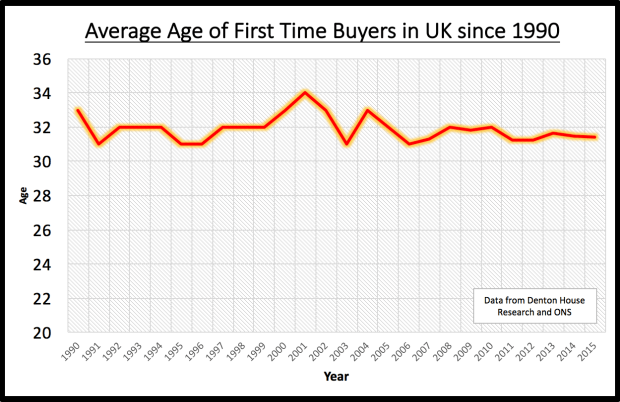
However, the numbers tell a different story. Looking at the age of first time buyers since 1990, the statistics could be seen to pour cold water on the idea that younger people are being priced out of the housing market. In 1990, when data was first published, the average age of a first time buyer was 33, today it’s 31.
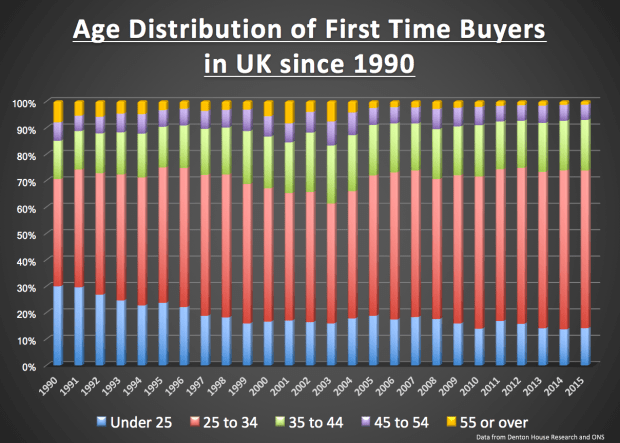
Nevertheless, the average age doesn’t tell the whole story. In the early 1990’s, 26.7% of first-time buyers were under 25, while in the last five years just 14.9% were. In the early 1990’s, four out of ten first time buyers were 25 to 34 years of age and now its six out of ten first time buyers.
Although there are also indications of how un-affordable housing is, the house price-to-earnings ratio has almost doubled for first-time buyers in the past 30 years. In 1983 the average Locks Heath home cost a first-time buyer (or buyers in the case of joint mortgages) the equivalent of 3.0 times their total annual earnings, whilst today, that has escalated to 6.1 times their income.
Again, those figures don’t tell the whole story. Back in 1983, the mortgage payments as percentage of mean take home pay for a Locks Heath first time buyer was 31.2%. In 1989, that had risen to 78.6%. Today it is 38.6%… and no that’s not a typo… 38.6% is the correct figure.

So, to answer the gentleman’s questions about the younger generation of Locks Heath being able to afford to buy and if it was right for Landlords to make money on the inability of others to buy property? It isn’t all to do with affordability as the numbers show.
And what of the Landlords? Some say the government should sort the housing problem out themselves, but according to my calculations, £18bn a year would need to be spent for the next 20 or so years to meet current demand for households. That would be the equivalent of raising income tax by 4p in the Pound. I don’t think UK tax payers would swallow that.
So, if the Government haven’t got the money who else will house these people? Private Sector Landlords and thankfully they have taken up the slack over the last 15 years.
Some say there is a tendency to equate property ownership with national prosperity, but this isn’t necessarily the case. The youngsters of Locks Heath are buying houses, but buying later in life. Also, many Locks Heath youngsters are actively choosing to rent for the long term, as it gives them flexibility – something our 21st Century society craves more than ever.
For more articles like this and all of the latest Buy to Let Deals please visit The Locks Heath Property Blog.
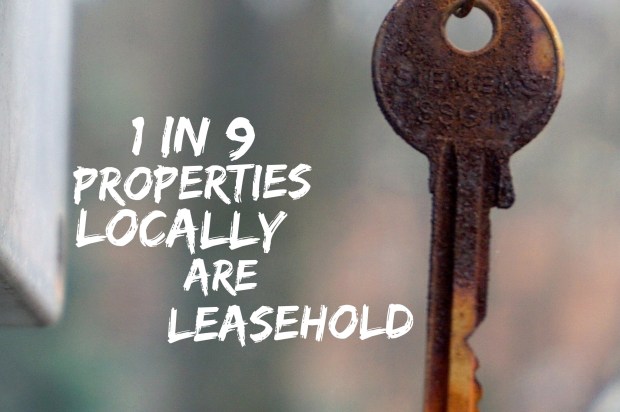 There are 23.36 million properties in England and Wales with 64% being owner occupied and 36% being rented either from a private landlord, local authority or housing association.
Over nine out of ten of those English and Welsh owner-occupied properties are a whole house or bungalow. Now, most people would assume they would be freehold – however, of those renting nearly half of rental properties, 44% to be precise, lived in other leasehold apartments and flats.
It might be wise to quickly explain the difference between freehold and leasehold. When someone owns the freehold of a property they own it outright, including the land it is built on, whilst with a leasehold property the leaseholder owns the property for the length of their lease agreement. Leaseholders must pay the person who owns land (the freeholder) ground rent and other fees. When the leasehold ends ownership returns to the freeholder, although the leaseholder can extend the lease or they can buy the freeholder out, but there are rules and regulations with regards to doing that.
Therefore, it would be safe to assume that houses are freehold and flats are leasehold wouldn’t it…..? Not necessarily! Most houses are freehold but some might be leasehold, usually through shared-ownership schemes. But more and more new homes builders are selling houses on a leasehold as well. The protection of the law afforded to leaseholders who own a flat is massive, but sadly lacking to leasehold houses sold privately.
Looking specifically at the figures for Locks Heath, at the last count in SO31 there were 19,768 properties. Since 1995, 21,209 properties in SO31 have changed hands and have been sold. Looking further at those 21,209 transactions in SO31 since 1995, using data from Land Registry and solicitors practice My-Home-Move, 10.56% have been leasehold (lower than the national average of 15%).

However, I am concerned about a few new homes builders selling new houses (not flats – houses) as leasehold. There has been a growing (yet small) trend for new-build houses to be sold as leasehold in recent years. While not all house builders use this model, those that do maintain it helps make developments financially viable.
The issue comes when builders sell the freehold separately to an investment company without informing the lease holder – which they are legally allowed to do without telling the leaseholder. In England and Wales the “right of first refusal” to buy the freehold is written in law to leaseholders of flats i.e. the freeholder must offer it to the leaseholders of all the flats of the building first), but not leaseholders of houses.
This is the point I am trying to get across. If you are buying a new home and it is a house (i.e. not a flat) please check very carefully indeed whether its freehold or leasehold. If it is a leasehold, whilst you do have rights, they are not as strong as for those people buying a leasehold flat. I appreciate I am only talking about a very small percentage of the property market, but potentially this could end up costing thousands of pounds to those affected.
 In Locks Heath, of the 17,423 households, 5,718 homes are owned without a mortgage and 8,190 homes are owned by a mortgage. Many homeowners have made contact with me asking what the General Election will do to the Locks Heath property market? The best way to tell the future is to look at the past.
I have looked over the last five general elections and analysed in detail what happened to the property market on the lead up to and after each general election. Some very interesting information has come to light.
Of the last five general elections (1997, 2001, 2005, 2010 and 2015), the two elections that weren’t certain were the last two (2010 with the collation and 2015 with unexpected Tory majority). Therefore, I wanted to compare what happened in 1997, 2001 and 2005 when Tony Blair was guaranteed to be elected/re-elected versus the last knife edge uncertain votes of 2010 and 2015 in terms of the number of houses sold and the prices achieved.
Look at the first graph below comparing the number of properties sold and the dates of the general elections.

It is clear, looking at the number of monthly transactions (the blue line), there is a certain rhythm or seasonality to the housing market. That rhythm/seasonality has never changed since 1995 (seasonality meaning the periodic fluctuations that occur regularly based on a season – i.e. you can see how the number of properties sold dips around Christmas, rises in Spring and Summer and drops again at the end of the year).
To remove that seasonality, I have introduced the red line. The red line is a 12 month ‘moving average’ trend line which enables us to look at the ‘de-seasonalised’ housing transaction numbers, whilst the yellow arrows denote the times of the general elections. It is clear to see that after the 1997, 2001 and 2005 elections, there was significant uplift in number of households sold, whilst in 2010 and 2015, there was slight drop in house transactions (i.e. number of properties sold).
Next, I wanted to consider what happened to property prices. In the graph below, I have used that same 12-month average, housing transactions numbers (in red) and yellow arrows for the dates of the general elections but this time compared that to what happened to property values (pink line).

It is quite clear none of the general elections had any effect on the property values. Also, the timescales between the calling of the election and the date itself also means that any property buyer’s indecisiveness and indecision before the election will have less of an impact on the market.
So finally, what does this mean for the landlords of the 2,104 private rented properties in Locks Heath? Well, as I have discussed in previous articles (and just as relevant for homeowners as well) property value growth in Locks Heath will be more subdued in the coming few years for reasons other than the general election. The growth of rents has taken a slight hit in the last few months as there has been a slight over supply of rental property in Locks Heath, making it imperative that Locks Heath landlords are realistic with their market rents. But in the long term, as the younger generation still choose to rent rather than buy, the prospects, even with the changes in taxation, mean investing in buy-to-let still looks a good bet. If you want to read more about the Locks Heath property market – then why not visit The Locks Heath Property Blog for more information.
 This was a question posed to me on social media a few weeks ago, after my article about our mature members of Locks Heath society and the fact many retirees feel trapped in their homes. After working hard for many years and buying a home for themselves and their family, the children have subsequently flown the nest and now they are left to rattle round in a big house. Many feel trapped in their big homes (hence I dubbed these Locks Heath home owning mature members of our society, ‘Generation Trapped’).
So, should we force OAP Locks Heath homeowners to downsize?
Well in the original article, I suggested that we as a society should encourage, through building, tax breaks and social acceptance that it’s a good thing to downsize. But should the Government force OAP’s?
Well, one of the biggest reasons OAP’s move home is health (or lack of it)
Looking at the statistics for Locks Heath (includes Warsash and Whiteley), of the 5,841 Homeowners who are 65 years and older, whilst 3,730 of them described themselves in good or very good health, a sizeable 1,636 home owning OAPs described themselves as in fair health and 475 in bad or very bad health.
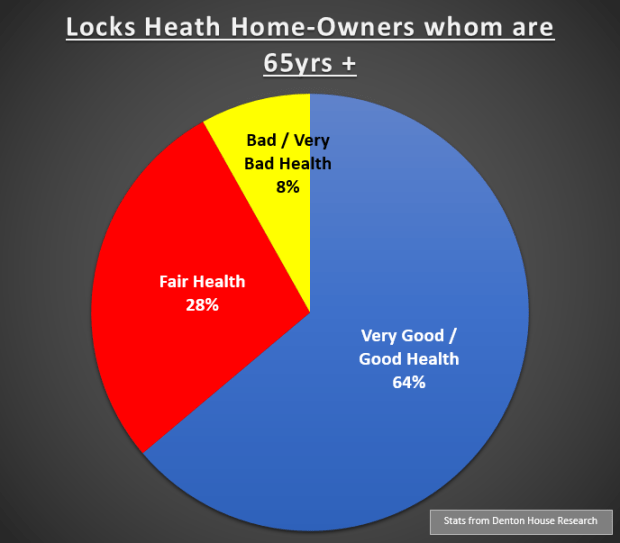
8.13% of Locks Heath home owning OAP’s are in poor health
But if you look at the figures for the whole of Fareham Borough Council (not just Locks Heath), there are only 807 specialist retirement homes that one could buy (if they were in fact for sale) and 415 homes available to rent from the Council and other specialist providers (again- you would be waiting for dead man’s shoes to get your foot in the door) and many older homeowners wouldn’t feel comfortable with the idea of renting a retirement property after enjoying the security of owning their own home for most of their adult lives.
My intuition tells me the majority ‘would be’ Locks Heath downsizers could certainly afford to move but are staying put in bigger family homes because they can’t find a suitable smaller property. The fact is there simply aren’t enough bungalows for the healthy older members of the Locks Heath population and specialist retirement properties for the ones who aren’t in such good health… we need to build more appropriate houses in Locks Heath.
The Government’s Housing White Paper, published a few weeks ago, could have solved so many problems with the UK housing market, including the issue of homing our aging population. Instead, it ended up feeling annoyingly ambiguous. Forcing our older generation to move with such measures as a punitive taxation (say a tax on wasted bedrooms for people who are retired) would be the wrong thing to do. Instead of the stick – maybe the Government could use the carrot tactics and offered tax breaks for downsizers. Who knows, but something has to happen.
Come to think about it, isn’t the word ‘downsize’ such an awful word? I prefer to use the word ‘decent-size’ instead of ‘down-size’- as the other phrase feels like they are lowering themselves, as though they are having to downgrade themselves in their retirement (and let’s be frank – no one likes to be downgraded).
The simple fact is we are living longer as a population and constantly growing with increased birth rates and immigration. So, what I would say to all the homeowners and property owning public of Locks Heath is… more houses and apartments need to be built in the Locks Heath area, especially more specialist retirement properties and bungalows. The Government had a golden opportunity with the White Paper – and were sadly found lacking.
And a message to my Locks Heath property investor readers whilst this issue gets sorted in the coming decade(s)… maybe seriously consider doing up older bungalows. People will pay handsomely for them – be they for sale or even rent? Just a thought!
 According to the Land Registry’s latest House Price Index for Locks Heath and the surrounding locality, the value of apartments/flats are rising at a faster rate than terraced/town houses, semi-detached properties and even detached property.
Values of apartments in Locks Heath have increased by 6.27% over the past year, which is proportionally 26% more than the Locks Heath average rise of 4.98%. The last time flats/apartments in Locks Heath out performed all the other types of property, by such a gulf, was back in the winter of 2005/6. For comparison, the other property types performed as follows:
Detached homes rose by 4.89%
Semi-detached homes rose by 4.76%
Terraced/Town-Houses rose by 4.53%
This moderately increasing rate of property value growth is opportune – but no one should confuse it with a strong and vigorous healthy Locks Heath property market. Instead, it is somewhat an indicator of the long-lasting lack of property on the market. In fact, I have spoken about the lack of homes for sale in Locks Heath on a number of occasions in my Locks Heath Property Blog and, whilst it isn’t as bad as it was 12 months ago, choice is quite limited for buyers.
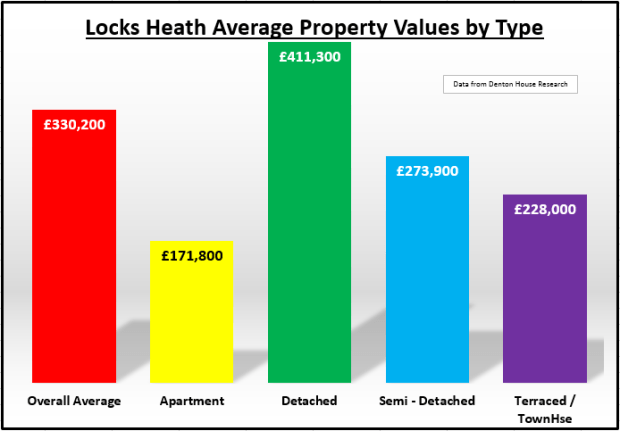
When split down into property types:
Locks Heath Apartments at £171,800
Locks Heath Detached at £411,300
Locks Heath Semi-Detached at £273,900
Locks Heath Terraced/Town-House at £228,000
When I scrutinised the figures for the rest of the UK, it appears that apartments are pacemakers in the clear majority of the country. Of the 379 local authority areas in the UK, the value of apartments is rising faster than detached, semi-detached and terraced houses in 320 of them.
So, should Locks Heath apartment owners be getting out the Champagne? Well, I would keep it on ice as the Land Registry figures are notorious for short term fluctuations. It’s hard to have faith in the fact that Locks Heath house values rose rapidly last month given that, in the last six months, the Land Registry has frequently made downward revisions to their first published House Price Index figures.
Thankfully, the bigger picture from the Council of Mortgage Lenders (CML) stated that home buying activity last month was up 2% over the same month in 2016 – not bad as we have had the Autumn, Winter and now Spring since the Brexit vote. The CML stated first time buyer’s levels of affordability was being squeezed and that the average amount borrowed by those first-time buyers dropped slightly last month, but the overall amount borrowed (by all buyers) was an impressive 12% higher than the same month in 2016.
So what next for the Locks Heath Property market? I believe the uplift in the values of apartments is a short-term blip. The real issue is with the way wage growth might not keep up with inflation as the effects of 2016 exchange rate sucks in inflation (meaning real wage growth stagnates). This will mean buyer demand growth will be curtailed and with property values already so full, I believe a renewed hastening in house price growth is unlikely.
I believe we are starting to return to the housing market we saw in the mid 1990’s…. Steady demand, steady supply – nothing silly when it comes to house price growth. Therefore, I believe, with what is happening around us, this isn’t a bad thing at all. HMS Locks Heath Property Market…. “Nice and steady as she goes”, says the Captain!
 So all cards up in the air! A general election will be on the books, but one thing is for sure… whoever gets the job to deal with Brexit has a hard job on their hands (I’m just glad its not me!). As it currently stands, by not assuring the rights of EU citizens in the UK, Theresa May has wasted an opportunity to give peace of mind to our EU co-workers working and living in Locks Heath (and the rest of the UK). No.10 Downing Street’s point of view is that in promising the rights of EU citizens in the UK, it will postpone the same guarantee to the 1.5 million UK citizens living in the other nations of the EU.
Putting aside the politics for one second, the simple fact is now Article 50 has been triggered, we have two years to make a deal with the EU; otherwise it will be a ‘hard Brexit’. Now you might not think a hard Brexit will affect you in your home in Locks Heath… but nothing could be further from the truth.
Of the 110,125 people who are resident in the Fareham Borough Council area, 103,937 were born in the UK, 1,607 were born in EU countries from West Europe and 405 were born in EU countries from the former Soviet States in East Europe (the rest coming from other countries around the world).
The rights of these EU citizens living in the Locks Heath area are not guaranteed and will now be part of the negotiation with Europe. It is true a lot of our EU next door neighbours in Locks Heath will have acquired rights relating to the right to live, to work, to own a business, to possess a property, the right to access health and education services and the right to remain in a UK after retirement… yet those acquired rights are up for negotiation in the next two years.
So, what would a hard Brexit do to the Locks Heath property market?
Well a hard Brexit could mean the nuclear option when it came to the Locks Heath housing market. It could mean that every EU citizen would have to leave the UK.
In the Fareham Borough area, 1,252 of the 1,607 Western European EU citizens own their own home and (so they would all need to be sold) and 233 of the 405 Eastern European EU citizens rent a property, so again all those rental properties would all come on the market at the same time.
Hard Brexit and mass EU Migration would mean c. 700 properties being dumped onto the housing market in a short period of time, meaning there would be a massive drop in Locks Heath property values and rents, causing negative equity for thousands of Locks Heath homeowners and many buy-to-let landlords would be out of pocket.
While there is no certainty as to what the future will hold, both UK expats in the EU and EU citizens in the UK rights will no longer be guaranteed and will be subject to bilateral renegotiation.
All I ask is that the politicians are sensible with each other in the negotiations. A lot of the success of the Locks Heath (and UK) property market has been built on high levels of homeownership and more recently in the last 10/15 years, a growth of the rental sector with lots of demand from Eastern Europeans coming to Locks Heath (and the surrounding area) to get work and provide for their families. Many Locks Heath people have invested their life savings into buying a buy to let property.
Much will depend on what is politically realistic. Unilateral knee-jerk reactions and measures caused by a hard Brexit would not only likely cause major disruption or suffering to the 3 million EU citizens living in the UK, but also everyone who owns property in the UK. Politics aside – a hard Brexit is in no one’s interests.
 The Locks Heath Property Market is a very interesting animal and has been particularly fascinating over the last 12 years when we consider what has happened to Locks Heath rents and house prices.
There’s currently much talk of what will happen to the rental property market following Brexit. To judge that, I believe we must look what happened in the 2008/9 credit crunch (and what has happened since) to judge rationale and methodically, the possible ramifications for long-term investors in the Locks Heath property market. You see, an important yet overlooked measure is the performance of rental income vs house prices (i.e. the resultant yields over time). In Locks Heath (as for the rest of Great Britain), notwithstanding a slight drop in 2008 and 2009, property rentals have been gradually increasing.
The income from rentals has been progressively increasing over the last 12 years. Today, they are 22.6% higher than they were at the beginning of 2005. In fact, over the last five years, the average growth has been 2.4% per annum. From a Landlord’s point of view, increase in average rental income is not to be sneered at. However, the observant readers will be noting that we are ignoring an important factor – our friend inflation.
Turn the clock back to 2005, and we have a property being rented for say £900 a month and that is still being rented at £900 a month today, in the Spring of 2017. While the Landlord is not getting any less income, this £900 is no longer worth as much. Let me explain…. In 2005 £900 may have bought a two-week 4* holiday in Italy. Yet, holidays have increased in line with inflation (which has been 38.5% since 2005), so our holiday would cost today £1,246 (£900 + 38.5% inflation = £1,246). Therefore the Landlord could no longer afford the same holiday, even though they are receiving the same amount in pound notes from their rental property.
This means when we compare rents in Locks Heath to inflation since 2005, Locks Heath Landlords are worse off today when they receive their monthly rental income, than they were in 2005 by 15.9% in real terms (rents increased by 22.6% since 2005, less the 38.5% inflation since 2005 – net affect 15.9% drop)
However, rental income is not the only way to generate money from property as property values can increase. Although in the short term cash flows are diminishing, many Locks Heath Landlords may be content to accept that for a colossal increase in capital value.
Property values in Locks Heath have risen by 42.8% since 2005
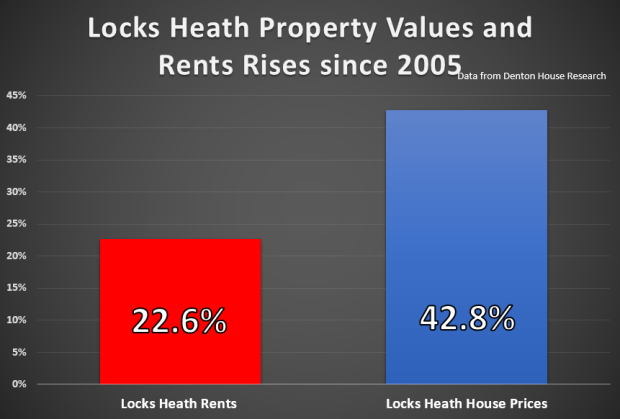
This equates to a reasonably healthy 3.57% per annum increase over the last 12 years. Even more interesting that this includes the 2008/9 property crash, this will make those Locks Heath Landlords and investors feel a little better about the information regarding rents after inflation.
Moving forward, the prospects of making easy money on buy to let in Locks Heath have diminished, when compared to 2005. Last decade making money from buy to let was as easy as falling off a log – but not anymore.
It would be true to say, my rental income verses property prices study does lead to noteworthy thoughts. I am often asked to look at my Landlord’s rental portfolios, to ascertain the spread of their investment across their multiple properties. It’s all about judging whether what you have will meet your needs of the investment in the future. It’s the balance of capital growth and yield whilst diversifying this risk.
If you are investing in the Locks Heath property market do your homework and do it well. While some yields may look attractive, there are properties in many areas that do not have the solid essentials in place to sustain them. If you are looking for capital growth, you might be surprised where the hidden gems really are. Take advice, even ask your agent for a portfolio analysis. The clear majority of agents in Locks Heath will be able to give a detailed analysis of past and anticipated investment opportunity on your portfolio. However, if they can’t help – well, you know where I am, the kettle is on!
For more thoughts on the Locks Heath Property market – visit the Locks Heath Property Blog
 thelocksheathpropertyblog.co.uk