695,136 People use Swanwick Train Station a year – How does that affect the Locks Heath Property Market?

RailwayIt might surprise you that it isn’t always the poshest villages around the Fareham Borough or the swankiest Locks Heath streets where properties sell and let the quickest. Quite often, it is the ones that have the best transport links.  I mean, there is a reason why one of the most popular property programmes on television is called Location, Location, Location!

As an agent in Locks Heath, I am frequently confronted with queries about the Locks Heath property market, and most days I am asked “What is the best part of Locks Heath and the surrounding villages to live in these days?”.  Now the answer is different for each person – a lot depends on the demographics of their family, their age, schooling requirements and interests etc. Nonetheless, one of the principal necessities for most tenants and buyers is ease of access to transport links, including public transport – of which the railways are very important.

Official figures recently released state that, in total, 955 people jump on a train each and every day from Swanwick Train station.  Of those, 475 are season ticket holders.  That’s a lot of money being spent when a season ticket, standard class, to London is £5,424 a year.

So, if up to £2.58m is being spent on rail season tickets each year from Swanwick, those commuters must have some impressive jobs and incomes to allow them to afford that season ticket in the first place.  That means demand for middle to upper market properties remains strong in Locks Heath and the surrounding area and so, in turn, these are the type of people who are happy to invest in the Locks Heath buy to let market – providing homes for the Tenants of Locks Heath.

The bottom line is that property values in Locks Heath would be much lower if it wasn’t for the proximity of the railway station and the people it serves in the suburb

And this isn’t a flash in the pan.  Rail is becoming increasingly important as the costs associated with car travel continue to rise and roads are becoming more and more congested.  This has resulted in a huge surge in rail travel.

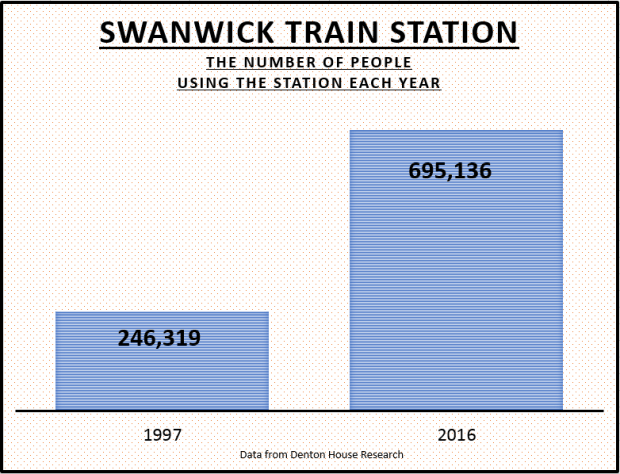
Overall usage of the station at Swanwick has increased over the last 20 years.  In 1997, a total of 246,319 people went through the barriers or connected with another train at the station in that 12-month period.  However, in 2016, that figure had risen to 695,136 people using the station (that’s 1,910 people a day).
163 gRAPH

The juxtaposition of the property and the train station has an important effect on the value and saleability of a Locks Heath property.  It is also significant for Tenants – so if you are a Locks Heath buy to let investor looking for a property the distance to and from the railway station can be extremely significant.

One of the first things house buyers and Tenants do when surfing the web for somewhere to live is find out the proximity of a property to the train station.  That is why Rightmove displays the distance to the railway station alongside each and every property on their website.

For more thoughts on the Locks Heath Property market please visit The Locks Heath Property Blog.

Locks Heath Rents To Rise Quicker Than Locks Heath Property Prices In The Next 5 Years

Trees - WordingThe next five years will see an interesting change in the Locks Heath property market.  My recent research has concluded that the rent private tenants pay in Locks Heath will rise faster than Locks Heath property prices over the next five years, creating further issues to Locks Heath’s growing multitude of renters.  In fact, my examination of statistics forecasts that ..
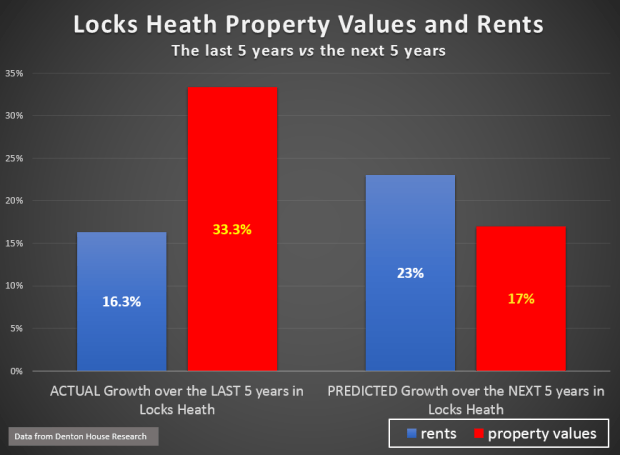
By 2022, Locks Heath rents will increase by 23%, whereas Locks Heath property values will only grow by 17%.

Let me explain why I have come to those conclusions:

Over the last five years property values in Locks Heath have risen by 33.3%, whilst rents have only risen by 16.3%.

160 Graph

Throughout the last few years, and compounded in 2016, Tenant demand for rental properties continued to go up whilst the Press predicted some Landlords expect to reduce their portfolios in the next couple of years.  Meaning that Locks Heath Tenants will have fewer properties to choose from, which will push rents higher.  In fact, talking to fellow property professionals in the area, there appears to be a shortage of new rental properties coming on to the Locks Heath lettings market.

Landlords have some intriguing challenges ahead of them in the coming years, most notably that the Tory’s have changed the taxation rules for Landlords in the way buy to let properties are to be taxed.  On top of that, there is the ban on letting agent fees which is still to come into force (probably in 2018).  When that happened in Scotland in 2012 Scottish letting agents passed on those fees to their Landlords, who in turn increased the rent they charged to their Tenants.

All I would say to Theresa May and Philip Hammond is that they must be wary about indicating both red and green lights at the same time to the private rented sector.  They can’t expect the armies of small private Landlords to continue to house around a fifth of the population and then tax the hell out of them.  They didn’t invest in buy to let as a charity or to satisfy any philanthropic urges.  Something has to give – and that will be significant rent rises over the coming few years (and before anyone gives me any derogatory comments about Landlords… if it wasn’t for Landlords buying all these buy to let properties over the last 15 years, I am not sure where everyone would be living today – because most of the Council houses were sold off in the 1980’s).

With the challenges ahead, with the ‘B’ word (that’s budget if you wondered!), house price inflation will be tempered over the coming five years in Locks Heath.  As I have discussed in previous articles, the number of properties on the market in Locks Heath remains close to historic lows, which is both good as it keeps houses prices relatively stable, yet not so good as it impedes choice for buyers… and hence why I believe property values in Locks Heath will only be 17% higher in five years’ time.

Whilst on the other side of the coin, with the challenges facing Landlords and the significant shortage of new homes being built, Locks Heath people still need somewhere to live.  If those people aren’t buying houses and the local authority aren’t building council houses in there thousands (because they have no money), with the average rent for a Locks Heath rental property currently standing at £882 per month…

Over the next five years, I predict the average rent in Locks Heath will rise to £1,085 per month

These are interesting times.  There is still money to be made in buy to let in Locks Heath – Locks Heath Landlords will just need to be smarter and more savvy with their investments.  If you are looking for such advice and opinion to help you meet those investment goals, one place you can find more information is The Locks Heath Property Blog.

357 Properties For Sale in Locks Heath… Is this an issue?

Q1 2017 UPDATE

2017 has started with some positive interest in the Locks Heath property market.  Taking a snap shot of the Locks Heath property market for the first quarter of 2017, the picture suggests some interesting trends when it comes to the number of properties available to buy, their asking prices and what prices properties are actually selling for.

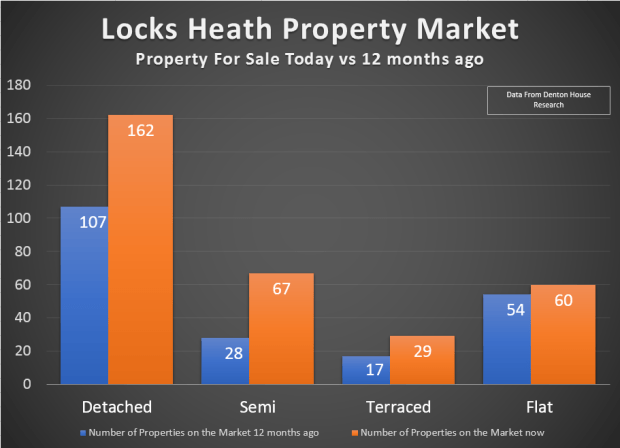
Let us first consider the number of properties for sale (in SO31), compared to 12 months ago:

159 Graph

Next, Locks Heath asking prices, compared to the same as a year ago, are 6% lower.

With that in mind, I wanted to look at what property was actually selling for in Locks Heath. Taking my information from the Land Registry, the last available six months property transactions for SO31 show an interesting picture (note the Land Registry data is always a few months behind due to the nature of the house buying process and so November 2016 is latest set of data). The price shown is the average price paid and the number in brackets is the number of properties actually sold.

Jun-16 Jul-16 Aug-16 Sep-16 Oct-16 Nov-16
Detached £464,355 (31) £478,659 (37) £422,293 (35) £453,431 (16) £430,550 (19) £437,247 (18)
Semi

Detached

£303,590 (20) £284,340 (11) £293,600 (24) £300,904 (12) £301,417 (18) £286,606 (9)
Terraced £314,856 (16) £324,617 (21) £225,801 (18) £251,390 (15) £280,353 (17) £237,496 (14)
Flat £169,638 (21) £170,818 (11) £231,992 (13) £194,386 (14) £183,525 (18) £159,781 (8)
All £330,305 (88) £369,175 (80) £321,188 (90) £304,526 (57) £301,047 (72) £307,205 (49)

So what does all this mean for the property owning folk of Locks Heath?

Well, with more property on the market than a year ago and asking prices 6% lower, those trying to sell their property need to be mindful that buyers, be they first timers, buy to let landlords or people moving up the Locks Heath property ladder, have much more price information about the Locks Heath property market at their fingertips than ever before.

Those Locks Heath people who are looking to sell their property in 2017 need to be aware of the risks of over pricing their property when initially placing it on the market. Over the last 12 months I have noticed the approach some Estate Agents take is to suggest an inflated asking price to encourage the homeowner and secure the property to sell on their books.  The down side to this is that when offered to the market for the first time, buyers will realise it is overpriced and won’t waste their time asking for a brochure.  They won’t even view the property, let alone make an offer.  So when the price is reduced a few months later the property has become market stale and continues to be ignored.

Whilst the Locks Heath property market has an unassailable demand for property – there is one saying that always rings true –

As long as the property is being marketed at the right price it will sell.

If you want to know if your Locks Heath property is being marketed at the right price, send me a web link and I will give you my honest opinion.

Warsash Planning Applications

Locks Heath SignI know how my readers like to keep abreast of planned developments in the local area. Having read the article below on the Daily Echo’s website over the weekend regarding two planned sites in Warsash I thought it was worth sharing.

http://www.dailyecho.co.uk/news/15194526.Two_Hampshire_countryside_sites_could_disappear_if_go_ahead_for_330_new_homes_is_given/?ref=fbpg

As always I welcome your thoughts and views on the plans.  Feel free to call me on 01489 570011 or email at james.hill@brooklettings.co.uk.

Mortgage Interest Relief Restrictions – Are you prepared?

It has been two years since we first heard the announcement that Landlords’ ability to deduct mortgage interest would be gradually phased down by 2020.  A recent YouGov Report suggests that, on the whole, mortgaged buy-to-let Landlords are fairly well informed about the changes.  But with the first phase of the restrictions due for implementation on 6 April 2017 I thought it was worth revisiting the subject.

The amount of Income Tax relief landlords can get on residential property finance costs will be restricted to the basic rate of tax.  As we now know these restrictions will be phased in over the next four years.

The restrictions will affect:

  • UK resident individuals that let residential properties in the UK or overseas
  • non-UK resident individuals that let residential properties in the UK
  • individuals who let such properties in partnership
  • trustees or beneficiaries of trusts liable for Income Tax on the property profits

The phasing down of mortgage and other finance costs will be as follows:

Tax Year % of finance costs deductible from rental income % of basic rate tax reduction
2017 / 18 75% 25%
2018 / 19 50% 50%
2019 / 20 25% 75%
2020 / 21 0% 100%

Those who will not be affected by the restrictions and will continue to receive relief for interest and other finance costs in the usual way are:

  • UK resident companies
  • non-UK resident companies
  • Landlords of Furnished Holiday Lettings

Most landlords who will be affected by the tax change will already be planning how they will prepare for the impact of the restrictions.  19% of the YouGov survey respondents declared that they would be making an increase to the rent.  Around one in five Landlords are considering either transferring the ownership of their property into a corporate structure or to a partner who pays a lower income tax rate.  About one-third are looking into remortgaging as a cost-saving option.

For more information or advice on the changes to mortgage interest relief and how it will affect you feel free to drop me a line at james.hill@brooklettings.co.uk or give me a call on 01489 570011.

‘Flipping’ Heck – Locks Heath Property Values Rise by £35.95 a day

Flipping propertyInvesting in Locks Heath buy to let property is different from investing in the stock market or depositing your hard-earned cash in the Building Society.  When you invest your money in the Building Society, this is considered by many as the ‘safe option’ but the returns you can achieve are awfully low (the best 2-year bond rate from Nationwide is a whopping 0.75% a year!).  Another investment is the Stock Market, which can give good returns, but unless you are on the phone every day to your Stockbroker, most people invest in stock market funds, making the investment quite hands-off and one always has the feeling of not being in control.

However, with buy to let, things can be more hands on.  One of the things many landlords like is the tactile nature of property – the fact that you can touch the bricks and mortar.  It is this factor that attracts many of Locks Heath’s Landlords – they are making their own decisions rather than entrusting them to city whizz kids in Canary Wharf playing roulette with their savings.

I always say investing in property is a long-term game.  When you invest in the property market, you can earn from your investment in two ways.  When a property increases in value over time, it is known as ‘capital growth’.  Capital growth, also known as capital appreciation, has been strong in recent times in Locks Heath, but the value of property does go up as well as down just like shares do but the initial purchase price rarely decreases.   Rental income is what the Tenant pays you – hopefully this will also grow over time.  If you divide the annual rent into the value (or purchase price) of the property, this is your yield, or annual return.  So, over the last 5 years, an average Locks Heath property has risen by £65,600 (equivalent to £35.95 a day), taking it to a current average value of £319,600.  Yields can range from 4.5% a year and can reach double digits’ percentages (although to achieve those sorts of returns, the risks are higher).

However, something I haven’t spoken of before is the more specialist area of flipping property to make money (flipping – buying a property, carrying out some minor cosmetics and re selling it quickly).  I have seen several investors recently who have made decent returns from this strategy.

This demonstrates how the Locks Heath property market has not only provided very strong returns for the average investor over the last five years but how it has permitted a group of motivated buy to let Locks Heath landlords and investors to become particularly wealthy.

As my article mentioned a few weeks ago, more and more Locks Heath people may be giving up on owning their own home and are instead accepting long term renting whilst buy to let lending continues to grow from strength to strength.  If you want to know what (and what would not) make a decent buy to let property in Locks Heath, then one place for such information would be the Locks Heath Property Blog.

Locks Heath’s ‘Generation Trapped’ and the £4.77bn legacy

Generation Trapped.pngTwo weeks ago I wrote an article on the plight of the Locks Heath 20 something’s often referred to by the press as ‘Generation Rent’.  Attitudes to renting have certainly changed over the last twenty years and as my analysis suggested, this change is likely to be permanent.  In the article, whilst a minority of this Generation Rent feel trapped, the majority don’t – making renting a choice not a predicament.  The Royal Institution of Chartered Surveyors (RICS) predicted that the private rental sector is likely to grow substantially by 1.8m households across the UK in the next 8 years, with demand for rental property unlikely to slow and newly formed households continuing to choose the rental market as opposed to buying.

However, my real concern for Locks Heath homeowners and Locks Heath landlords alike is our mature members of the population of Locks Heath.  The ‘Baby Boomers’, the 50yr to 64yr old Locks Heath people and what their properties are worth – and more importantly, how the current state of affairs could be holding back those younger Generation Renters.

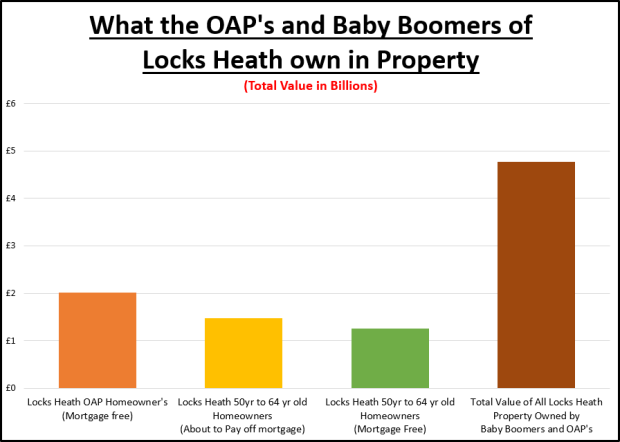
In Locks Heath (SO31), there are 4,236 households whose owners are aged between 50yrs and 64yrs and about to pay their mortgage off.  That property is worth, in today’s prices, £1.48bn.  There are an additional 3,617 mortgage free Locks Heath households, owned by 50yr to 64yr olds, worth £1.26bn in today’s prices, meaning…

Locks Heath Baby Boomers and Locks Heath OAP’s are sitting on £4.77bn worth of Locks Heath Property

156 Graph

These Locks Heath Baby Boomers and OAP’s are sitting on 13,654 Locks Heath properties and many of them feel trapped in their homes, and hence I have dubbed them ‘Generation Trapped’.

Recently, the English Housing Survey stated 49% of these properties owned by the ‘Generation Trapped’ are ‘under-occupied’ (under-occupied classed as having at least two bedrooms more than needed).  These houses could be better utilised by younger families, but research carried out by the Prudential suggest in Britain it’s estimated that only one in ten older people downsize while in the USA for example one in five do so.

The growing numbers of older homeowners who want to downsize their home are often put off by the difficulties of moving.  The charity United for all Ages, suggested recently many are put off by the lack of housing options, 19% by the hassle and cost of moving, 14% by having to declutter their possessions and 14% by family reasons such as staying close to children and grandchildren.

Helping mature Locks Heath (and the Country) homeowners to downsize at the right time will also enable younger Locks Heath people to find the homes they need – meaning every generation wins, both young and old.  However, to ensure downsizing works, as a Country, we need more choices for these ‘last time buyers’.

Theresa May and Philip Hammond can do their part and consider stamp duty tax breaks for downsizers, our local Council in Locks Heath and the Planning Department should play their part, as should Landlords and property investors to ensure Locks Heath’s ‘Generation Trapped’ can find suitable property locally – close to friends, family and facilities.

How The Rented Sector Has Transformed The Property Market In Locks Heath

Crowd blur - WordingThe Locks Heath housing market has gone through a sea of change in the past decades with the Buy-to-Let (BTL) sector evolving as a key trend, for both Locks Heath Tenants and Locks Heath Landlords.

A few weeks ago, the Government released a White Paper on housing.  I have had a chance now to digest the report and wish to offer my thoughts on the topic.  It was interesting that the private rental sector played a major part in the future plans for housing.  This is especially important for our growing Locks Heath population.

In 1981, the population of Fareham stood at 89,000 and today it stands at 114,800.

157 Graph

Currently, the private rented (BTL) sector accounts for 12.1% of households in the town.  The Government want to assist people living in the houses and help the economy by encouraging the provision of quality homes, in a housing sector that has grown due to worldwide economic forces, pushing home ownership out of the reach of more and more people.  Interestingly, when we look at the 1981 figures for homeownership, a different story is told.

79.38% Locks Heath people owned their own home in 1981

13.8% Locks Heath people rented from the Council or Housing Association in 1981

and 6.82% Locks Heath rented from a Private Landlord

The significance of a suitable housing policy is vital to ensure suitable economic activity and create a vibrant place people want to live in.  With the population of Fareham set to grow to 130,000 by 2037 it is imperative that Fareham Borough Council and Central Government all work actively together to ensure the residential property market doesn’t hold the area back, by encouraging the building and provision of quality homes for its inhabitants.

One idea the Government has proclaimed is a variety of measures aimed at encouraging the Build-to-Rent (BTR) sector (instead of the BTL sector). These include allowing local authorities to proactively plan for BTR schemes, and making it simpler for BTR developers to offer inexpensive private rented homes.

To do this, the government will invent a distinct affordable housing class for BTR, called ‘Affordable Private Rent’, which will oblige new homes builders to provide at least 1 in 5 of a new home development at a 20% discount on open-market rents and three year tenancies for Tenants.  In return, the new homebuilders will get better planning assurances.

Private Landlords will not be expected to offer discounts, nor offer 3-year tenancies – but it is something Locks Heath Landlords need to be aware of as there will be greater competition for tenants.

Over the last ten years, home ownership has not been a primary goal for young adults as the world has changed. These youngsters expect ‘on demand’ services from Click and Collect, Amazon, Dating Apps and TV with the likes of Netflix.  Many Locks Heath youngsters see that renting more than meets their accommodation needs, as it combines the freedom from a lifetime of property maintenance and financial obligations, making it an attractive lifestyle option.

Private rented housing in Locks Heath and Fareham, be it BTL or BTR, has the potential to play a very positive role.

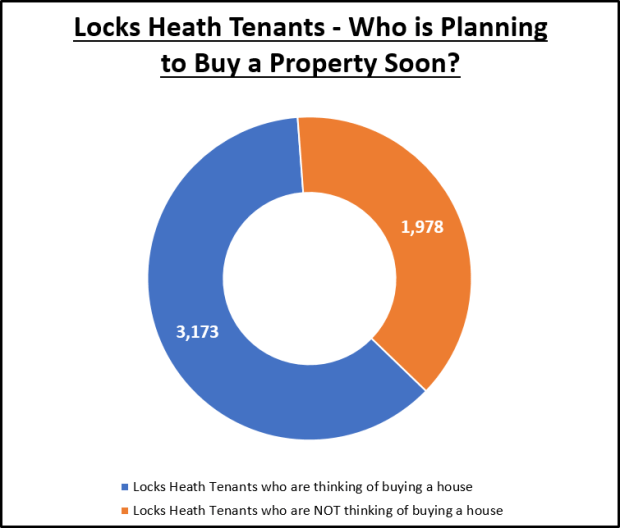
‘Generation Rent (Forever)’ – 1,978 Locks Heath Tenants have no intention of ever buying a property to call home

TeenagerThe good old days of the 1980’s eh… with such highlights lowlights as 17% interest rates,  13% unemployment, power cuts – Those were the days (not)!  But at least people could afford to buy their own home.  So why aren’t the 20 and 30 something’s buying in the same numbers as they were 30 or 40 years ago?
Many people blame the credit crunch and global recession of 2008, which had an enormous impact on the Locks Heath (and UK) housing market.  Predominantly, the 20 something first-time buyers who, confronting a problematic mortgage market, the perceived need for big deposits, reduced job security and declining disposable income, discovered it challenging to assemble the monetary means to get on to the Locks Heath property ladder.

However, I would say there has been something else at play other than the issue of raising a deposit – having sufficient income and rising property prices in Locks Heath.  Whilst these are important factors and barriers to home ownership, I also believe there has been a generational change in attitudes towards home ownership in Locks Heath (and in fact the rest of the Country).

Back in 2011, the Halifax did a survey of thousands of Tenants and 19% of Tenants said they had no plans to buy a home for themselves.  A recent, almost identical survey of Tenants, carried out by The Deposit Protection Service revealed, in late 2016, that figure had risen to 38.4%, with many no-longer equating home ownership to success and believing renting to be better suited to their lifestyle.

You see, I believe renting is a fundamental part of the housing sector, and a meaningful proportion of the younger adult members of the Locks Heath population choose to be Tenants as it better suits their plans and lifestyle.  Local Government in Locks Heath (including the planners – especially the planners), land owners and Landlords need an adaptable Locks Heath residential property sector that allows the diverse choices of these Locks Heath 20 and 30 year olds to be met.

This means, if we applied the same percentages to the current 5,151 Locks Heath Tenants in their 2,299 private rental properties, 1,978 tenants have no plans to ever buy a property – good news for the Landlords of those 883 properties.  Interestingly, in the same report, just under two thirds (62%) of tenants said they didn’t expect to buy within the next year.

155 Graph

But does that mean that the other third will be buying in Locks Heath in the next 12 months?

Some will, but most won’t.  In fact, the Royal Institution of Chartered Surveyors (RICS) predicts that, by 2025, that the number of people renting will increase, not drop.  Yes, many Tenants might hope to buy but the reality is different for the reasons set out above.  The RICS predicts the number of Tenants looking to rent will increase by 1.8 million households by 2025, as rising house prices continue to make home ownership increasingly unaffordable for younger generations.  So, if we applied this rise to Locks Heath, we will in fact need an additional 985 private rental properties over the next eight years (or 123 a year)… meaning the number of private rented properties in Locks Heath is projected to rise to an eye watering 3,284 households.

For more insight and thoughts like this on the Locks Heath Property Market – please visit The Locks Heath Property Blog.

With 5,151 people in Private Rented Properties in Locks Heath – Should you still be investing in Locks Heath Buy To Let?

wall-wordingIf I were a buy to let Landlord in Locks Heath today, I might feel a little bruised by the assault made on my wallet after being (and continuing to be) ransacked over the last 12 months by HM Treasury’s tax changes on buy to let.  To add insult to injury, Brexit has caused a tempering of the Locks Heath property market with property prices not increasing by the levels we have seen in the last few years. I think we might even see a very slight drop in property prices this year and, if Locks Heath property prices do drop, the downside to that is that first time buyers could be attracted back into the Locks Heath property market; meaning less demand for renting (meaning rents will go down).  Yet, before we all run for the hills, all these things could be serendipitous to every Locks Heath Landlord, almost a blessing in disguise.

Locks Heath has a population of 44,109, so when I looked at the number of people who lived in private rented accommodation, the numbers surprised me…

Locks Heath – Accommodation Type and the Number of Occupiers
Owned outright – Locks Heath Owned with a mortgage – Locks Heath Shared ownership (part owned and part rented) – Locks Heath Social rented (aka Council Housing) –  Locks Heath Private rented – Locks Heath Living rent free – Locks Heath
12,320 21,396 255 4,676 5,151 311
27.9% 48.5% 0.6% 10.6% 11.7% 0.7%

153-graphYields will rise if Locks Heath property prices fall, which will also make it easier to obtain a buy to let mortgage, as the income would cover more of the interest cost.  If property values were to level off or come down that could help Locks Heath Landlords add to their portfolio.  Rental demand in Locks Heath is expected to stay solid and may even see an improvement if uncertainty is prolonged. However, there is something even more important that Locks Heath Landlords should be aware of: the change in the human nature of these 20 something potential first time buyers.

I have recently come back from a family get together.  I got chatting with my step mother’s niece and her partner.  Both are in their mid/late twenties, both have decent jobs and they rent.  Yet, here was the bombshell, they were planning to rent for the foreseeable future with no plans to even save for a deposit, let alone buy a property.  I asked why they weren’t planning to buy?  The answers surprised me as a 30 something, and it will you.  Firstly, they don’t want to put cash into property, they would rather spend it on living and socialising by going on nice holidays and buying the latest tech and gadgets.  They want the flexibility to live where they choose and finally, they don’t like the idea of paying for repairs.  Most of their friends feel the same.  I was quite taken aback that buying a house is just not top of the list for these youngsters anymore.

So, as 11.7% of Locks Heath people are in rented accommodation and as that figure is set to grow over the next decade, now might just be a good time to buy property in Locks Heath – because what else are you going to invest in?  Give your money to the stock market run by sharp suited city whizz kids?  Because at least with property it is something you can touch – there is nothing like bricks and mortar!

For more views and opinions on the Locks Heath Property Market – visit The Locks Heath Property Blog.