7 Top Tips To Get The Best Tenant For Your Property

What is your greatest fear as a Landlord?  Like most it is more than likely a Tenant either not paying the rent or trashing the property.

So how do you avoid the pitfalls and ensure that you give yourself the best chance of getting yourself a good Tenant?

Here I detail my 7 Top Tips to help you find the best Tenant for your property.

1. Make sure you carry out background checks

If you are going to be letting a Tenant live in your property you want to make sure that they have the income or savings to pay you every month.  Proof of income can be in the form of confirmation from an employer or accountant, payslips or bank statements.

You also want to know what sort of Tenant they have been in their previous property that they have been renting so get their current Landlord or Agent’s information and contact them for some details of their tenancy. Some good questions to ask are:

  • Have they paid their rent on time and in full each month?
  • Did they leave the property in good condition at the end of their tenancy?
  • Would they let to them again?

Needless to say that the sure-fire method of carrying out background checks is through a professional referencing agency. But if you are doing the checks yourself don’t be afraid to be intrusive and ask some detailed questions to ensure you have the full picture on your prospective Tenant.

2. Avoid Facebook groups

We all like to save some money and Facebook has become a very popular medium for us to buy or sell second hand goods. ‘For Sale in….’ groups have popped up for most local small towns and villages and Landlords have turned to these to advertise their properties.  But before you take your photos and upload them to your local Facebook Group there is something you need to consider…  Are you going to be attracting the best quality Tenant?

Some prospective Tenants are legitimately looking to save some money on fees by going to a private Landlord.  Sadly however there are also a lot of Tenants with chequered pasts that resort to Facebook because they know that full referencing checks will not be carried out. The warning signs may not be there at first; they may come across really well at your face to face meeting at the property but once that agreement is signed and they have moved in things can quickly change.

3. Have the right legal documents in place

Having the right tenancy agreement is essential when letting your property.  Without the right clauses protecting you you could end up with no recourse should the Tenant let you down.

Always ensure that you use a properly written and legally binding contract. If your proposed tenancy is eligible you should always use an Assured Shorthold Tenancy.

4. Take a deposit and handle it correctly

Typically in the SO31, PO14 or PO15 areas a deposit of between one month and six weeks’ rent is taken from Tenants.  Needless to say that this should be paid by your Tenants in cleared funds prior to you handing over any keys.

To comply with Deposit Legislation the deposit should be registered with a government recognised Deposit Protection Scheme and prescribed information regarding the deposit should be issued to the Tenants all within 30 days.

The deposit will remain protected until the end of the tenancy and will protect you against any damages to the property or the contents.  In the event of a dispute between you and your Tenant the Deposit Scheme will adjudicate.

5. Carry out an Inventory

In correlation with the deposit it is essential that you prepare an Inventory on the condition of the property and the contents.  This should include a full list of all fixtures, fittings and furnishings and some photographs showing them.

The Inventory should make reference to any existing defects, blemishes and wear and tear.  You and the Tenant should both sign the document on the day of occupation to confirm agreement that the document is a fair representation of the condition of the property.

Although it is an additional expense to an already long list of upfront costs I would always recommend getting an independent third party to prepare a professional Inventory.  This keeps everything impartial and free from any bias.

My article on the importance of an Inventory goes in to more detail on this subject.  CLICK HERE to read more.

6. Take ID and carry out a Right to Rent Check

It goes without saying that you want to be sure that your Tenant is who they say they are.  But the Immigration Act 2014 and 2016 now takes that a step further by stipulating that Landlords must ensure that their tenants have a ‘right to rent’ – the right to remain in the UK.  This means that you must carry out Right to Rent checks on all prospective adult occupiers.

Establish who will live in the property.  Obtain, Check and Copy one or more original documents that demonstrate the Right to Rent in the UK for all adult occupiers for that property in the presence of the holder.  Acceptable documents include a UK passport and a permanent residence card or travel document showing indefinite leave to remain.

Landlords must also carry out follow up checks where tenants satisfied initial checks using time limited ID.

7. Trust your gut instinct

Although credit checks and other references from employers can confirm whether the Tenant is financially sound it doesn’t necessarily guarantee that they will be a good Tenant.

First impressions count for a lot and your face to face meeting with the Tenant on the viewing is the ideal time to chat to them and get a feeling for what type of person they are.

Trust your gut instinct and if you are the slightest bit unsure about the Tenants do not agree to let to them and keep looking.

If you would like any more information or would like to discuss any other property related matter please give me a call on 01489 570011.  You can also email me at james.hill@brooklettings.co.uk.

For more articles like this one and all the latest buy to let deals for investors visit The Locks Heath Property Blog.
103 Locks Heath Households Occupied by OAP Renters

old-couple-wordingRecent statistics published by the Office of National Statistics show that there are 267,704 private rented households in the Country that are occupied by people aged 65 and older, meaning 4.39% of OAP’s are living in private rented property.
It got me thinking two things. How many of these OAP’s have always rented and how many have sold up and become a Tenant?  In retirement, selling up could make financial sense to the mature generation in Locks Heath, potentially allowing them to liquidate the equity of their main home to enhance their retirement income.  I wanted to know why these older people rent and whether there was opportunity for the buy to let Landlords of Locks Heath.

The Prudential published a survey recently that said nearly six out of ten OAP renters had never owned a home.  Two out of ten OAP renters were required to sell up because of debt, just about one in ten OAP renters sold their property to use the money to fund their retirement and the remaining one out ten OAP renters, rented for other reasons.

Funding retirement is important as the life expectancy of someone from Locks Heath at age 65 (years) is 19.2 years for males and 21.5 years for females (interesting when compared to the National Average of 18.7 years for males and 21.1 years for females).  The burdens of financing a long retirement are being felt by many mature people of Locks Heath.  The state of play is not helped by rising living costs and ultra-low interest rates reducing returns for savers.

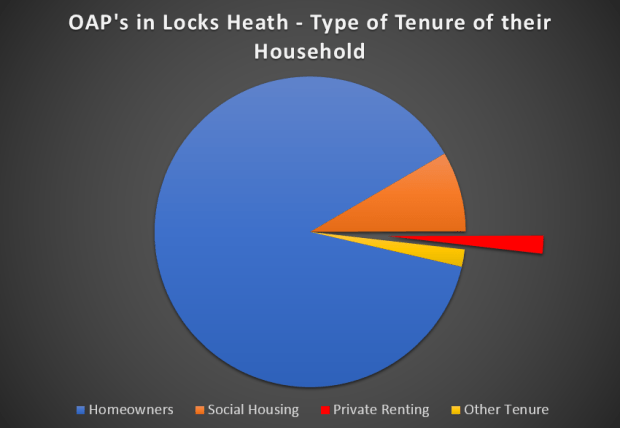
So, what of Locks Heath?  Of the 5,518 households in Locks Heath, whose head of the household is 65 or over, not surprisingly 4,855 of households were owned (87.98%) and 461 (8.35%) were in social housing.  However, the figure that fascinated me was the 103 (1.87%) households that were in privately rented properties.

152-graph

More and more Locks Heath OAP’s are selling their large Locks Heath homes and renting something more manageable, allowing them to release all of their equity from their old home.  This equity can be gifted to grandchildren (allowing them to get on the property ladder), invested in plans that produce a decent income and while living the life they want to live.

These Locks Heath OAP renters know they have a fixed monthly expenditure and can budget accordingly with the peace of mind that their property maintenance and the upkeep of the buildings are included in the rent.  Some Landlords will also include gardening in the rent! Renting is also more adaptable to the trials of being an OAP – the capability to move at short notice can be convenient for those moving into nursing homes, and it doesn’t leave family members panicking to sell the property to fund care home fees.

Locks Heath Landlords should seriously consider low maintenance semi-detached bungalows on decent bus routes and close to doctor’s surgeries as a potential investment strategy to broaden their portfolio.  Get it right and you will have a wonderful Tenant who, if the property offers everything a mature Tenant wants and needs, will pay top dollar in rent!

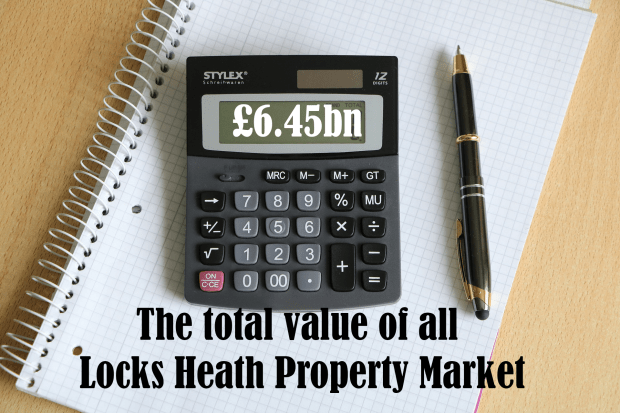
£6.45bn – The total value of all Locks Heath Property Market

calc-wording

“How much would it cost to buy all the properties in Locks Heath?”

This fascinating question was posed by the 11-year-old son of one of my Locks Heath Landlords when they both popped into my offices before the Christmas break (doesn’t that seem forever ago now!).  I thought to myself, that over the Christmas break, I would sit down and calculate what the total value of all the properties in Locks Heath are worth… and just for fun, work out how much they have gone up in value since his son was born back in the autumn of 2005.

In the last 11 years, since the autumn of 2005, the total value of Locks Heath property has increased by 50% or £2.15 billion to a total of £6.45 billion.  Interesting, when you consider the FTSE100 has only risen by 30.78% and inflation (i.e. the UK Retail Price Index) rose by 37% during the same 11 years.

When I delved deeper into the numbers, the average price currently being paid by Locks Heath households stands at £337.839.… but you know me, I wasn’t going to stop there, so I split the property market down into individual property types in Locks Heath; the average numbers come out like this:

Locks Heath Property Market
Average Value of a Detached Property Average Value of a Semi-Detached Property Average Value of a Terraced/Town House Property Average Value of an Apartment
£455,550 £305,344 £286,403 £180,333

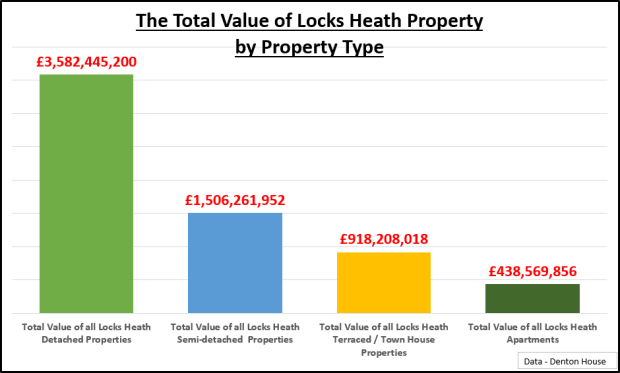
It got even more fascinating when I multiplied the total number of each type of property by the average value.  As detached houses are so expensive, when you compare them with the much cheaper terraced/town houses and apartments, you can quite clearly see how valuable detached properties are in terms of total pound note value, when compared to the value of the terraced/town houses and apartments.

Total Value of all the Locks Heath Detached Properties Total Value of all the Locks Heath Semi-Detached Properties Total Value of all the Locks Heath Terraced/Town House Properties Total Value of all the Locks Heath Apartments
£3,582,445,200 £1,506,261,952 £918,208,018 £438,569,856

150-graph

So, what does this all mean for Locks Heath?  Well as we enter the uncharted waters of 2017 and beyond, even though property values are already declining in certain parts of the previously over cooked Central London property market, the outlook in Locks Heath remains relatively good as over the last five years, the local property market was a lot more sensible than central London’s.

Locks Heath house values will remain resilient for several reasons.  Firstly, demand for rental property remains strong with continued immigration and population growth.  Secondly, with 0.25% interest rates, borrowing has never been so cheap and finally the simple lack of new house building in Locks Heath not keeping up with current demand, let alone eating into years and years of under investment means only one thing – yes it might be a bumpy ride over the next 12 to 24 months but, in the medium term, property ownership and property investment in Locks Heath has always, and will always, ride out the storm.

In the coming weeks, I will look in greater detail at my thoughts for the 2017 Locks Heath Property Market. As always, all my articles can be found at the The Locks Heath Property Blog 

£23m a year black hole in the Locks Heath Property Market – Is Buy to Let Immoral? (Part 2)

149-graphic-4

An Englishman’s Home is His Castle as Maggie Thatcher lauded – everyone should own their own home.  In 1971, around 50% of people owned their own home and, as the baby-boomers got better jobs and pay, that proportion of homeowners rose to 69% by 2001.  Homeownership was here to stay as many baby boomers assumed it’s very much a cultural thing here in Britain to own your own home.

But on the back of TV programmes like Homes Under the Hammer, these same baby boomers started to jump on the band wagon of Locks Heath buy to let properties as an investment.  Locks Heath first time buyers were in competition with Locks Heath Landlords to buy these smaller starter homes pushing house prices up in the 2000’s (as mentioned in Part One last week) beyond the reach of first time buyers.  However, it is not as simple as that.  Many factors come into play, such as economics, the banks and government policy.  But are Locks Heath Landlords fanning the flames of the Locks Heath housing crisis bonfire?

I believe that the Landlords of the 2,299 Locks Heath rental properties are not exploitative and are, in fact, making many positive contributions to Locks Heath and the people of Locks Heath.  Like I have said before, Locks Heath (and the rest of the UK) isn’t building enough properties to keep up the demand; with high birth rate, job mobility, growing population and longer life expectancy.

According to the Barker Review, for the UK to standstill and meet current demand, the country needs to be building 8.7 new households each and every year for every 1,000 households already built.  Nationally, we are currently running at 5.07 per thousand and in the early part of this decade were running at 4.1 to 4.3 per thousand.

It doesn’t sound a lot of difference, so let us look at what this means for Locks Heath…

For Locks Heath to meet its obligation on the building of new homes, Locks Heath would need to build 162 households each year.  Yet, we are missing that figure by around 67 households a year.

For the Government to buy the land and build those additional 67 households, it would need to spend £23,046,072 a year in Locks Heath alone.  Add up all the additional households required over the whole of the UK and the Government would need to spend £23.31bn each year… the Country hasn’t got that sort of money!

With these problems, it is the property developers who are buying the old run-down houses and office blocks which are deemed uninhabitable by the local authority, and turning them into new attractive homes to either be rented privately to Locks Heath families or Locks Heath people who need council housing because the local authority hasn’t got enough properties to go around.

The bottom line is that, as the population grows, there aren’t enough properties being built for everyone to have a roof over their head.  Rogue Landlords need to be put out of business, whilst Tenants should expect a more regulated rental market, with greater security for Tenants, where they can rely on good Landlords providing them high standards from their safe and modernised home.  As in Europe, where most people rent rather than buy, it doesn’t matter who owns the house – all people want is a clean, decent roof over their head at a reasonable rent.

So only you, the reader, can decide if buy to let is immoral.  But first let me ask this question – if the private buy to let Landlords had not taken up the slack and provided a roof over these people’s heads over the last decade where would these Tenants be living now?

Locks Heath’s private renting set to hit 2,967 households by 2021 – Is Buy to Let immoral? (Part 1)

keys-wordingCan we blame the 55 to 70-year-old Locks Heath citizens for the current housing crisis in the town?
Also known as the ‘Baby Boomer Generation’, these Locks Heath people were born after the end of the Second World War as the country saw a massive rise in births as they slowly recovered from the economic hardships experienced during wartime.

Throughout the 1970’s and 1980’s, they experienced (whilst in their 20’s, 30’s and 40’s) an unparalleled level of economic growth and prosperity throughout their working lifetime on the back of improved education, government subsidies, escalating property prices and technological developments, they have emerged as a successful and prosperous generation.

…Yet some have suggested these Locks Heath baby boomers have (and are) making too much money to the detriment of their children, creating a ‘generational economic imbalance’, where mature people benefit from house-price growth while their children are forced either to pay massive rents or pay large mortgages.

Between 2001 and today, average earnings rose by 65%, but average Locks Heath house prices rose by 109.6%

148-graph

The issue of housing is particularly acute with the generation called the Millennials, who are young people born between the mid 1980’s and the late 1990’s. These 18 to 30 years, moulded by the computer and internet revolution, are finding as they enter early adult life, it very hard to buy a property, as these ‘greedy’ landlords are buying up all the property to rent out back to them at exorbitant rents… it’s no wonder these Millennials are lashing out at buy to let landlords, as they are seen as the greedy, immoral, wicked people who are cashing in on a social despair.

Like all things in life, we must look to the past, to appreciate where we are now.

The three biggest influencing factors on the Locks Heath (and UK) property market in the latter half of the 20th Century were, firstly, the mass building of Council Housing in the 1950’s and 60’s. Secondly, for the Tory’s to sell most of those Council Houses off in the 1980’s and finally 15% interest rates in the early 1990’s which resulted in many houses being repossessed.  It was these major factors that underpinned the housing crisis we have today in Locks Heath.

To start with, in 1995 the USA relaxed its lending rules by rewriting the Community Reinvestment Act.  This Act saw a relaxation on the Bank’s lending criteria as there was pressure on these banks to lend on mortgages in low wage neighbourhoods, as the viewpoint in the USA was that anyone (even someone on the minimum wage) should be able to buy a home.  Unsurprisingly, the UK followed suit in the early 2000’s, as Banks and Building Society’s relaxed their lending criteria and brought to the market 100% mortgages, even Northern Rock started lending every man and his dog 125% mortgages.

So when we roll the clock forward to today, and we can observe those very same footloose banks from the early/mid 2000’s (that lent 125% with a just note from your Mum and a couple of breakfast cereal tokens), ironically reciting the Bank of England backed hymn-sheet of responsible-lending.  On every first time buyer mortgage application, they are now looking at every line on the 20-something’s banks statements, asking if they are spending too much on socialising and holidays… no wonder these Millennials are afraid to ask for a mortgage (as more often than not after all that – the answer is negative).

So, in Part Two next week, I will continue this emotive article and show you some very interesting findings on why young people aren’t buying property anymore (and it’s not what you think!).

Locks Heath Property Market Sees An Unpredicted Autumn Boost of 14%

shuttle-wording

Well, it doesn’t seem like two minutes ago that it was Christmas – and now it’s all over! One cold December afternoon, after arranging the office’s Christmas cards I thought I would nip out to Waitrose to get some lunch.  I met an old client of mine in there and we got talking about the Locks Heath property market.  I had just completed my research for my next blog article and I would like to share with you the parts of the conversation relating to the Locks Heath property market.

He asked me what my thoughts were about the last half of the year in regard to the Locks Heath property market and if there were any great buy to let deals around.  In reply I said that, in my view, shrugging off the uncertainty of the initial post Brexit vote, I have seen an increase in supply and a rise in the number of properties selling at the lower to middle end of the market, meaning both first time buyers and buy to let Landlords have been returning in the last few months – proof the market is beginning to bounce back.

So let’s look at the numbers…

In November 2016, according to the three main property portals (Rightmove, Zoopla and OnTheMarket) there were a total of 335 properties for sale in Locks Heath. In November 2015, there were only 293 properties for sale, a rise of 14%.

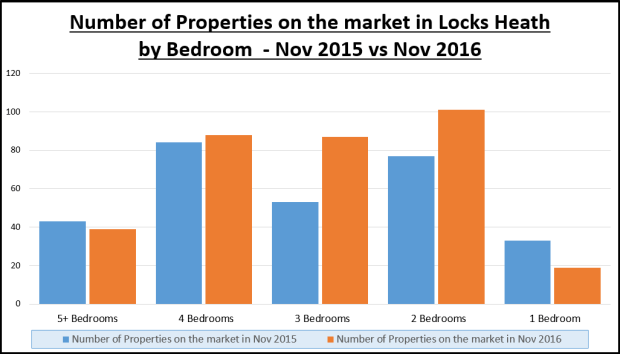
When I split it down into bedrooms (note things like building plots and part commercial/part residential etc won’t be in these figures so the numbers below wont exactly match up to those in the above paragraph).

# Properties on the market in Nov 2015 # Properties on the market in Nov 2016 Percentage Change
5+ Bedrooms 43 39 -9%
4 Bedrooms 84 88 +5%
3 Bedrooms 53 87 +64%
2 Bedrooms 77 101 +31%
1 Bedroom 33 19 -42%

147-graph

… and when I looked at type of properties it got even more interesting…

Type of Property # Properties on the market in Nov 2015 # Properties on the market in Nov 2016 Percentage Change
Detached 139 149 +7%
Semi 37 48 +30%
Terraced 7 27 +286%
Flat 79 76 -4%

As the number of Locks Heath properties put up for sale has risen by 14%, homeowners have become more realistic about how much their homes are worth.  This increase in homeowners wanting to sell suggests there is renewed confidence in the Locks Heath property market and there are also signs that people are being more realistic about pricing their property.

As you can see, there has been a significant uplift in terraced properties, which means they are a great choice for first time buyers and Landlords.  So with a combination of realistic pricing and more properties on the market – both first time buyers and Landlords alike might be able to pick up a few bargains!

‘Deal of the Week’ -4.7% Gross Yield in Locks Heath

pennycress

I have been taking a look at the latest properties to come to the market since we all returned after the festive break and come across this exciting prospect that I thought I would share with you.

It is a three bedroom end of terrace house in Pennycress, Locks Heath with a garage in a block.  From the pictures online with Purple Bricks the property looks in decent order to let straight out with little fuss.

Three bedroom houses have Tenants fighting over them in Locks Heath currently so finding a Tenant quickly won’t be a problem.  A monthly rent of £995 will give you a gross yield of 4.7% based on the asking price of £250,000 (OIEO).

I realise that yields aren’t the only point of interest for Landlords and that capital growth is a major factor to consider.  This property last sold in October 2012 for £181,000 meaning that in just over 4 years the property has increased in value by 38.12%.

Full details can be found HERE but this one shouldn’t be around for long so be quick.

I am always happy to give you my unbiased opinion on any properties that you are thinking of purchasing so feel free to give me a call on 01489 570011 or send me the details through to james.hill@brooklettings.co.uk.

Locks Heath property price rises set to be more restrained in 2017 due to Brexit

belt-wordingWhile Brexit has not yet had a sizeable impact on the Locks Heath housing market, my analysis is pointing to the fact that the economic viewpoint still remains uncertain and Locks Heath property price growth is likely to be more subdued in 2017 – although that isn’t a bad thing so let me explain.

Since the summer, apart from a little wobble of uncertainty a few weeks after the Referendum vote, property values (and the economy), on the whole has outperformed what most people were anticipating.  In fact, when I looked at the property prices for our Fareham Borough Council area, these were the results…

146-graph

October 2016               – drop of 1.42%

September 2016         – drop of 0.48%

August 2016                 – rise of 0.47%

July 2016                       – rise of 1.23%

June 2016                      – rise of 1.78%

The UK property market continues to perform robustly (because we can’t just look at Locks Heath as if in its own little bubble) with annual price growth set to end 2016 at 6.91% and the South East region property market at 9.1%.

Talking to fellow agents in London, the significant tidal wave of growth seen from 2013 through to 2015 in the capital has subdued over the last six months.  However, as that central London house price wave has started to ripple out, agents are starting to see stronger property growth values in East Anglia and the South East regions outside of London, than what is being seen within the M25.  So, fellow Locks Heath Landlords and homeowners, is this the time to get your surfboards ready for the London wave?

Well, we in Locks Heath haven’t really been affected by what is happening in the central London property mega bubble (i.e. Kensington, Chelsea, Marylebone, Mayfair etc.).  The property market locally is more driven by sentiment, especially the ‘C’ word… confidence. The main forces for a weaker Locks Heath Property market relate to economic uncertainty surrounding the Brexit process, which I believe will impact unhelpfully on consumer confidence in the run up to and just after the serving of the Section 50 Notice by the end of Q1 2017.

In addition, the influence of reforms to the taxation of Landlords is expected to result in a reduced demand from buy to let Landlords, which will limit upward pressure on property values.  However, on the other side of the coin, demand from Tenants has been strong, but this has been counterbalanced by a strong supply of rental properties.  In my opinion, there is a slight risk of rents not growing as much in 2017 as they did in 2016, but by 2018 they will rise again to counteract Philip Hammond’s changes to Tenant fees.

The broader Locks Heath rental market looks relatively positive with modest rental growth expected and rents might rise further if Landlords begin to sell properties in an effort to offset to the impact of tax rises.

But these predictions do not take into account any effect of a possible snap General Election or further referendum on ratifying any Brexit deal (if that comes to pass in the future).

Locks Heath Property Market – Q4 Update

Santa - Wording.pngWell, hasn’t 2016 been eventful.  The ups and downs of Brexit, the Queen’s 90th, Andy Murray winning Wimbledon, Trump, Bake Off to Channel 4 and something close to the hearts of every buy to let Landlord and homeowner in Locks Heath … the Locks Heath property market.
So, let’s look at the headlines for the Locks Heath property market…

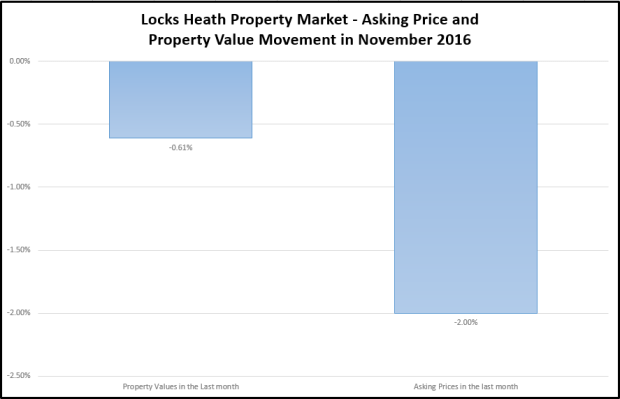
144-graph

In the last month, Locks Heath property values dropped by 0.61%, leaving them, year on year 10.1% higher, whilst interestingly, Locks Heath asking prices are down 2.0% month on month.  All three statistics go to show the Locks Heath property market has recovered well after the summer lull, which was worsened by the uncertainty surrounding the EU vote back in June.  Irrespective of all the issues, the average value of a Locks Heath home now stands at £344,700.

Generally, Locks Heath asking prices continue to hold up well, as asking prices are 4.7% higher year on year.  At this time of year, asking prices tend to drop on the run up to Christmas, and locally they dropped by 2.0% in November 2016, although this still compares well with last year’s drop in Locks Heath asking prices, as we saw asking prices drop by 1.1% in November 2015.

It is also interesting to take note from a recent survey by the Royal Institution of Chartered Surveyors, stating new buyer enquiries and new instructions are falling at the same rate, suggesting that there will not be a downward pressure on property values.

Looking at the figures for the UK (as we can’t just look at Locks Heath in isolation), property values are generally rising slower than a few years ago, but on a positive note, there is still growth across the UK.  You see, slowing property value growth isn’t solely Brexit related, but after a number years of double digit rises in property values, affordability has weakened and cooling price growth is widely seen to be a natural correction of the market.

On the other hand, interest rates being at a record low of 0.25% are helping the property market.  The cut in interest rates in the late summer was the medicine for the post-Brexit worry and will, as a consequence, ensure that the UK economy continues to be underpinned by buoyant property prices.

So, what will happen in 2017 in the Locks Heath property market?

Some say until we know what type of exit the UK will make from the EU it is hard to evaluate the outcome.  Although, I believe, the whole Brexit issue is a sideshow to the main issue in the UK (and Locks Heath) housing market as a whole.  As I have mentioned time and time again over the last few months, the biggest issue is demand outstripping supply when it comes to the number of households required to house us all.  Locks Heath has an ever-growing population: with immigration (we still have at least two years of free movement from EU members into the UK), people living longer and the fact we need thousands of additional households as the country has nearly 115,000 divorces a year (where one household becomes two households).  These are interesting times ahead!