To increase the rent or not increase the rent? That is the question.

money-with-wordingRent increases can be a tricky subject to tackle but it is something I am discussing with increasing regularity with Landlords so this week I thought I would break from my usual articles and share my thoughts with my lovely readers.

So should you rock the boat and increase your Tenant’s rent or not?  Let’s have a look at some points to help you make your mind up…

Potential problems

Before you make a decision you should take time to consider whether an increase is really needed.  A hasty decision could damage your relationship with your Tenant and in extreme cases could lead to them leaving the property altogether.  This can leave you with an empty property and some costs involved with finding a new Tenant.

Why am I thinking about an increase?

Ask yourself why you feel an increase is necessary – Are you increasing it because your costs or mortgage rates have risen or are you doing it out of greed?

From my experience, if you have a good Tenant (i.e. one that pays the rent on time and looks after the property) and treat them fairly, that usually equates to the most profitable experience – even without increasing rent.

Good reasons Vs Bad reasons

Some valid reasons for an increase can be a mortgage rate increase, changes in taxation, changes in market conditions or simply that the property is costing more to maintain.

However if you are increasing the rent out of greed or just because you can then I would recommend leaving it alone.

If you think that your property is worth more rent than you are currently getting then you should speak to a local lettings expert who can advise you on the current market conditions and give you an accurate up-to-date valuation of your property.

Am I able to increase my Tenant’s rent?

Before making any other considerations you need to know if you are actually able to increase your Tenant’s rent.

If you are currently within a fixed term tenancy then you cannot make an increase unless there is a clause in the tenancy agreement that specifically states that the Landlord can review the rent during the fixed term or it is specifically stated that the rent will increase to a set amount after a period of time (ie. After the first six months).  Of course any such clause would need to be deemed fair, and too much of a dramatic increase may spur your Tenant to contest the new rent amount at a tribunal.

How do I increase the rent?

Ok, so you’ve finally made up your mind and are looking to increase the rent.  Before you take the plunge there are strict procedures to follow.  Failure to follow the correct procedure could lead to your request for more rent being invalid.

  1. Negotiate the rent increase when renewing the Tenant’s contract.

If your tenancy has recently come to an end you may want to renew it on to another fixed term tenancy.  If this is the case the easiest way to enforce a new rent can be to agree it as part of the renewal process.  Just ensure that the new rent is detailed in the new tenancy agreement.

  1. Agree an increase mid-tenancy and document it

As I briefly mentioned earlier in this article you can agree a review of the rent or a set increase to take place during a tenancy before the tenancy agreements are signed.  Any clause must be fair and detailed within the tenancy agreement.  You should also write to the Tenant when the time comes to notify them that you would like to enforce the clause giving adequate notice.

  1. Serve the Tenant with a Rent Increase Notice

If nothing is done to renew the tenancy agreement after the fixed term ends it will roll on to a Statutory Periodic tenancy.  In this instance you should issue your Tenant with a Rent Increase Notice if you wish to increase the rent.

A Section 13(2) Notice of the Housing Act 1988 must be served proposing the new rent and the date at which you would like it to commence.  For a monthly, weekly or fortnightly tenancy, you should provide at least one month’s notice to your Tenant of the increase.

What if the Tenant refuses the rent increase?

If the Tenant feels that the rent increase that you are trying to enforce via a Section 13(2) notice is excessive and they do not wish to discuss it with you, they can refer the rent increase to the Tribunal.  They must do this before the starting date of the proposed new rent.  In this instance they should notify you that they are doing so.

The tribunal will consider the Tenant’s application and decide what the maximum rent for the property should be. In setting a rent, the tribunal must decide what rent the landlord could reasonably expect for the property if it were let on the open market under a new tenancy on the same terms. The tribunal may therefore set a rent that is higher, lower or the same as the proposed new rent.

A note to remember…

If you have a good Tenant paying the rent on time and looking after your property then think before increasing the rent.  A good Tenant can be hard to find so if you already have one then take into consideration how much time and money it will cost you to find a new Tenant should they not want to pay your increase.

Keep an eye on the market and comparative rental prices.  If you are charging less and the market is buoyant then it may be a good time to bargain with your Tenant.  If they can see that an alternative property will cost them more a month and that they will incur more fees and moving costs they will be more inclined to accept your increase.

For more articles on the local property market please visit www.thelocksheathpropertyblog.co.uk.

New House Building in Locks Heath increased by 2.4% in the last year

builders-wordingLet me speak frankly, even with Brexit and the fact immigration numbers will now be reduced in the coming years, there is an unending and severe shortage of new housing being built in the Locks Heath area (and the UK as a whole).  Even if there are short term confidence trembles fueled by newspapers hungry for bad news, the ever growing population of Locks Heath with its high demand for property versus curtailed supply of properties being built, this imbalance of supply/demand and the possibility of even lower interest rates will underpin the property market.
When the Tories were elected in 2015, Mr. Cameron vowed to build 1,000,000 new homes by 2020.  If we as a Country hit those levels of building, most academics stated the UK Housing market would balance itself as the increased supply of property would give a chance for the younger generation to buy their own home as opposed to rent.  However, the up-to-date building figures show that in the first three months of 2016 building starts were down.  Nationally, there were 35,530 house building starts in the first quarter, a long way off the 50,000 a quarter required to hit those ambitious targets.

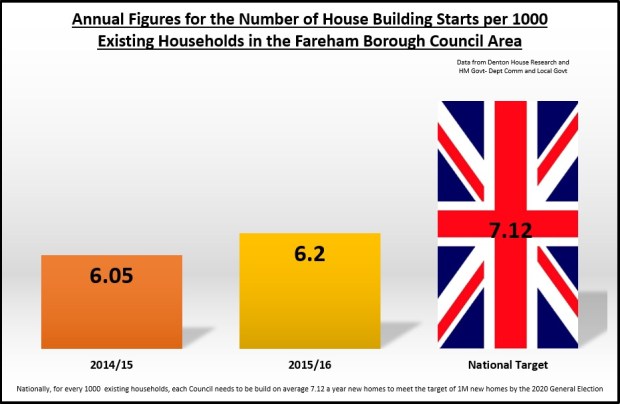
Looking closer to home, over the last 12 months, new building in the Fareham Borough Council area has grown.  In 2014/15, for every one thousand existing households in the area, an additional 6.05 homes were built.  For 2015/16, that figure is now 6.2 homes built per thousand existing households.  Nationally, to meet that 1,000,000 new homes target, we need to be at 7.12 new homes per thousand.

127-graph

To put those numbers into real chimney pots, over the last 12 months, in the Fareham Borough Council area,

  • 280 Private Builders (e.g. New Homes Builders)
  • 20 Housing Association
  • Nil Local Authority

These new house building numbers are down to the fact that not enough is being done to fix the broken Locks Heath housing market.  Although we are seeing 300 new homes being built per year in the Fareham Borough Council area, when we at least 345 a year to even stand still!

I am of the opinion Messers Cameron and Osborne focused their attention too much on the demand side of the housing equation, using the Help to Buy scheme and low deposit mortgages to convert the ‘Generation Rent’ i.e. Locks Heath ‘20 somethings’ who are set to rent for the rest of their lives to ‘Generation Buy’.  On the other side of the coin, I would strongly recommend the new Housing Minister, Gavin Barwell, should concentrate the Government’s efforts on the supply side of the equation.  There needs to be transformations to planning laws, massive scale releases of public land and more investment, as more inventive solutions are needed.

However, ultimately, responsibility has to rest on the shoulders of Theresa May.  Whilst our new PM has many plates to spin, evading on the housing crisis will only come at greater cost later on.  What a legacy it would be if it was Mrs May who finally got to grips with the persistent and enduring shortage of homes to live in.  The PM has already referenced the ‘need to do far more to get more houses built’ and stop the decline of home ownership.  However, she has also ruled out any changes to the green belt policy – something I will talk about in a future article.  Hopefully these statistics will raise the alarm bells again and persuade both residents and Councilors in the Fareham Borough Council area that housing needs to be higher on its agenda.

Locally of course fundamental changes to the district’s infrastructure will be required to ensure that there are adequate schools and doctors to support any new housing and subsequent increase of population.  I know that this is a hot topic amongst local residents and that there is an outcry for this to be addressed by Councilors when planning is considered.

In the meantime, for more thoughts and opinion on the Locks Heath Property Market, please visit the Locks Heath Property Blog.

Plans for flat complex at Warsash Maritime Academy expected

Long has it been the subject of conversation for the villagers of Warsash and other local residents in the area but it has recently been confirmed that plans to turn buildings at the Warsash Maritime Academy in Newtown Road into flats are set to be unveiled in the coming weeks.

The upper part of the Academy will be the subject of a planning application for a flat complex in the next month according to Councillor Trevor Cartwright who represents Warsash on Fareham Borough Council.

Southampton Solent University, which runs the academy has confirmed that it will be moving the facilities in the upper part to its central campus in Southampton.  However the site is set to retain the specialist facilities by the shore such as the lower part of the site and the pier.

Residents of Warsash will have mixed feelings about the news.  The Academy has been on the site for more than 100 years and has around 150 staff and 5,000 students.

I will post more details when they are made public.

For more articles about the local property market read The Locks Heath Property Blog.


Post Brexit – Locks Heath Property Prices set to drop £26,700 in the next 12 months?

shocked-wordsEven the most sane person in Britain has to admit the Brexit vote will, in one shape or another, affect the UK Property market. Excluding central London which is another world, most commentators are saying prices will be affected by around 10%. So looking at the commentators’ thoughts in more detail, property values in Locks Heath will be 10% lower than they would have been if we hadn’t voted to leave the EU.
As the average value of a property in the Fareham Borough Council area is £267,100, this means property values are set to drop for the average Locks Heath property by £26,710 … batten down the hatches .. soup kitchens and mega recession here we come ..it’s going to get rough.

but before we all go into panic mode in Locks Heath… the devil is always in the detail

Look at the phrase again, and I have highlighted the relevant part “Property values in Locks Heath will be 10% lower than they would have been if we hadn’t voted to leave the EU”

Property values today, according to the Land Registry are 9.87% higher than a year ago in the Fareham Borough Council area. The 12 months before that they rose by 11.16% and the 12 months before that, they rose by 5.37%. If we hadn’t voted to leave, I believe on these figures, we could have safely assumed Locks Heath House prices would have been 9% higher by the Summer of 2017.

… and that’s the point, we won’t see a house price crash in Locks Heath, it’s just that house prices in a year’s time will be 1% lower than they are now (ie 9% less the 10% lower figure because of Brexit). Let’s look at the historic figures and how that compares to today’s figures for the Fareham Borough Council area and Locks Heath as a whole.

Average Value of a property 20 years ago                             £  64,000

Average Value of a property 10 years ago                             £193,800

Average Value of a property 2 years ago                               £218,700

Average Value of a property 1 year ago                                  £243,100

Average Value of a property today                                          £267,100

Projected Value of a property in 12 months’ time             £264,400

Therefore, I believe the average value of a Locks Heath property will be £2,700 lower in 12 months’ time than today.

That’s not to say Locks Heath property prices might not dip slightly in the run up to Christmas (in fact they always have done just about every year since the year 2000 and most of those were boom years).  But in 12 months’ time this is my considered opinion of where Locks Heath property values will be, and looking at the historic prices, even if I (and many other property market commentators) are wrong and they do drop 10% from TODAY’S figure… in the whole scheme of things, we have been through a Credit Crunch, Black Monday and 15% interest rates over the last 20 to 30 years and still Locks Heath house prices have always bounced back.

… and Locks Heath landlords?  They have recently been thrashed by Osborne’s tax changes, but yields could rise if Locks Heath house prices fall/stablise and rents grow. This might also make it easier to obtain mortgages, as the income would cover more of the interest cost. If prices were to level or come down that could help Locks Heath landlords add to their portfolio, as rental demand for Locks Heath property is expected to stay strong as more people find it more and more difficult to obtain mortgages.

For more articles like this please visit The Locks Heath Property Blog.

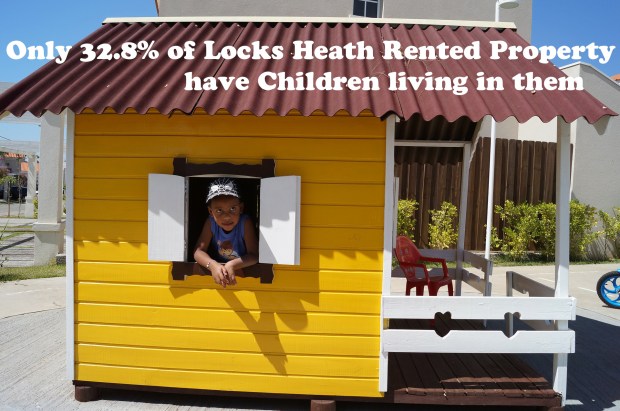
Only 32.8% of Locks Heath Rented Property have Children living in them

Play House - wordedA few weeks ago I was asked a fascinating question by a local Councillor who, after reading the Locks Heath Property Blog, emailed me and asked me –
Are Locks Heath Landlords meeting the Challenges of tenanted families bringing up their families in Locks Heath?”

What an interesting question to be asked.

Irrespective of whether you are Tenant or a homeowner, to bring up a family, the most important factors are security and stability in the home. A great part of that security and stability in a rented property stems from whether Tenants are constantly being evicted. Many tenancies last just six months with families at risk of being thrown out after that with just two months’ notice for no reason.

Some “left leaning Politicians” keep saying we need to deal with the terrible insecurity of Britain’s private rental market by creating longer tenancies of 3 or 5 years instead of the current six months. However, the numbers seem to be telling a different story. The average length of residence in private rental homes has risen in the last 5 years from 3.7 years to 4 years (a growth of 8.1%), which in turn has directly affected the number of renters who have children. In fact, the proportion of private rented property that have dependent children in them, has gone from 29.1% in 2003 to 37.4% today.

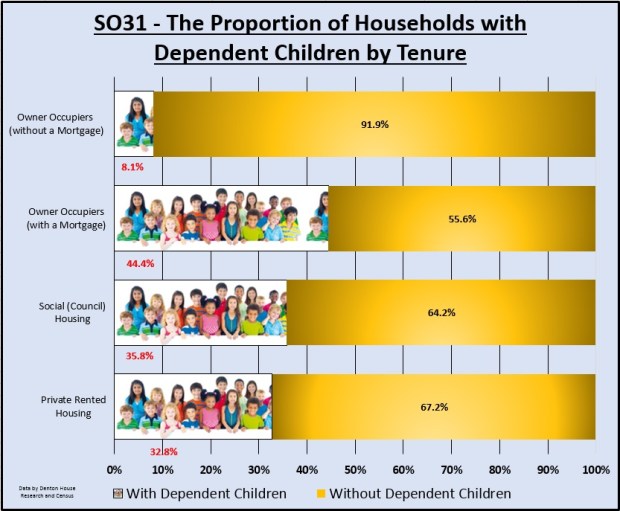
Looking specifically at the SO31 are including Locks Heath compared to the National figures, of the 2,467 private rental homes in Locks Heath, 810 of these have dependent children in them (or 32.8%), which is interestingly (although expected) below the National average of already stated 37.4%.

Even more fascinating are the other tenure types in SO31 Locks Heath…

35.8% of Social (Council) Housing in Locks Heath have dependent children

44.4% of Locks Heath Owner Occupiers (with a Mortgage) have dependent children

8.1% of Owner Occupiers (without a Mortgage) have dependent children

129 Graph

Although, when we look at the length of time these other tenure types have, whilst the average length of a tenancy for the private rented sector is 4 years, it is 11.4 years in social (council) housing, 24.1 years for home owners without a mortgage and 10.4 years of homeowners with mortgages.

Anecdotally I have always known this, but this just proves landlords do not spend their time seeking opportunities to evict a Tenant as the average length of tenancy has steadily increased. This noteworthy 8.1% increase in the average length of time Tenants stay in a private rented property over the last 5 years, shows Tenants are happy to stay longer and start families.

So, as Landlords are already meeting Tenants’ wants and needs when it comes to the length of tenancy, I find it strange some politicians are calling for fixed term 3 and 5 year tenancies. Such heavy handed regulation could stop Landlords renting their property out in the first place, cutting off the supply of much needed rental property, meaning Tenants would suffer as rents went up. Also, if such legislation was brought in, Tenants would lose their ‘Get Out of Jail card’, as under current rules, they can leave at any time with one month’s notice not the three or six month Tenant notice suggested by some commentators.

Finally, there is an extra piece of good news for Locks Heath Tenants. The English Housing Survey notes that those living in private rented housing for a long periods of time generally paid less rent than those who chopped and changed.

For more articles like this please visit the Locks Heath Property Blog www.thelocksheathpropertyblog.co.uk.

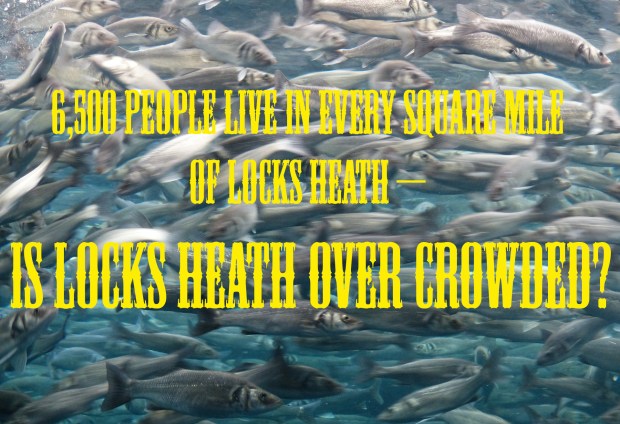
6,500 People Live In Every Square Mile Of Locks Heath – Is Locks Heath Over Crowded?

Fish wordingLocks Heath is already in the clutches of a population crisis that has now started to affect the quality of life of those living in Locks Heath. There are simply not enough homes in Locks Heath to house the greater number of people wanting to live in the suburb. The burden on public services is almost at breaking point with many parents unable to send their child to their first choice of primary or secondary school and the chances of getting a decent Dentist or GP Doctor Surgery next to nil.
Let’s look at real numbers with the housing issue in Locks Heath. To start with, the UK has roughly 1,065 people per square mile – the second highest in Europe. The total area of Locks Heath, Warsash and Whiteley itself is 6.578 square miles and there are 43,300 Locks Heath, Warsash and Whiteley residents, meaning…

6,500 people live in each square mile of Locks Heath, Warsash and Whiteley, it is no wonder we appear to be bursting at the seams! 

128 Graph

… but yet again, newspapers, politicians and property market bloggers quote big numbers to sell more newspapers, get elected or get people to read their blog (I recognise the irony!).  A square mile is enormous, so the numbers look correspondingly large (and headline grabbing). Most people reading this will know what an ‘acre’ is, but those younger readers who don’t, it is an imperial unit of measurement for land and it is approximately 63 metres square.

In Locks Heath, Warsash and Whiteley, only 9.39 people live in every acre… not as headline grabbing, but a lot closer to home and relative to everyday life, and if I am being honest, a figure that doesn’t seem that bad.

Yet, the issue at hand is, we need more homes building. In 2007, Tony Blair set a target that 240,000 homes a year needed to be built to keep up with the population growth, whilst the Tory’s new target since 2010 was a more modest 200,000 a year. However, since 2010, as a country, we have only been building between 140,000 and 150,000 houses a year. So where are we going to build these homes… because we have no space!  Or do we?

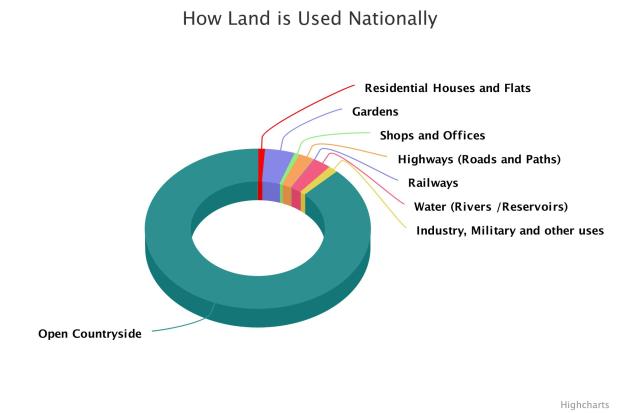
Well, let me tell you this fascinating piece of information I found out recently in an official Government report. Looking specifically at England (as it is the most densely populated country of the Union), all the 20 million English homes cover only 1.1% of its land mass. That is not a typo, only one point one per cent (1.1%) of land in England is covered by residential property. In more detail, of all the land in the Country:

  • Residential Houses and Flats 1%
  • Gardens 4.3%
  • Shops and Offices 0.7%
  • Highways (Roads and Paths) 2.3%
  • Railways 0.1%
  • Water(Rivers /Reservoirs) 6%
  • Industry,Military and other uses 1.4%

… leaving 88.5% as Open Countryside (and if you think about it, add to that the gardens, which are green spaces, and the country is 92.8% greenspace)

Land use

As a country, we have plenty of space to build more homes for the younger generation and the five million more homes needed in the next 20 years would use only 0.25% of the country’s land.  Now I am not advocating building massive housing estates and 20 storey concrete and glass apartment blocks next to local beauty spots such as nearby Titchfield Haven National Nature Reserve or Titchfield Abbey, but with some clever planning and joined up thinking, we really do need to think outside the box when it comes to how we are going to build and house our children and our children’s children in the coming 50 years in Locks Heath. If anyone has their own ideas, I would love to hear from you.

In the meantime, if you would like to read other articles about Locks Heath Property Market, please visit the Locks Heath Property Blog www.thelocksheathpropertyblog.co.uk.

87.8% of Locks Heath Properties Have 3 or More Bedrooms – Problem or Opportunity?

EdittedThe orthodox way of classifying property in the UK is to look at the number of bedrooms rather than its size in square metres (although now we are leaving the EU – I wonder if we can go back to feet and inches?). It seems that homeowners and tenants are happy to pay for more space. It’s quite obvious, the more bedrooms a house or apartment has, the bigger it is likely to be. The reason being not only the actual additional bedroom space, but the properties with more bedrooms tend to have larger / more reception (living) rooms. However, if you think about it, this isn’t so astonishing given that properties with more bedrooms would typically accommodate more people and therefore require larger reception rooms.
In today’s Locks Heath property market, the Locks Heath homeowners and Locks Heath landlords I talk to are always asking me which attributes and features are likely to make their property comparatively more attractive and which ones may detract from the price. Over time, buyers’ and tenants’ wants and needs have changed. In Locks Heath, location is still the No. 1 factor affecting the value of property, and a property in the most sought after neighbourhoods, say Warsash, can command a higher price than a similar house in an ‘average’ area.  However, after location, the next characteristic that has a significant influence on the desirability, and thus price, of property is the number of bedrooms and the type (i.e. Detached/ Semi/Terraced/Flat).

In previous articles, I have analysed the Locks Heath housing stock into bedrooms and type of property, but never before now have I cross-referenced type against bedrooms. These figures for the Fareham Borough Council area make fascinating reading. It shows 87.8% of all properties in the area have 3 or more bedrooms

Detached Semi-detached Terraced (including end-terrace) Flat
1 bedroom 14 58 17 101
2 bedrooms 138 554 772 1,104
3 bedrooms 1,987 4,585 3,700 115
4 bedrooms 5,126 1,560 697 10
5 or more bedrooms 1,755 345 125 2

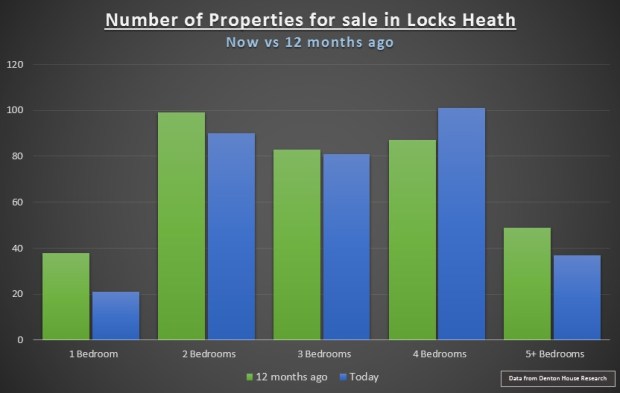
I was genuinely surprised at the low numbers of one and two bed properties, especially 2 bed semi detached houses, especially as tenants like the smaller one and two bed properties in Locks Heath. You see, it might interest the homeowners and landlords of Locks Heath, that there has been a change in the numbers of properties on the market and the split in bedrooms on the market over the last 12 months

  • 12 months ago, 38 one bed properties were for sale in Locks Heath, today 21, a drop of 45%
  • 12 months ago, 99 two bed properties were for sale in Locks Heath, today 90, a drop of 9%
  • 12 months ago, 83 three bed properties were for sale in Locks Heath, today 81, a drop of 2%
  • 12 months ago, 87 four bed properties were for sale in Locks Heath, today 101, a rise of 16%
  • 12 months ago, 49 five + bed properties were for sale in Locks Heath, today 37, drop of 24%

126 Graph

For several years Locks Heath buy-to-let investors have been the only buyers at the lower end (starter homes) of the market, as they have been enticed by high tenant demand and attractive returns. Some Locks Heath landlords believe their window of opportunity has started to close with the new tax regime for landlords, whilst it already appears to be opening wider for first-time buyers. This is great news for first time buyers, but one final note for Locks Heath landlords – all is not lost, you can still pick up bargains, you just need to be a lot more savvy and do your homework. One source of such information with articles like this is the Locks Heath Property Blog – http://www.thelocksheathpropertyblog.co.uk.

25.3% Of Locks Heath Homes Are One Person Households

Single person wordingI was having an interesting chat with a Locks Heath buy to let Landlord the other day when the subject of size of households came up in conversation.  For those of you who read my Brexit article published on the morning after the referendum, one of the reasons on why I thought the Locks Heath property market would, in the medium to long term, be OK, was the fact that the size of households in the 21st Century was getting smaller – which would create demand for Locks Heath Property and therefore keep property prices from dropping.
Looking at the stats going back to the early 1960’s, when the average number of people in a home was exactly 3, it has steadily over the years dropped by a fifth to today’s figure of 2.4 people per household. Doesn’t sound a lot, but if the population remained at the same level for the next 50 years and the we had the same 20% drop in household size, the UK would need to build an additional 5.28 million properties ( or 105,769 per year). When you consider the Country is only building 139,800 properties a year it doesn’t leave much for people living longer and immigration. Looking closer to home…

In the Fareham Borough Council area, the average number of occupants per household is 2.4 people

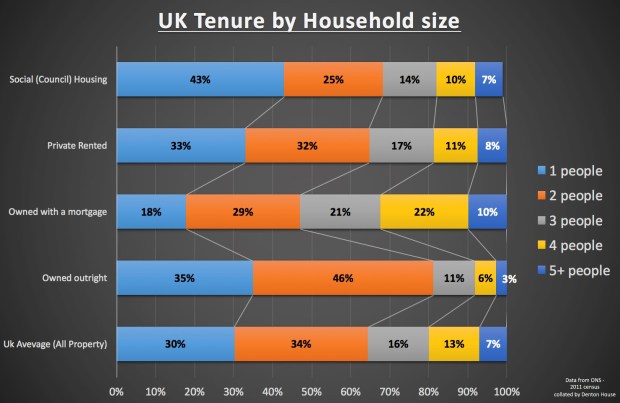
When we look at the current picture nationally and split it down into tenure types (i.e. owned, council houses and private renting, a fascinating picture appears.

The vast majority of homeowners who don’t have a mortgage are occupied by one or two people (81% in fact), although this can be explained as residents being older, with some members of the family having moved out, or a pensioner living alone.  People living on their own are more likely to live in a Council house (43%) and the largest households (those with 4 or more people living in them are homeowners with a mortgage – but again, that can be explained as homeowners with families tend to need a mortgage to buy. What surprised me was the even spread of private rented households and how that sector of population are so evenly spread across the occupant range – in fact that sector is the closest to the national average, even though they only represent a sixth of the population.

UK Tenure Graph 124

When we look at the Fareham Borough Council figures for all tenures (Owned, Council and Private Rented) a slightly different picture appears…

1 person households in Locks Heath 2 person households in Locks Heath 3 person households In Locks Heath 4 person households in Locks Heath 5+ person households in Locks Heath
25.36% 39.33% 16.02% 13.97% 5.32%

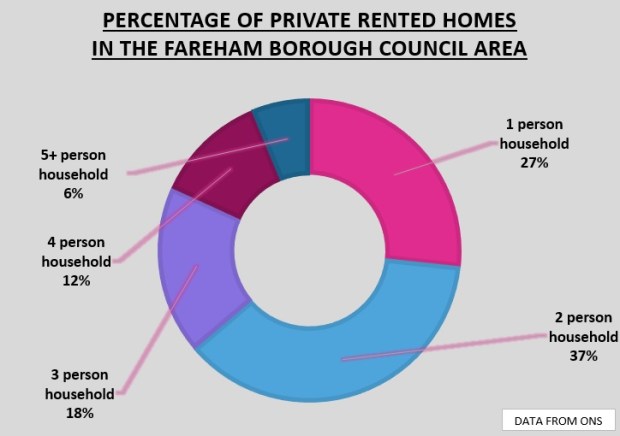
But it gets even more interesting when we focus on just private rental properties in Locks Heath, as it is the rental market in Locks Heath that really fascinates me. When I analysed those Fareham Borough Council private rental household composition figures, a slightly different picture appears. Of the 3,906 Private rental properties in the  Fareham Borough Council area:

  • 26.6% of Private Rental Properties are 1 person Households
  • 36.9% of Private Rental Properties are 2 person Households
  • 18% of Private Rental Properties are 3 person Households
  • 11.9% of Private Rental Properties are 4 person Households
  • 6.2% of Private Rental Properties are 5+ person Households

% Private Rented in FBC Graph

As you can see, Locks Heath is not too dissimilar from the national picture but there is story to tell. If you are considering future buy to let purchases in the coming 12 to 18 months, I would seriously consider looking at two and three bedroom houses. Even with the numbers stated, there are simply not enough two and three bedroom houses to meet the demand. They have to be in the right part of Locks Heath and priced realistically, but they will always let and when you need to sell, irrespective of market conditions at the time, will always be the target of buyers. To read more articles on the Locks Heath Property Market and where I consider best buy to let deals are in Locks Heath and the rest of the local area, please visit the Locks Heath Property Blog http://www.thelocksheathpropertyblog.co.uk.

89.3% of Locks Heath Homeowners are over 35 – The affect of their Brexit vote on the Locks Heath Property Market

Brexit - wordedWell it’s been four weeks since the Referendum vote and we have had a chance to reflect on the momentous decision that the British public took. Many of you read the article I wrote on the morning of the results. I had gone to bed the night before with a draft of my Remain article nicely all but finished, to be presented, first thing in the morning, with the declaration by the BBC saying we were leaving the EU. I don’t think any of us were expecting that.

If you want to read a copy of that original Post Brexit blog post, please visit my blog www.thelocksheathpropertyblog.co.uk and scroll back to late June to find it.  In this article I would like to take my thoughts on from that initial article and now start to see the clearer picture as the dust settles on the UK, but more importantly, the Locks Heath Property Market.

In case you weren’t aware, the residents of the Fareham Borough Council area went with the National mood and voted as follows:

Fareham Borough Council      Remain Votes              32,210             (44.9% of the vote)

Fareham Borough Council      Leave Votes                 39,525             (55.1% of the vote)

Fareham Borough Council Turnout    79.6%

I have been reading there is some evidence to indicate younger voters were vastly more likely to vote Remain than their parents and grandparents and, whilst the polling industry’s techniques may have been widely criticised, following them getting both the 2010 General Election and the recent Brexit vote wrong, anecdotally, many surveys seem to suggest there was a relationship between age and likelihood to support leaving the EU.

Interestingly, the average age of a Locks Heath resident is 42.6 years old, which is above the national average of 39.3, which might go someway to back up the way Locks Heath voted? What I do know is that putting aside whether you were a remain or leave voter, the vote to leave has, and will, create uncertainty and the last thing the British property market needs is uncertainty (because as with previous episodes of uncertainty in the UK economy – UK house prices have tended to go down).

Interestingly, when we look at the Homeownership rates in the Fareham Borough Council area, of the 37,734 properties that are owned in the Fareham Borough Council area (Owned being owned outright, owned with a mortgage or shared ownership), the age range paints a noteworthy picture:

Age 16 to 34 homeowners      2,545    or       6.7%  (Nationally 9.6%)

Age 35 to 49 homeowners    10,429    or     27.7%  (Nationally 29.2%)

Age 50 to 64 homeowners    11,906    or     31.5%  (Nationally 30.7%)

Aged 65+ homeowners         12,854    or     30.1%  (Nationally 30.5%)

123 Graph

So, looking at these figures, and the high proportion of older homeowners, you might think all the Fareham Borough Council area homeowners would vote Remain to keep house prices stable and younger people would vote out so house prices come down- so they could afford to buy?

But there’s a risk in oversimplifying this. The sample of the polling firms are in the thousands whilst the country voted in its millions. Other demographic influences have been at play in the way people voted, as early evidence is starting to suggest that class, level of education, the levels of immigration and ethnic diversity had an influence on the way the various parts of the UK voted.

So what I suggest is this – Don’t assume everyone over the age of 50 voted ‘Leave’ and don’t assume most 20 somethings backed ‘Remain’; because many didn’t!

… and the Locks Heath Property Market – well, read my original article in the Locks Heath Property Blog and you can make your own mind up: https://thelocksheathpropertyblog.co.uk/2016/06/24/55-1-of-fareham-voters-voted-to-leave-the-eu-what-now-for-the-16279-locks-heath-landlords-and-homeowners/

Which is the best month to sell your Locks Heath home?

FlowersI had a Landlord from Park Gate email me the other day. She said she had been following my blog (the Locks Heath Property Blog) for a while and wanted to pick my brain on when is the best time of the year to sell a property. Trying to calculate the best time to put your Locks Heath property on the market can often seem something akin to witchcraft and, whilst I would agree that there are particular times of the year that can prove more productive than others, there are plenty of factors that need to be taken into consideration.
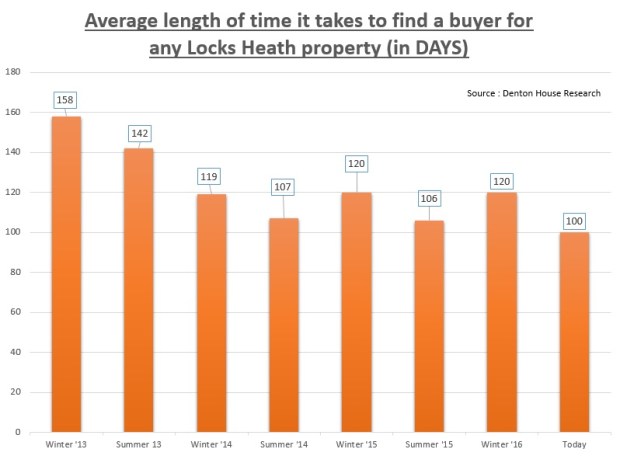
Even if you are putting your property on the market, you don’t know how long it will take to find a buyer – no crystal ball to help with that one. At the moment, the latest set of figures for all 24 estate agents in Locks Heath, show the average length of time it takes to find a buyer for any Locks Heath property is as follows:

Detached                    97  days

Semi                            84  days

Terraced                     80  days

Flat                              121 days

Overall average        100 days

If we roll the clock back to January 2016, the overall average time it took to find a buyer (again using data from all of the 24 Locks Heath Estate Agents) was 120 days.

So, on the face of it, things have vastly improved over the last six months or so. When I looked at the data going back to 2009, and every Spring since then, the average length of time it takes to sell a property drops between January and the Summer months, for it to rise on the run up to Christmas. For example:

Winter 2009 – 191 days           Summer 2009  – 165 days

and in more recent times…

Winter 2013 – 158 days           Summer 2013  – 142 days

Winter 2014 – 119 days           Summer 2014  – 107 days

Winter 2015 – 120 days           Summer 2015  – 106 days

120 Graph

Coming back to the present; Even if you placed your property on the market today in Locks Heath, if it takes you on average a little over fourteen weeks to find a buyer, then you can expect solicitors and the chain to take an additional eight and twelve weeks after that, before you move. It comes down to personal choice as to when you place your property on the market. Children often affect the decision. On one side you might delay putting that for sale board in your front garden so you can move in the summer school holidays, but on the other side, you might want to move sooner to be in the catchment area of a preferred school, in plenty of time for the next academic year.

There are times of the year when it’s better to sell, and times when waiting a little longer can pay off in the long run. In a nutshell, I would say this is the way of the seasons:

Spring: Customarily there are more house-buyers as the Daffodils show themselves

Summer: Sellers may miss out on house-buyers being on holiday

Autumn: The enthusiasm for buying homes returns

Winter: Interest diminishes as festive period looms

What this means to buyers and Landlord investors is that they often pick up a bargain in later months of the year, as there is less competition from owner occupiers. So, whilst there are better months to achieve a quicker sale, the only piece of advice I can give to every home  owner and Landlord in Locks Heath, is do the right thing for yourself, do your homework and buy (and sell) with both your head as well as your heart.

For more thoughts on the Locks Heath Property Market  visit the Locks Heath Property Blog www.thelocksheathpropertyblog.co.uk.